
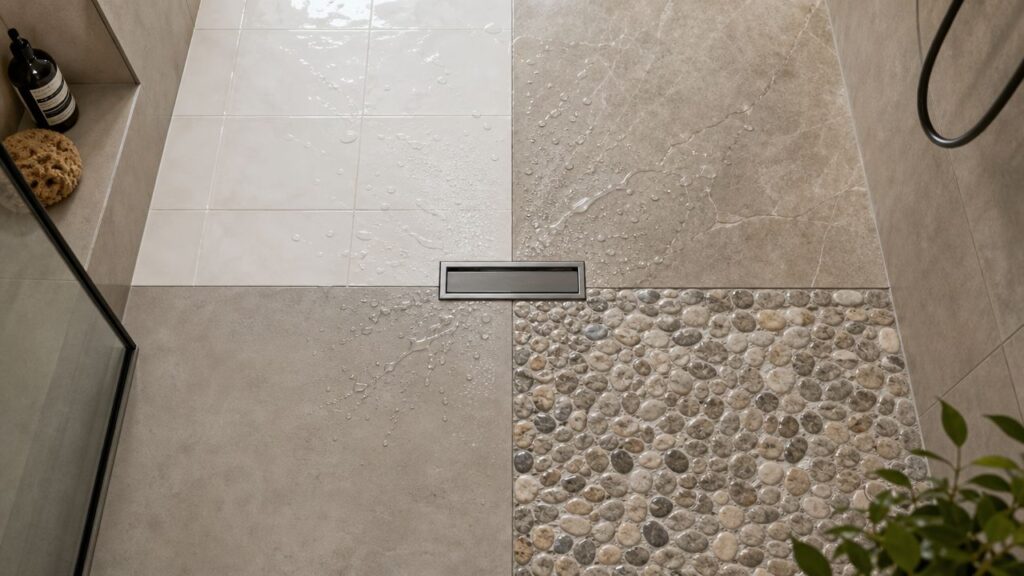
You're probably doing what most South Jersey homeowners do at the start of a bathroom remodel. You save a few shower photos, notice a tile you like, then realize the choices multiply fast. Mosaic or large format. Pebble or porcelain. Center drain or linear drain. Curbed or curbless.
The part that gets missed is the part that decides whether the shower performs well. The visible floor is only the finish layer. Under it sits the underlying system: subfloor prep, slope, drain placement, waterproofing, pan construction, and the way all of those pieces connect. If those parts are handled well, a wide range of shower floor options can work. If they're handled poorly, even an expensive finish can become a maintenance problem.
That's how I frame this conversation with homeowners. Don't start with “What tile do I want?” Start with “What kind of shower system fits this bathroom, this household, and this budget?” Once that answer is clear, the right surface choice usually gets easier.
Table of Contents
- Choosing Your Shower Floor Beyond the Surface Look
- The Unseen Foundation of a Leak-Proof Shower
- A Detailed Comparison of Shower Floor Materials
- Designing for Flow Drains and Curbless Showers
- Making the Right Choice for Your South Jersey Home
- Your Remodel Journey with The Cabinet Coach
- Frequently Asked Questions About Shower Floors
Choosing Your Shower Floor Beyond the Surface Look
A homeowner might come in convinced they want marble hex tile because that's the photo they keep returning to. Then we talk through how the bathroom is used. Two kids. One rushed weekday routine. Hard use. Limited patience for grout cleaning. Suddenly the best answer may not be marble at all.
That doesn't mean style doesn't matter. It does. But the shower floor is one of those places where performance and style have to agree. A floor can look sharp on day one and still be the wrong choice if it stains easily, feels slick, or needs more upkeep than your household will realistically give it.
The visible floor is only the top layer
The most dependable way to evaluate shower floor options is to think in layers:
- Structure first: The framing and subfloor have to support the shower assembly and allow the right slope.
- Water control next: The pan, membrane, seams, corners, and drain connection decide whether water stays where it belongs.
- Finish last: Tile, stone, solid surface, or resin gives you the final look and underfoot feel.
If you reverse that order, you usually spend too much attention on the least important decision.
Practical rule: If a contractor talks about tile selection before talking about slope, waterproofing, and drain layout, the conversation is out of order.
What homeowners usually regret
The regrets are rarely about color. They're about maintenance and function. People get tired of scrubbing pebble grout, wish they'd chosen a lower-threshold entry, or realize too late that the floor doesn't drain cleanly.
Good shower floors do three things well:
- They shed water reliably
- They feel secure underfoot
- They fit the way the bathroom is used
That's why the best shower floor options aren't a single material. They're a coordinated system with the right finish on top.
The Unseen Foundation of a Leak-Proof Shower
The best-looking shower in the room can still fail if the base assembly is sloppy. Water doesn't care how expensive the tile is. It follows weak seams, bad drain connections, flat spots, and missed waterproofing details.
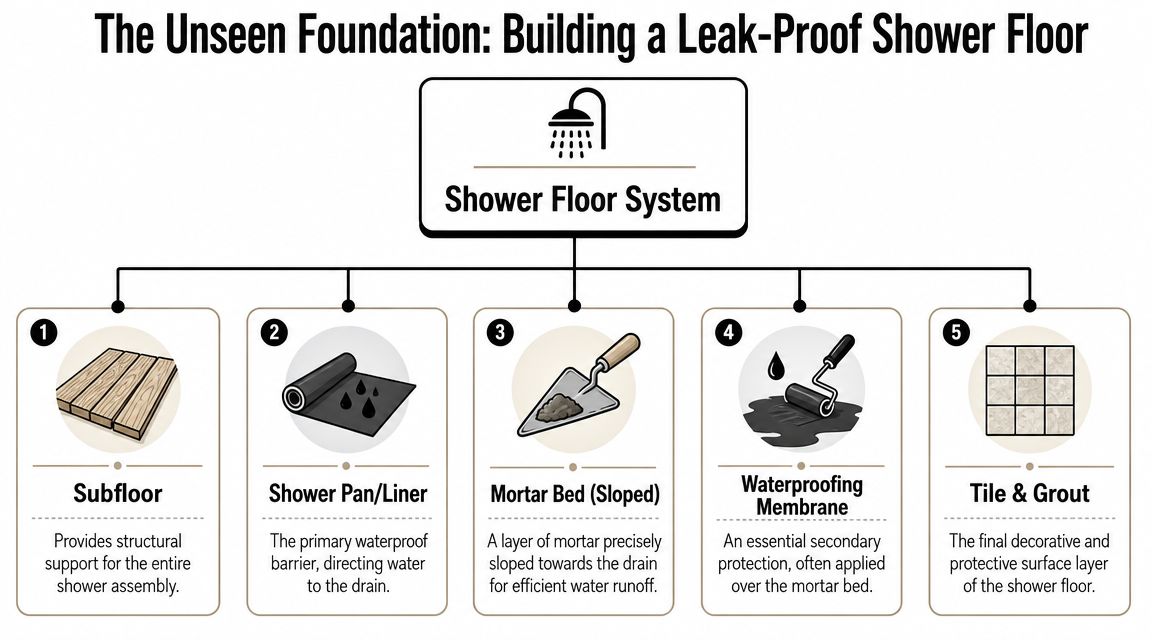
Quick comparison of the full system
| System Piece | What It Does | Where Problems Start |
|---|---|---|
| Subfloor | Supports the full shower assembly | Deflection, movement, poor prep |
| Pan or sloped base | Directs water to the drain | Flat spots, wrong pitch, poor sizing |
| Waterproofing membrane | Keeps water out of framing | Bad seams, skipped corners, poor transitions |
| Drain assembly | Receives and evacuates water | Weak connections, poor placement |
| Finish surface | Provides look, feel, and traction | Wrong material for use pattern |
Prefabricated pans versus site-built bases
Most showers start with one of two directions. A prefabricated shower pan gives you a manufactured base with a controlled shape and consistent pitch. A site-built mud bed gives you flexibility in shape, drain location, and layout.
Prefabricated pans have come a long way. According to Lowe's shower pan buying guide, common sizes start at 32 inches and extend to 42 inches wide by 60 inches long and larger, with depths ranging from 1 inch to 6 inches. That wider range makes prefabricated options much more practical than they used to be for walk-in layouts and larger remodels.
Mud beds still have a place. They're useful when the room is out of square, the drain needs to land in a tricky spot, or the design calls for a custom footprint. The trade-off is that they depend heavily on installer skill. A good crew can make them perform beautifully. A rushed crew can leave you with drainage issues hidden beneath finished tile.
Why waterproofing matters more than the finish
Homeowners often assume grout or tile is what keeps a shower waterproof. It isn't. The waterproof layer sits underneath the finish surface and around every transition.
That's why I pay close attention to how a remodeler explains the full assembly. If they can't clearly describe the membrane, drain integration, corners, curb treatment, and wall-to-floor transitions, that's a red flag. If you want a plain-language look at how moisture problems can build in wet rooms, this Florida homeowner's mold guide gives a useful overview of what persistent bathroom moisture can lead to when water management fails.
The shower floor isn't one product. It's a chain of details, and the weak detail is usually where trouble starts.
For homeowners comparing installers, it helps to review what a qualified bathroom remodeling process should include before any finish selection is finalized. The Cabinet Coach has a practical page on bathroom renovation contractors near you that outlines what a full-service approach should look like.
A Detailed Comparison of Shower Floor Materials
Once the base assembly is right, the surface choice becomes much easier to judge. At this stage, aesthetics, cleaning habits, comfort, and safety all meet.
One safety benchmark matters more than most shoppers realize. For wet barefoot use, look for materials with a wet Dynamic Coefficient of Friction of 0.60 or higher, while the Tile Council of North America lists 0.50 as the minimum for interior wet areas, as explained in this shower flooring safety guide. In plain terms, don't settle for marketing words like “grippy” or “textured” if no testing data is available.
Shower floor material comparison
| Material | Durability | Maintenance | Typical Cost | Best For |
|---|---|---|---|---|
| Porcelain tile | High | Moderate | Moderate to high | Custom looks with strong performance |
| Ceramic tile | Moderate | Moderate | Lower to moderate | Budget-conscious remodels |
| Natural stone | Moderate to high | High | High | Spa-like visual impact |
| Pebble tile | Moderate | High | Moderate to high | Textured, organic look |
| Solid-surface pan | High | Low | Moderate to high | Easy cleaning and low grout |
| Engineered stone base | High | Low | High | Premium one-piece look |
| Poured resin system | High when installed well | Low to moderate | High | Seamless modern design |
If you're working in a compact footprint, these material choices also interact with layout more than many people expect. Smaller bathrooms benefit from surfaces and drain strategies that keep the floor visually calm. The Cabinet Coach has a helpful gallery of small bathroom design ideas in Cherry Hill that shows how floor finish and room scale affect each other.
Tile choices and where they succeed
Porcelain tile is still one of the safest all-around picks. It's durable, broadly available, and comes in finishes that can support a better wet-foot feel than glossy products. Small-format porcelain mosaics are especially practical because the extra grout joints help with footing and let the installer follow the slope more naturally.
Ceramic tile can work, but it's less forgiving in a shower floor application. It's usually a better fit when budget leads the discussion and the product selected is suitable for wet use. I'm more cautious with ceramic on floors than on walls.
Tile gives you design freedom that one-piece pans can't match. It also asks more from the install and more from the homeowner over time.
Solid surface engineered options and poured systems
Solid-surface shower pans are popular for good reason. They reduce grout lines, feel cleaner visually, and simplify daily maintenance. For a busy household, this is often the most practical compromise between design and upkeep.
Engineered stone bases push that idea further with a heavier, more substantial feel. They can deliver a premium matte appearance and a more architectural look than standard acrylic.
Poured resin systems are one of the more modern shower floor options. When done well, they create a continuous floor with a contemporary finish and very few interruptions. The upside is the clean look. The downside is that success depends on a crew that knows the system well, especially at edges, drain transitions, and waterproofing interfaces.
Best use case: If you want the least visual clutter and the least grout maintenance, a solid-surface or engineered base is often the smartest move.
Where natural stone and pebble floors fit
Natural stone, including marble, can be beautiful. It also asks for a realistic owner. It needs more care, and some stones show wear, soap residue, or etching faster than homeowners expect.
Pebble floors divide opinion for a reason. They can provide texture and an organic spa look, but they create many grout joints and can feel uneven underfoot if the stones are too rounded or poorly set. Some homeowners love the foot massage feel. Others get tired of the maintenance.
Here's the practical ranking I often give clients:
- Best balance of style and performance: Porcelain tile
- Best for easy cleaning: Solid-surface or engineered one-piece base
- Best for a luxury visual statement: Natural stone
- Most installer-dependent finish: Poured resin
- Most likely to become a maintenance complaint: Pebble tile
Designing for Flow Drains and Curbless Showers
Drain design changes more than appearance. It affects slope direction, tile format, cleanup, and whether the shower floor feels intentional or awkward.
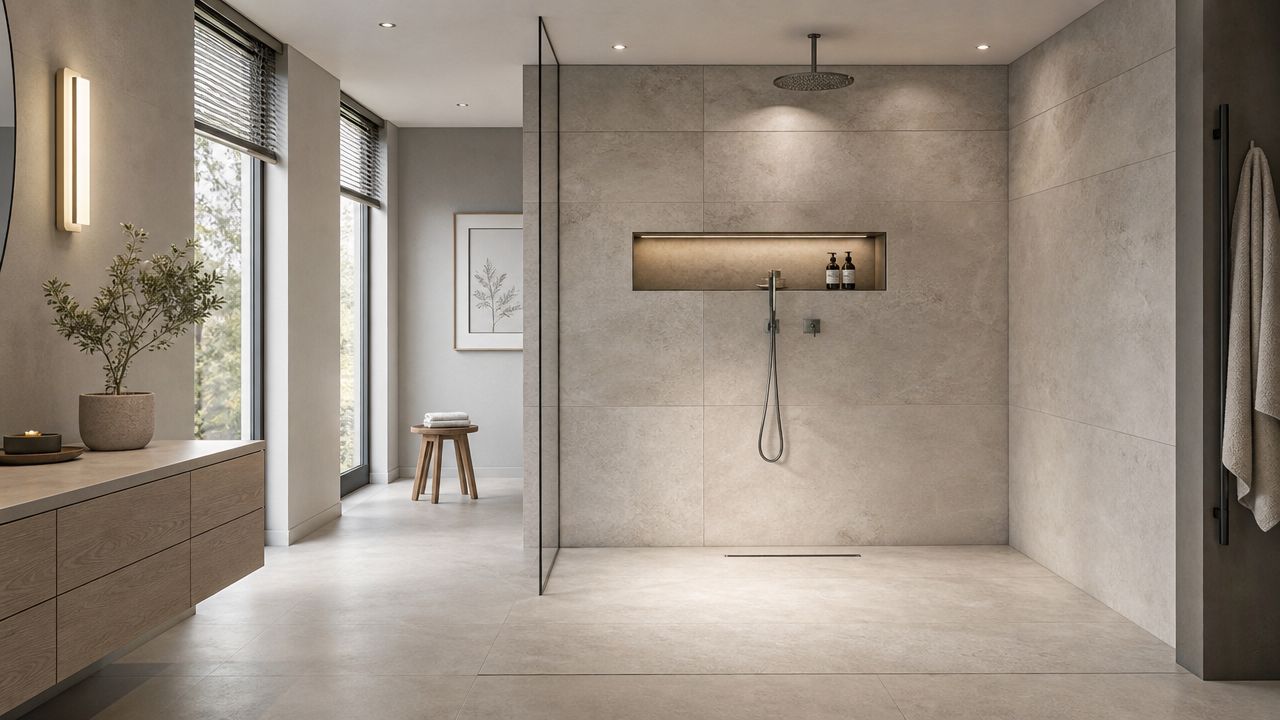
Drain choice changes the whole layout
A traditional center drain usually means the floor pitches from multiple directions toward a middle point. That works well with mosaics because smaller tile handles those directional changes more gracefully.
A linear drain lets the floor pitch in a single direction. That can simplify the visual field and make larger tile more workable on the shower floor. It also creates the cleaner, more minimal look many homeowners want in newer primary baths.
If you're still sorting out base size and layout, it helps to understand the room dimensions first. The Cabinet Coach has a good primer on typical shower stall dimensions that can help you judge whether a linear drain layout is realistic in your space.
Curbless showers need structure not just style
Curbless showers are one of the most requested upgrades right now, and for good reason. They look open, they support aging in place, and they can make a bathroom feel larger.
They also require real construction planning. ADA-oriented guidance calls for a shower floor slope of 1:48, or about 1/4 inch per foot, toward the drain, as outlined in this ADA shower slope reference. That slope matters because the floor still has to drain properly without becoming uncomfortable underfoot.
A curbless entry usually means the installer must address subfloor height, framing conditions, drain placement, and waterproofing transitions before tile ever goes down.
Curbless showers fail when people treat them like a tile decision. They're a structural and drainage decision first.
This installation overview is worth watching if you want to see how these assemblies come together in practice:
When modern design and drainage work together
The best curbless showers don't just look continuous. They move water decisively and leave very little standing water behind.
That's why I like to evaluate these projects in three layers:
- Entry condition: Flush or low-threshold transitions need to be planned at framing stage.
- Drain placement: Linear drains can make large-format looks easier, but they need precise execution.
- Waterproof envelope: Every transition has to be treated as part of one continuous wet-area system.
If you already have slow drainage issues elsewhere in the bathroom, don't ignore them during planning. A simple homeowner guide on when to call a drain professional can help you tell the difference between a basic maintenance issue and a sign that the drainage side of the remodel deserves closer attention.
Making the Right Choice for Your South Jersey Home
Most homeowners don't need every shower floor option on the table. They need the one that fits their house, their routine, and their tolerance for upkeep.
The wrong choice usually isn't ugly. It's impractical. It asks too much cleaning, creates avoidable risk, or forces a design idea into a room that doesn't support it well.
Best fit for a busy family bath
For a shared hall bath or a kid-heavy household, I'd lean toward slip-conscious porcelain tile or a solid-surface pan. Both are durable choices. The difference is maintenance. Tile gives more design flexibility. A one-piece base usually wins on easier cleaning and fewer grout lines.
Best fit for aging in place
For long-term accessibility, I'd push the conversation toward a curbless or low-threshold system planned from the framing and waterproofing stage forward. The caution here is simple: the rising demand for curbless showers doesn't change the fact that success depends on subfloor modification, precise slope creation, and integrated waterproofing, as shown in this curbless shower installation discussion.
That's where projects go wrong. Homeowners hear “modern” and think finish. Installers who know better think structure first.
Best fit for a luxury look
If the goal is a refined primary bath, there are two strong paths. Go with porcelain that mimics stone if you want beauty with less maintenance anxiety. Or choose natural stone or a poured system if you're comfortable with higher care and want a more custom feel.
My strongest advice is to match ambition with project management. Luxury showers have more moving parts, and those parts need coordination. If you want a useful checklist for that side of the remodel, The Cabinet Coach offers a smart guide on how to manage contractors.
A good final filter is this:
- Choose porcelain if you want balance
- Choose solid surface if you want simplicity
- Choose curbless systems if accessibility matters and the room can support the build
- Choose stone or resin if design is the priority and you accept more complexity
Your Remodel Journey with The Cabinet Coach
Once you see how many decisions sit under the surface of a shower floor, it makes sense to want help tying them together. That's where a guided remodel process matters.

The Cabinet Coach works differently than the usual showroom-first model. Instead of sending you all over South Jersey to compare finishes under store lighting, the team brings curated selections to your home so you can evaluate tile, cabinetry, countertops, and bath materials where they'll live.
That matters in bathrooms. Lighting, wall color, room size, and adjacent finishes all affect how a shower floor reads. A tile that feels perfect in a display vignette can look too busy or too cold once it's in your own space.
If you want to see how that process works from consultation through completion, take a look at The Cabinet Coach experience. It's a practical fit for homeowners who want expert guidance without turning the remodel into a second job.
Frequently Asked Questions About Shower Floors
What shower floor is easiest to keep clean
A solid-surface pan or engineered one-piece base is usually the easiest to maintain because it has fewer joints and less grout. If you want tile, porcelain is generally the more practical choice for a shower floor than higher-maintenance natural stone.
Are pebble shower floors a good idea
They can be, but only for the right homeowner. Pebble floors bring texture and a natural look, but they also bring more grout and more surface variation. If you love the style and accept the upkeep, they can work. If you want quick cleaning and a smoother feel, there are better shower floor options.
Is a tiled shower floor better than a one-piece pan
Not automatically. Tile gives you more design freedom and can be excellent when paired with a well-built base and strong waterproofing. A one-piece pan often wins on maintenance and installation simplicity. Better depends on whether your priority is custom design, easy cleaning, accessibility, or a continuous appearance.
What matters most if I want a curbless shower
The hidden construction. The floor assembly has to be engineered for drainage, entry transition, and waterproof continuity. If those decisions are rushed, the cleanest-looking curbless shower can become the most frustrating one to live with.
Ask your remodeler to explain the slope plan, the drain location, and the waterproofing sequence in plain English. If they can't, keep asking questions.
If you're planning a bathroom remodel and want help sorting through shower floor options without guessing your way through the details, The Cabinet Coach can guide you from layout and material selection to coordinated finishes and project management. The process is built for South Jersey homeowners who want clear advice, curated choices, and a shower that looks right because it's built right.