
You’re probably in one of two spots right now. Either you walk into your kitchen every morning, look at those worn cabinet doors, dated stain color, and old hardware, and think, “This room is dragging the whole house down.” Or you already priced a full remodel and decided fast that replacing everything doesn’t make sense for cabinets that still function well.
That’s where a good painting cabinets company earns its keep. Not with a rushed coat of paint and a nice sales pitch, but with the kind of prep, spraying, and product selection that makes old cabinets look sharp again and stay that way. In South Jersey, that matters. A lot of homes in Cherry Hill, Moorestown, Haddonfield, Medford, and Mount Laurel have solid cabinet boxes that don’t need to be torn out. They need the right finish system and the right crew.
If you want a kitchen that feels current without turning your house into a construction zone for weeks, cabinet painting is often the smartest move. If you’re still weighing the bigger remodel picture, this guide on how to plan a kitchen remodel is a good starting point.
Table of Contents
- Is Your South Jersey Kitchen Ready for a Change?
- The Professional Cabinet Painting Process Explained
- Painting vs Refacing vs Replacing Your Cabinets
- How to Choose a Painting Company in South Jersey
- The Cabinet Coach Advantage A Mobile Showroom Experience
- What to Expect During Your Cabinet Painting Project
- Transform Your Kitchen with Confidence
Is Your South Jersey Kitchen Ready for a Change?
A lot of South Jersey kitchens have the same problem. The layout still works, the cabinet boxes are still sturdy, but the look is stuck in another decade.
You see it all the time. Orange oak grain. Scuffed drawer fronts near the trash pullout. Yellowed finish around the stove. Brass knobs that made sense years ago and now make the whole room feel tired.

That’s usually the moment homeowners start bouncing between bad options. Live with it. Blow the budget on full replacement. Or try a quick paint job that looks fine for a month and then starts chipping around the handles.
There’s a better answer. Professional cabinet painting gives you a visible transformation without ripping out usable cabinetry. Done right, it changes the entire feel of the kitchen because cabinets dominate the room. They set the tone more than the backsplash, more than the stools, and often more than the counters.
Most kitchens don’t need demolition. They need better decisions.
For homes in Cherry Hill, Voorhees, Marlton, Moorestown, and nearby towns, cabinet painting makes sense when the bones are good and the finish is the problem. It’s especially practical if you want to update color, swap hardware, improve resale appeal, or coordinate cabinets with new counters or tile without committing to a full gut remodel.
The key is understanding one simple truth. A painted cabinet finish is only as good as the process behind it. That’s why the company you hire matters more than the color you pick.
The Professional Cabinet Painting Process Explained
Most cabinet failures happen long before the first topcoat goes on. They start with weak prep, lazy cleaning, the wrong primer, or a crew that treats cabinets like walls.
A professional job is methodical. It should feel more like finishing furniture than painting a bedroom.
Why prep decides everything
If a company can’t explain prep clearly, don’t hire them.
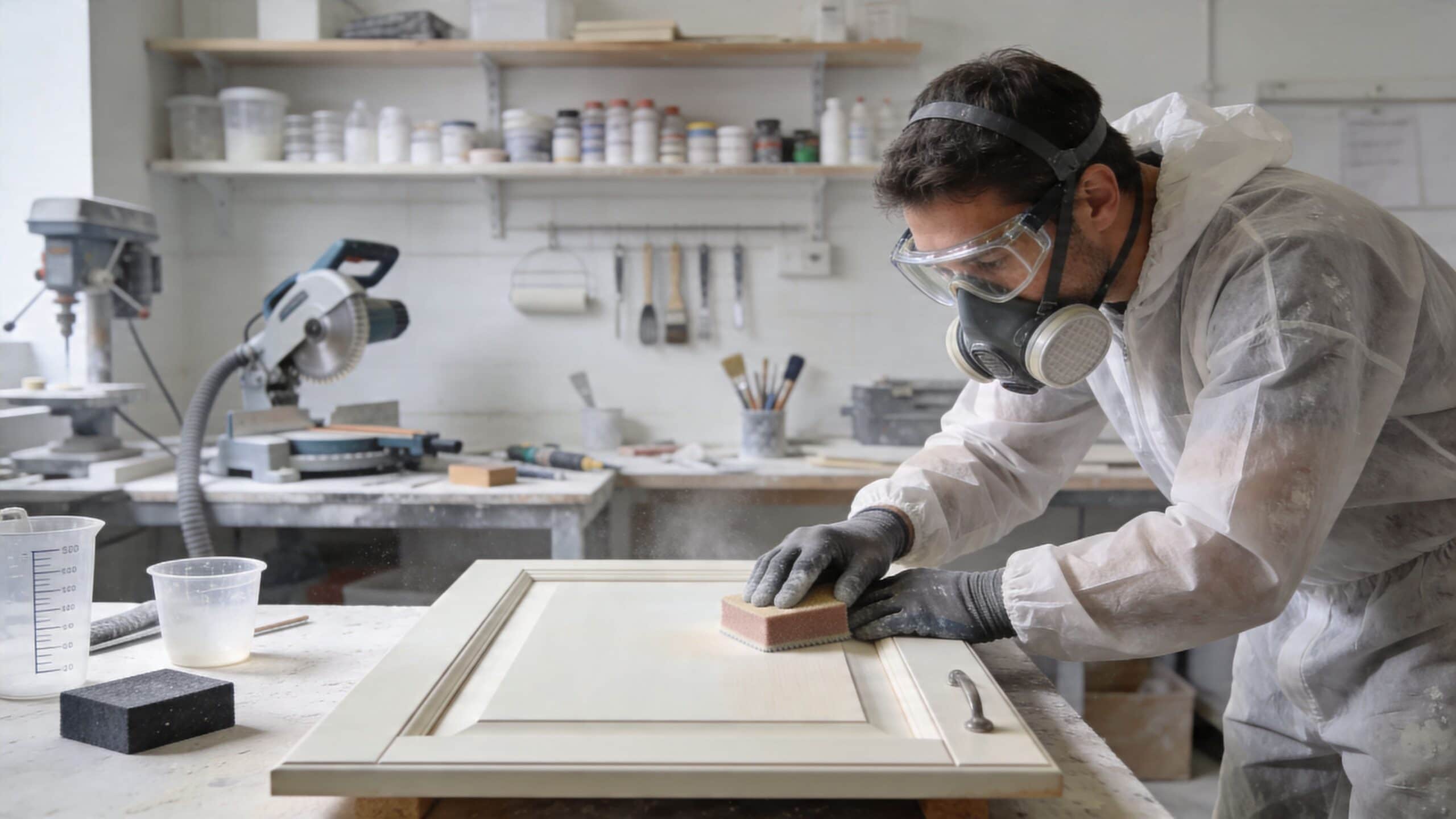
A proper refinishing process can involve up to 12 detailed steps per door, including cleaning, sanding with progressive grits from 120 to 220, and using substrate-specific primers. For oak, heavy-bodied primers can fill 95% of the grain pores, which is a major reason pro finishes look smoother and more uniform (allaboutpaintllc.com on the professional cabinet refinishing process). If you’re comparing materials too, this guide on MDF vs. wood cabinet doors helps explain why different surfaces need different treatment.
Here’s what a real process usually includes:
- Door and drawer removal. Every piece gets labeled so reinstall is clean and organized.
- Hardware removal. Hinges, pulls, knobs, and bumpers come off.
- Degreasing. Around stoves and sinks, this is essential.
- Sanding. Not random scuffing. The goal is to create tooth for adhesion.
- Repairs. Dings, chips, and old hardware holes get addressed if the project calls for it.
- Primer selection. This depends on whether the surface is oak, maple, laminate, or a previously coated finish.
- More sanding. Between coats, not just at the beginning.
- Topcoat application. Usually with professional cabinet coatings, not leftover wall paint.
- Curing and handling. Freshly sprayed pieces need protection during transport and reinstall.
- Reassembly and adjustment. Doors get rehung, aligned, and checked.
That sounds tedious because it is. That’s the work you’re paying for.
Practical rule: If the estimate sounds cheap because “we’ll just clean, prime, and paint,” expect the finish to fail where hands, grease, steam, and cleaning products hit first.
Why pros spray instead of brush
Cabinets need a different finish quality than trim or drywall. You touch them every day. You see them up close. Brush marks and roller stipple look worse on a cabinet door than almost anywhere else in the house.
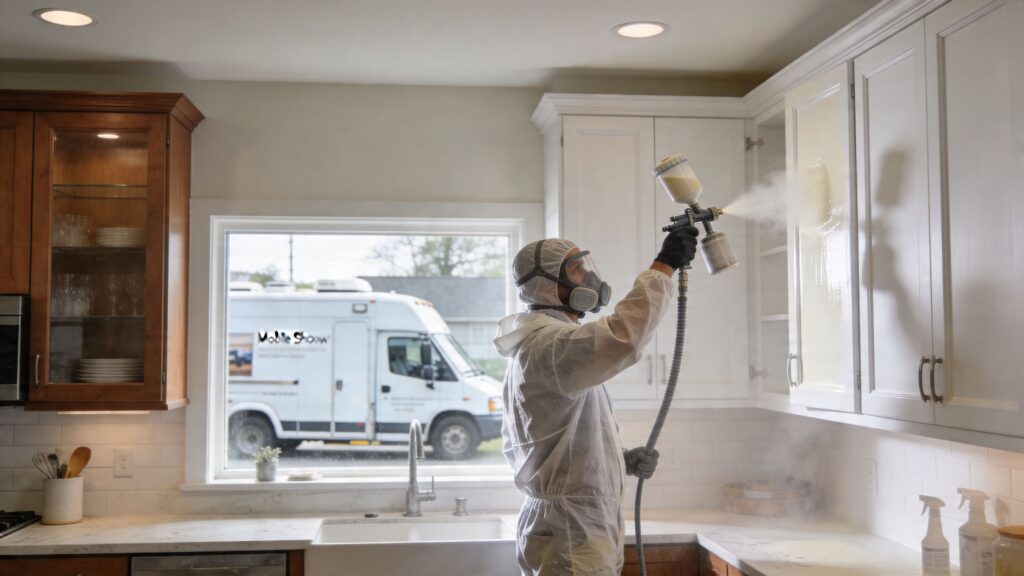
Pros use spray equipment because it creates a more even, furniture-grade result. They also control the jobsite. That means masking, dust control, air movement, and careful handling of doors and drawers.
Here’s a look at the kind of work that separates a cabinet refinishing crew from a general painter.
The process should also include practical details homeowners don’t always think to ask about:
- Labeling systems so every hinge and door goes back where it belongs
- Masking and containment to protect floors, counters, appliances, and adjacent rooms
- Off-site spraying for doors and drawers when the workflow calls for it
- On-site frame finishing with tight control around living areas
- Final punch review for alignment, missed edges, and hardware fit
If a company brushes cabinet faces and calls it premium work, that’s a sign they’re cutting corners. Good cabinet painting looks smooth, consistent, and deliberate. Bad cabinet painting looks like what it is. House paint on furniture.
Painting vs Refacing vs Replacing Your Cabinets
Homeowners usually ask the wrong question first. They ask, “What’s cheapest?” The better question is, “What gives me the best result for the condition of my cabinets and the amount of disruption I can tolerate?”
There are three realistic paths. Paint what you have. Reface the cabinets. Replace them entirely.
Kitchen Cabinet Update Options Compared
Nationally, professional kitchen cabinet painting averages around $938, refacing averages $3,115, and full replacement with custom cabinets can cost $2,500 to $7,000 according to this cabinet painting and refinishing market report.
| Factor | Painting | Refacing | Replacement |
|---|---|---|---|
| Cost | Lowest entry cost based on national averages | Mid-range option | Highest cost, especially for custom work |
| What changes | Color, finish, hardware, overall look | Doors, drawer fronts, exterior skins | Entire cabinet system |
| Best for | Solid cabinets with a dated finish | Good layouts needing a style shift | Poor layout, damaged boxes, major redesign |
| Disruption | Lower than full replacement | Moderate | Highest |
| Speed | Typically faster than replacement | Slower than painting, usually less invasive than a gut remodel | Longest process |
| Layout changes | No | No major layout change | Yes |
| Value proposition | Strong cosmetic upgrade for the money | Bigger visual reset without full tear-out | Best when function is the real problem |
Painting is the smart choice when the cabinet boxes are in good shape and the room doesn’t need a new footprint. Refacing makes sense if the door style is the issue and you want a more dramatic style update without removing the cabinet boxes. Replacement is the right move when the layout is broken, the cabinets are damaged beyond cosmetic repair, or you want a completely different kitchen.
My recommendation for most South Jersey homes
For many homes in Camden and Burlington County, painting is the best value. Not because it’s the cheapest, but because it solves the core problem. Most homeowners aren’t trying to reinvent the kitchen from scratch. They want it to look cleaner, newer, brighter, and more intentional.
That’s where painting wins.
Refacing has its place, especially if slab doors or shaker profiles are part of the goal. Replacement also has a place, especially when storage is poor or appliance placement needs to change. But if your cabinet structure is sound, replacement can be an expensive way to fix a finish problem.
If the boxes are solid and the layout works, tearing everything out is often overspending.
If you’re weighing those tradeoffs in more detail, this breakdown of the cost of kitchen cabinets refacing helps clarify when refacing makes more sense than painting.
How to Choose a Painting Company in South Jersey
At this stage, homeowners either save themselves a headache or buy one.
A polished website doesn’t mean much. Neither does a low quote. If you want a cabinet finish that lasts, vet the company on process, products, and accountability.
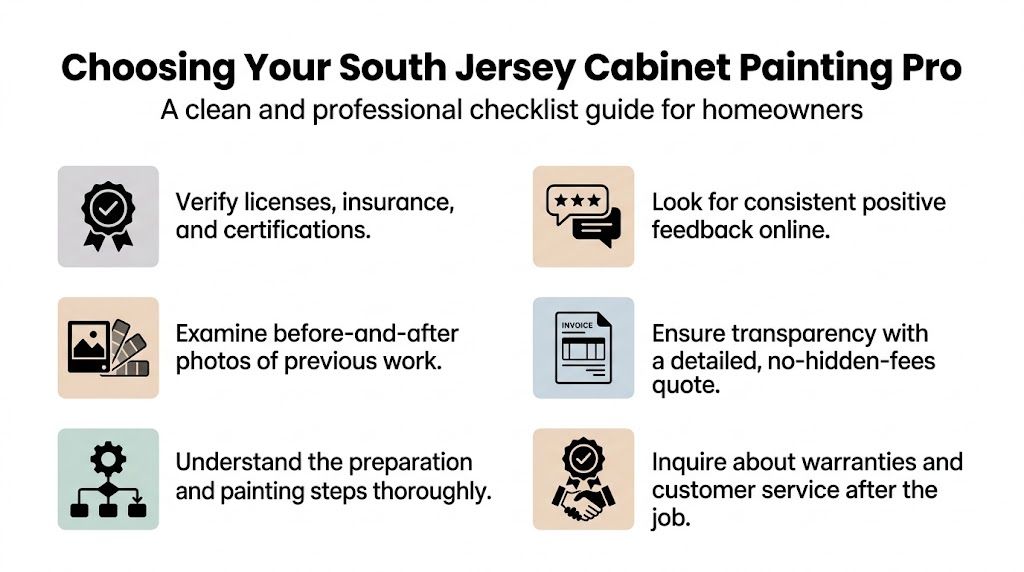
Industry surveys from 2025 indicate that 30% to 40% of DIY or low-end professional cabinet paint jobs fail within 2 to 5 years, mostly because of poor surface prep. That failure rate drops to under 10% for professional services using climate-appropriate protocols, according to Obringer’s cabinet refinishing guidance. In South Jersey, that matters because kitchens deal with humidity, cooking residue, and repeated cleaning.
Questions that separate pros from dabblers
Ask direct questions and listen for direct answers.
- What’s your prep process? They should mention degreasing, sanding, primer choice, and dust control.
- Do you remove doors and hardware? If they paint around hinges, expect a sloppy result.
- What products do you use on boxes, doors, and drawers? A real cabinet painter knows the coating system, not just the paint color.
- How do you spray and where do the doors get finished? You want a clear explanation, not vague talk.
- How do you protect the house? Masking, containment, and handling should be part of the answer.
- Are you insured and registered in New Jersey? This isn’t paperwork trivia. It’s basic accountability.
- What happens if there’s an issue after the job? Good companies don’t dodge this question.
Online reviews help, but they shouldn’t be your whole decision. What you really want is consistency between their reviews, their photos, and their explanation of the process. This overview of The Cabinet Coach experience shows the kind of structured, guided approach homeowners should look for from any remodeling partner.
Red flags that should end the conversation
Some warning signs are obvious. Others sound reasonable until the finish starts failing.
Watch for these:
- Suspiciously low pricing. If a bid comes in far below others, something is missing.
- No material detail. “We use a premium paint” is not a serious answer.
- No written scope. You need to know what gets removed, sprayed, repaired, and reinstalled.
- No portfolio close-ups. Wide kitchen shots hide flaws.
- No climate discussion. In this region, moisture and adhesion matter.
- No post-job support. If they won’t talk about warranty or touch-up policy, move on.
A good painting cabinets company should be able to explain the work in plain English. If they can’t explain it, they probably can’t execute it well either.
The Cabinet Coach Advantage A Mobile Showroom Experience
Most remodeling decisions get harder when homeowners leave the house to make them.
You stand in a showroom under artificial lighting, hold three door samples, look at a countertop slab on a rack, and try to imagine how all of it will look in your kitchen. That’s not a design process. That’s guesswork.
Why in-home selection works better
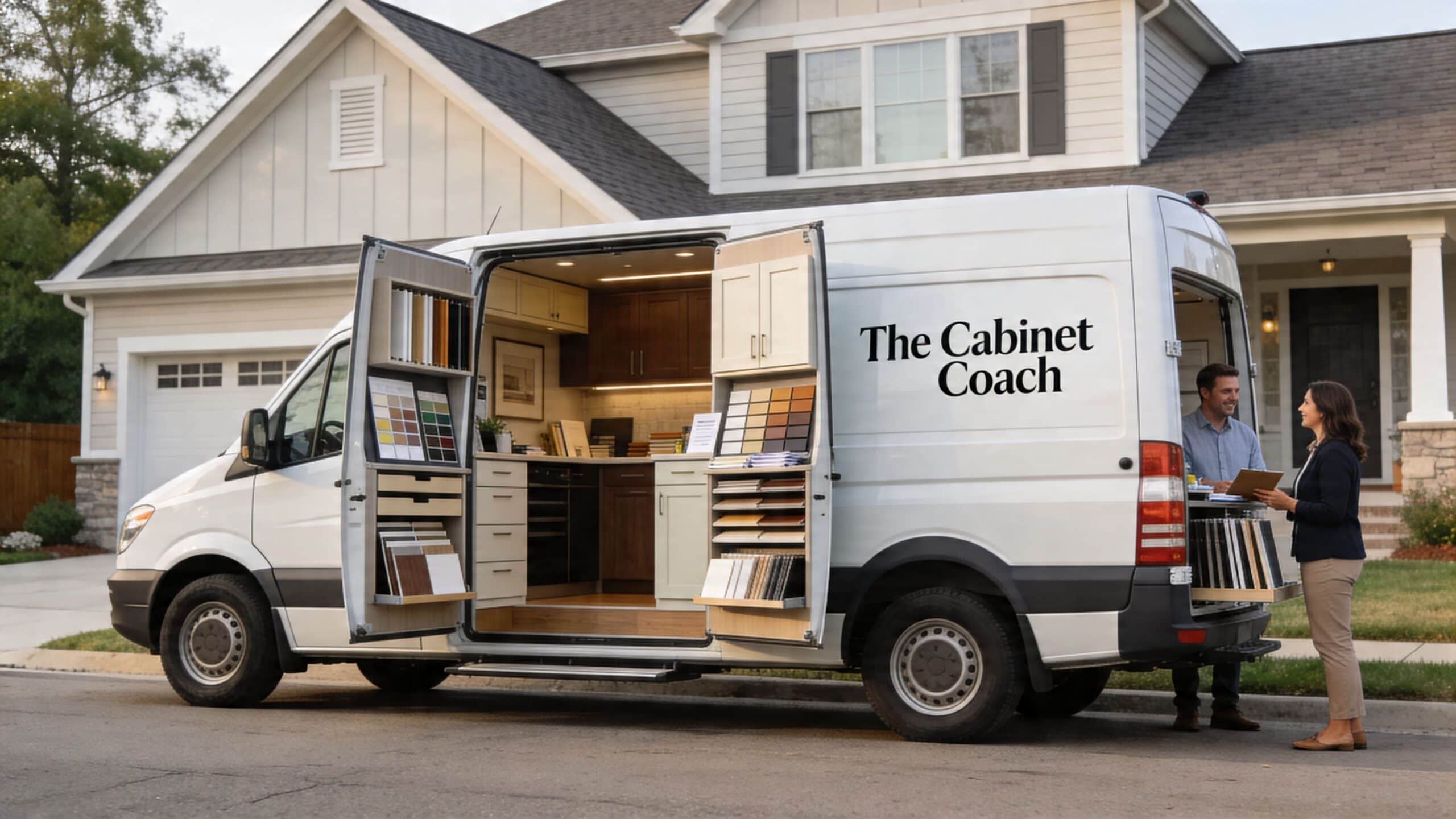
A mobile showroom model fixes a problem the traditional process creates. It lets homeowners compare cabinetry, counters, hardware, and tile where those choices matter. In the home. Under natural light. Next to the existing floor. Against the wall color that’s staying.
That’s not a small improvement. It changes decision quality.
Instead of dragging samples back and forth from store to home, you can evaluate combinations on site and eliminate choices faster. You also reduce the common mistake of choosing a finish that looked great in the showroom but feels wrong once it’s in the room.
A service model built around in-home guidance is especially useful when cabinet painting is only one part of the update. If you’re coordinating painted cabinets with new hardware, backsplash, counters, or a bathroom vanity refresh, having those options reviewed together leads to a cleaner final result.
Good design decisions happen in context, not under showroom track lights.
According to 2025 data, a minor kitchen remodel that includes refinishing cabinets can yield an ROI of up to 113.7%. That makes thoughtful finish and material decisions financially relevant, not just cosmetic (Mordor Intelligence coverage of the kitchen cabinets market and related remodeling value).
What busy South Jersey homeowners actually need
Busy homeowners don’t need more errands. They need fewer moving parts.
The strongest remodeling experiences usually include:
- A guided selection process that narrows options instead of overwhelming you
- Budget alignment early so product choices stay realistic
- Clear sequencing between design, ordering, and installation
- One point of contact who can coordinate trades and keep the project moving
- A plan for cohesion so cabinets, counters, tile, and hardware work together
That’s why the mobile showroom model has become so compelling in South Jersey. It respects your time and improves the quality of the decisions. If you want to see why that approach is gaining traction locally, read why a mobile cabinet showroom is the future of kitchen remodeling in South Jersey.
What to Expect During Your Cabinet Painting Project
A good cabinet project should feel organized, not chaotic. You should know what’s happening, what the kitchen access looks like, and when things go back together.
A realistic project rhythm
The full job often takes several days, but your kitchen usually isn’t fully out of service that entire time. A professional workflow typically starts with setup, masking, door and drawer removal, and surface prep. The doors and drawers are often finished off-site, while the frames are prepped and coated with careful containment in the home.
That controlled spraying process matters. Spraying cabinets in a controlled environment and using HEPA air filtration on-site results in a finish smoothness equivalent to 180 to 320 grit sandpaper, which is well beyond what brushing or rolling usually delivers, according to BEHR’s professional cabinet painting guidance.
Here’s the homeowner version of the schedule:
- Day one usually covers protection, labeling, removal, cleaning, and early prep.
- Middle days focus on sanding, priming, spraying, curing, and frame work.
- Final day is reinstall, alignment, hardware, and punch list review.
Before the crew arrives, do a few simple things:
- Clear countertops so masking and access are easier
- Empty the cabinets that need work if your painter asks for it
- Plan simple meals because the kitchen flow will be limited for part of the project
- Keep pets and kids away from the work zone so the crew can move safely
The biggest surprise for homeowners is usually this. The project feels far less disruptive when the company has a tight system. The worst jobs drag because the contractor is improvising.
Transform Your Kitchen with Confidence
If your cabinets are structurally sound and your kitchen just feels dated, cabinet painting is usually the smartest move. It gives you a major visual upgrade without the cost and disruption of tearing everything out.
But don’t confuse cabinet painting with basic painting. The finish lasts only when the prep is disciplined, the primer matches the surface, and the application is handled like fine finish work. That’s why choosing the right painting cabinets company matters more than choosing the trendiest color.
For South Jersey homeowners, the best results come from local pros who understand how to evaluate existing cabinetry, explain their process clearly, and guide decisions in a practical way. You want a company that respects your house, your time, and your budget.
A better kitchen doesn’t always start with demolition. Sometimes it starts with keeping what works and upgrading it the right way.
If you’re in Cherry Hill, Haddonfield, Moorestown, Medford, Mount Laurel, Voorhees, or anywhere nearby, The Cabinet Coach offers a smarter way to plan your kitchen or bath update with a South Jersey mobile showroom, personalized guidance, and end-to-end remodeling support that helps you make confident decisions from the start.