
You’re probably staring at a bathroom you’ve learned to ignore.
The tile is dated. The vanity doesn’t hold much. The caulk has seen better days. Maybe the layout still works, but the room feels tired every time you step into it. Then resale enters the conversation. A move to a bigger home. A downsizing plan. A rental property you want to improve before listing.
That’s when many South Jersey homeowners run into the same uncomfortable question. Is a bathroom remodel worth it, or is it just another expensive project that won’t pay you back?
The short answer is that a bathroom remodel return on investment can be strong, but only when you understand what kind of remodel you’re doing, what buyers in your area care about, and what delay may be costing you in the meantime. An outdated bathroom doesn’t just sit there neutrally. It shapes buyer impressions, invites tougher negotiations, and can make your home feel less move-in ready than the one down the street.
That’s especially true in places like Cherry Hill, Voorhees, Haddonfield, Moorestown, and surrounding parts of Camden and Burlington County, where buyers often compare finishes closely. If one home has a clean, functional, updated bath and another has yellowing surfaces and cramped storage, the difference shows up quickly in perceived value. If you’re weighing timing and budget, this guide on navigating kitchen and bathroom remodeling in the current economy can help frame the decision.
Table of Contents
- Introduction to Bathroom Remodel ROI
- Understanding Bathroom Remodel Return on Investment
- Calculating Your Bathroom Remodel ROI with Examples
- Regional Cost Versus Resale Value Data
- High ROI Bathroom Upgrades to Prioritize
- Actionable Tips to Maximize Resale Value
- Conclusion and South Jersey Market Insights
Introduction to Bathroom Remodel ROI
A bathroom remodel becomes a money question the moment your home enters a competitive market.
In South Jersey, that often happens before the first showing. A homeowner in Cherry Hill may feel their house is in good shape overall, then hear the same feedback from multiple buyers. The bathroom feels old. The finishes look worn. The storage is limited. Nobody says the room makes the house unsellable, but it starts pulling offers downward because buyers mentally add their own renovation costs.
That’s where ROI, or return on investment, starts to matter.
It’s not just a contractor term or a resale spreadsheet. It’s a way to judge whether the money you put into a bathroom is likely to come back to you through higher value, stronger buyer interest, or fewer objections during negotiations. It also helps you avoid a common mistake. Many homeowners assume the best remodel is the fanciest one. In reality, broad buyer appeal often matters more than luxury.
Why homeowners often miss the real issue
A dated bathroom creates a drag on perception.
Buyers don’t only notice dramatic problems like mold or broken fixtures. They also react to old lighting, stained grout, cramped vanities, worn flooring, and layouts that feel inconvenient. Each one chips away at confidence. A buyer may start wondering what else in the home hasn’t been updated.
A bathroom doesn’t have to be disastrous to hurt value. It only has to feel like work.
That’s why the cost of delaying a remodel deserves more attention than it gets. Most homeowners think about what a remodel costs today. Fewer think about what postponing it may cost when offers come in softer, or when the same materials issue becomes a bigger repair later.
ROI changes the conversation
Once you look at your bathroom through the lens of return, the decision gets clearer.
You stop asking, “Should we make it look nicer?” and start asking better questions:
- Which updates matter most to buyers
- How much should we spend for this neighborhood
- What upgrades improve function without overbuilding
- What’s the cost of waiting another year or two
Those are the questions that lead to a smart bathroom remodel return on investment, not just a prettier room.
Understanding Bathroom Remodel Return on Investment
ROI sounds technical, but the idea is simple. You plant money into a project and later harvest some of that value back.
If the bathroom remodel is the seed, the resale benefit is the crop. Some projects produce a healthy harvest because they match what buyers want. Others consume a bigger budget without producing a proportionally better result.
Why ROI feels confusing to homeowners
People often mix up three different ideas.
One is project cost, meaning what you spend. Another is value recaptured at resale, meaning how much of that spending comes back when you sell. The third is overall home value uplift, which can reflect how the remodeled bathroom improves the appeal of the whole house.
Those ideas overlap, but they aren’t identical. That’s why people can hear one homeowner say, “We got most of our money back,” while another says, “The remodel helped the whole house sell better.” Both can be true.
A good design article on spa bathroom ideas in Cherry Hill can inspire finishes and layouts, but inspiration should still be filtered through budget and resale logic.
What the number is really telling you
The strongest benchmark in the data is for midrange work. According to the 2024 Cost vs. Value Report summary cited here, a midrange bathroom remodel in 2025 averages $25,251 in cost nationally and recoups $18,613 upon resale, yielding a 74% ROI.
That’s a useful anchor because it tells homeowners two things at once.
First, bathroom remodel return on investment can be substantial without being total payback. Second, the highest-value work usually sits in the middle of the market, not at the luxury extreme.
Here’s the part that trips people up. A remodel can be a smart investment even if you don’t recoup every dollar directly at resale. The updated bathroom may also help your listing feel more polished, reduce buyer hesitation, and support the price of the entire home.
Practical rule: Aim for the bathroom your neighborhood expects, not the bathroom a luxury magazine would feature.
That’s why minor and midrange updates often outperform upscale remodels. Buyers tend to reward functional improvements they can immediately use. They’re less likely to fully pay extra for highly customized materials or personal-style features that don’t fit the local market.
Calculating Your Bathroom Remodel ROI with Examples
The math behind ROI isn’t hard. The tricky part is using the right input and understanding what the result means.
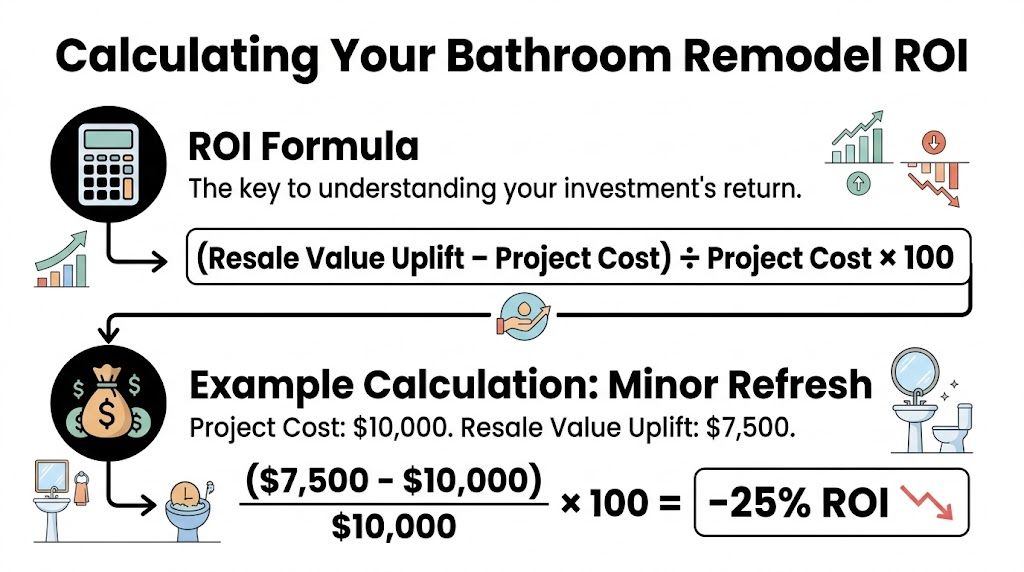
The formula often shown is:
(Resale Value Uplift – Project Cost) ÷ Project Cost × 100
That formula measures net gain or loss relative to cost. It is not the same as the common remodeling shorthand where people say a project had “74% ROI” to mean 74% of the cost was recouped at resale. Homeowners get confused because both conversations use the term ROI.
The formula and the common mistake
Use this distinction:
| Method | What it tells you |
|---|---|
| Value recapture percentage | How much of your remodel cost comes back at resale |
| Net ROI formula | Whether the resale uplift exceeded the cost |
Most remodeling reports use the first meaning in everyday language. That’s why a project can be described as having a strong “ROI” even when the strict net formula would show a negative number.
If you want a broader framework for home pricing, this guide on how to calculate property value is useful because bathroom ROI always sits inside the larger question of total property value.
A planning checklist also helps before numbers go into a spreadsheet. This overview of how to get started before hiring a contractor is a practical place to organize scope, priorities, and budget.
Two examples side by side
Start with a minor refresh.
- Project cost: $10,000
- Value recaptured at resale: $7,500
- Value recapture percentage: 75%
Using the net formula:
($7,500 – $10,000) ÷ $10,000 × 100 = -25%
That looks discouraging until you remember what the formula is measuring. It’s not saying the project was a mistake. It’s saying the direct resale recapture didn’t exceed the amount spent. Homeowners still may have gained daily use, better marketability, and a stronger overall listing.
Now look at a midrange remodel using the commonly cited benchmark.
- Project cost: $25,251
- Value recaptured at resale: $18,613
- Value recapture percentage: 74%
With the net formula:
($18,613 – $25,251) ÷ $25,251 × 100 = a negative net result
That’s why you need to be clear about language. Remodeling professionals often talk about the share of cost recouped, not an investment return in the stock-market sense.
According to the midrange bathroom remodel cost and recapture data summarized here, mid-range bathroom remodels deliver a national average ROI of 67.2–80%, with costs averaging $26,138–$27,710 and recouping $20,915–$25,217. That range reinforces the same lesson. The sweet spot is usually practical, durable, broadly appealing work.
When you calculate bathroom remodel return on investment, always ask which meaning of ROI the speaker is using.
Regional Cost Versus Resale Value Data
National numbers are helpful, but South Jersey homeowners need a local lens.
Camden County and Burlington County don’t price every remodel the same way. Labor, permitting, home values, and buyer expectations all shift the outcome. A bathroom that feels perfectly adequate in one neighborhood may feel behind the market in another.
A simple South Jersey comparison table
The challenge is that publicly available sources don’t provide a verified county-by-county bathroom ROI table for Camden and Burlington with precise remodel costs and recapture numbers. So the safest way to use local data is to pair the verified national benchmark with the verified South Jersey home-value uplift range.
| Region | Average Cost | Resale Value Recaptured | ROI Percentage |
|---|---|---|---|
| National midrange benchmark | $25,251 | $18,613 | 74% |
| Camden County | Qualitatively varies by scope, finishes, labor, and permitting | Often reflected through home value uplift rather than a published county recapture figure | Use neighborhood comps and buyer expectations |
| Burlington County | Qualitatively varies by scope, finishes, labor, and permitting | Often reflected through home value uplift rather than a published county recapture figure | Use neighborhood comps and buyer expectations |
A separate verified South Jersey benchmark helps fill in that picture. According to this 2025 home-value guide, a well-executed bathroom remodel can increase overall home value by 4–7% on average, translating to $16,000–$35,000 in South Jersey markets with median home prices of $400,000–$500,000.
Why local variation matters
That range explains why two homeowners can spend similar amounts and walk away with different outcomes.
A home in Cherry Hill or Moorestown may benefit from cleaner recapture because buyers expect updated finishes and may pay a stronger premium for move-in-ready bathrooms. In another area, the same remodel may still help, but the scope has to stay closer to the neighborhood standard or it risks outrunning comparable sales.
Three local factors usually shape the result:
- Buyer expectation: In some neighborhoods, dated baths stand out faster.
- Scope discipline: Keeping the layout intact often protects value better than chasing dramatic reconfiguration.
- Material fit: Buyers notice durability and coordinated finishes before they notice extravagance.
Local ROI isn’t only about cost. It’s about whether the finished bathroom feels right for the home, the block, and the buyer pool.
High ROI Bathroom Upgrades to Prioritize
If your goal is resale strength, every bathroom dollar shouldn’t be treated equally.
Some upgrades make the room feel cleaner, more usable, and more current to a wide range of buyers. Others are beautiful but too personal, too expensive, or too specialized to return their full cost.
What buyers usually respond to first
Buyers tend to react to function before luxury.
They notice whether the vanity offers useful storage. They notice whether the shower feels open and easy to enter. They notice lighting, hardware, countertop durability, and whether the room feels fresh rather than fussy.
For that reason, these upgrades often make sense in a value-focused remodel:
- Walk-in shower improvements: They modernize the room and can make daily use easier.
- Updated vanities: Storage matters because clutter makes bathrooms feel smaller.
- Durable finishes: Porcelain tile and quartz-style surfaces tend to signal lower maintenance.
- Fixtures with broad appeal: Clean-lined faucets, shower trim, and lighting often age better than trend-heavy choices.
If you’re comparing finishes, this guide to choosing the perfect kitchen or bathroom fixture is helpful because fixture selection can shape both style and buyer confidence.
Why accessibility can be a value play
Universal design is one of the most overlooked categories in bathroom remodeling.
According to Zillow’s ROI discussion of bathroom remodels, universal design (ADA-compliant) bathroom remodels achieve a 61% ROI and can expand the buyer pool by 20–30% in mature markets like South Jersey. That matters in an area with many homeowners thinking about aging in place, multigenerational living, or future-proofing.
Features that often appeal beyond any one age group include:
- Zero-threshold showers
- Comfort-height toilets
- Lever-style handles
- Layouts that feel easier to move through
These choices don’t have to make the room look institutional. Done well, they make it more comfortable and more broadly usable.
A quick visual example can help as you think about which features feel current and practical.
The key is balance. Build for comfort, durability, and widespread appeal. That’s usually where bathroom remodel return on investment gets stronger.
Actionable Tips to Maximize Resale Value
A profitable remodel usually comes down to a series of small decisions that work together.
You don’t need every premium upgrade. You need a bathroom that feels coherent, low-maintenance, and easy for buyers to say yes to.
Seven practical choices that influence buyer perception
Choose a neutral palette that won’t date quickly.
White, warm greige, soft taupe, and natural wood tones tend to make bathrooms feel clean and flexible.Put storage where clutter usually appears.
Vanity drawers, mirrored medicine cabinets, and tall linen solutions make a bathroom feel more functional during both daily life and showings.Keep the plumbing layout if it already works.
Major moves can increase complexity without improving buyer perception enough to justify the cost.Focus on ventilation as much as finishes.
A beautiful bath that traps moisture won’t inspire confidence.Coordinate hardware, lighting, tile, and countertop selections.
Buyers often can’t name why a bathroom feels polished, but they can tell when the finishes work together.Use moisture-resistant cabinetry and easy-care surfaces.
Bathrooms get judged hard on maintenance expectations.Stage the finished room minimally.**
Crisp towels, clear counters, and a clean mirror help buyers feel the room is ready now.
A broader pre-sale checklist can also help. These strategies to maximize your home's resale value are useful because bathroom improvements work best when the rest of the house supports the same move-in-ready impression.
The hidden value of coordination
Bathrooms often lose value not because any one item is wrong, but because the room feels pieced together.
A new vanity with old lighting. Great tile with dated plumbing trim. Fresh paint with worn accessories. Buyers read that as unfinished thinking.
Good resale design usually looks calm, not complicated.
If you’re trying to maximize bathroom remodel return on investment, choose a lane and stay in it. A modest, well-coordinated bathroom usually beats a room with a few expensive items that don’t relate to one another.
That same rule applies to timing. If the bathroom already shows age, waiting rarely makes coordination easier. It usually means more mismatch, more patchwork, and a harder project later.
Conclusion and South Jersey Market Insights
The strongest bathroom remodels do two jobs at once. They improve your daily life now and protect resale later.
The data gives homeowners a practical framework. Midrange remodels have strong value recapture. South Jersey homes can see meaningful overall value uplift from a well-executed bathroom update. Accessibility features can broaden appeal. And local fit matters just as much as national averages.
What waiting can cost you
This is the part many homeowners skip.
There’s verified data on what a remodel can return, but there’s a documented gap in the industry around the true cost of not remodeling. We know outdated bathrooms with visible wear, safety concerns, and old finishes can weaken buyer response. We don’t have a verified universal percentage for annual value loss, so it’s more honest to describe that cost qualitatively.
In plain terms, delay can mean:
- lower perceived value during showings
- more buyer objections
- tougher inspection conversations
- more visible wear by the time you finally renovate
- a remodel that becomes more repair-driven than design-driven
For South Jersey sellers, that matters because many buyers in areas like Cherry Hill, Voorhees, Haddonfield, Marlton, and Moorestown compare convenience closely. A bathroom that looks ready today often feels less risky than one that clearly needs work.
How to decide your next move
Ask yourself three questions.
- Is the bathroom hurting buyer perception already
- Would a practical midrange update bring it in line with neighborhood expectations
- Are you delaying because the project is unnecessary, or because the decision feels overwhelming
If the room is already outdated, delay isn’t neutral. It can reduce the strength of your listing and narrow your negotiating position. That’s the opportunity cost.
A smart next step is to define scope before style. Decide what must improve functionally, what should improve visually, and what can wait. That’s how you protect budget and improve your odds of a solid bathroom remodel return on investment.
For a local view on why so many homeowners are making this move now, this perspective on why South Jersey homeowners are remodeling kitchens and bathrooms for comfort and function adds useful context.
If you’re planning a bathroom update in South Jersey and want expert guidance on cabinetry, countertops, hardware, tile, and layout decisions, The Cabinet Coach offers a mobile showroom experience that brings the planning process to you. It’s a practical way to compare options, align the design with your budget, and build a bathroom that works for both everyday life and future resale.