
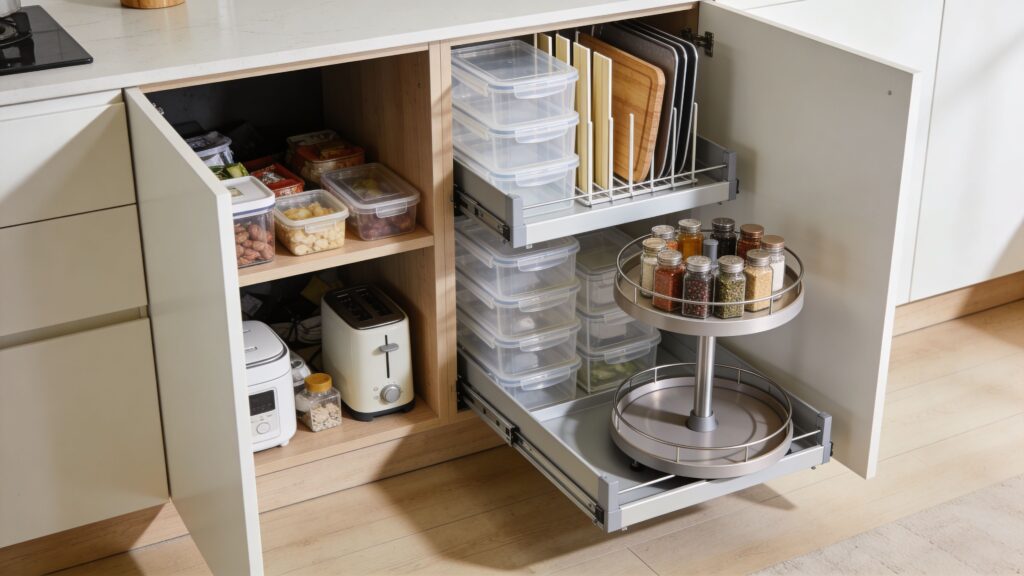
You open a deep kitchen cabinet to grab one saucepan, and three lids slide forward, a baking dish catches on the shelf lip, and the hand mixer you forgot you owned is buried behind a stack of plastic containers. That frustration is common in South Jersey kitchens, especially in older homes where the cabinets are still solid but the storage logic never really worked.
Deep cabinets aren’t the problem by themselves. The problem is access. Standard base cabinets are 24 inches deep, and that depth often turns the back half into invisible storage unless you add a system. According to cabinetry professionals, 30 to 50% of stored items can become inaccessible without organization aids, and hidden clutter can reduce effective storage capacity by up to 40% (why cabinet depth matters).
If you’re trying to figure out how to organize deep kitchen cabinets, start with one principle. Don’t buy organizers first. Decide how the cabinet needs to function, then choose the hardware or bins that match that job.
Table of Contents
- Reclaiming Your Cabinet Space Through Prep and Planning
- Choosing the Right Organizers for Your Needs
- A System for Storing and Accessing Everything
- Installation Tips and Long-Term Maintenance
- DIY Fix vs. Professional Remodel When to Get Help
- Start Your South Jersey Kitchen Upgrade with The Cabinet Coach
Reclaiming Your Cabinet Space Through Prep and Planning
The worst deep cabinets usually aren’t packed because you own too much. They’re packed because the cabinet never got a plan. Items drift in, small things migrate backward, and before long the shelf becomes a holding area instead of working storage.
That’s why the first win is simple. Pull everything out.
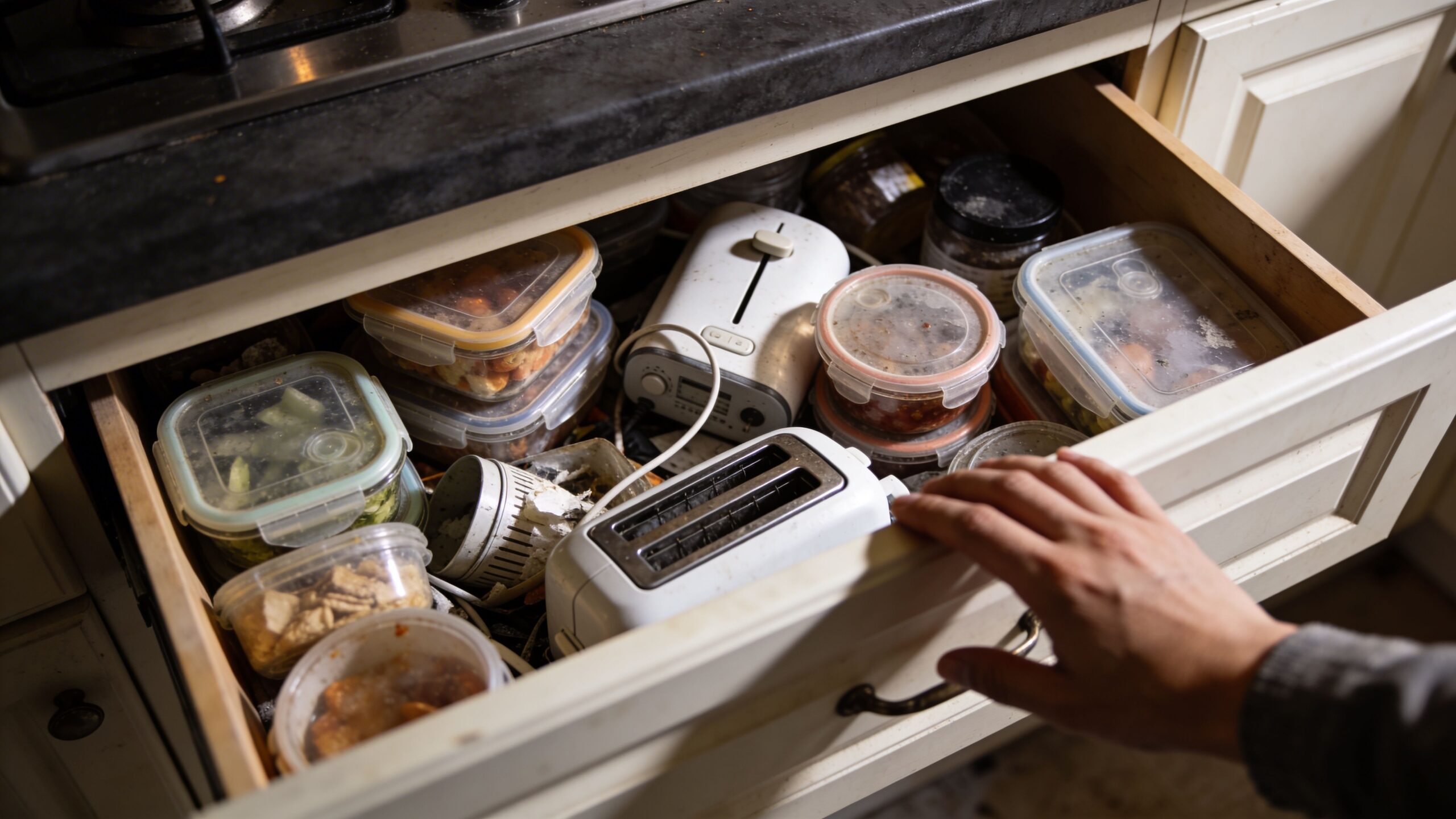
Empty first and sort by real use
Put every item on the counter or table. Then sort by how you use the kitchen, not by what seems tidy for five minutes.
A practical sort usually looks like this:
- Daily-use cookware such as pans, mixing bowls, and colanders
- Occasional-use appliances like a slow cooker or waffle maker
- Serveware and seasonal pieces that don’t need prime access
- Loose small items that shouldn’t live uncontained in a deep base cabinet at all
If you’re planning a larger kitchen update, this same exercise also helps you spot layout problems early. It’s worth reviewing a remodeling planning guide before you buy any products, especially if the cabinet issue points to a bigger workflow problem: how to plan a kitchen remodel.
Practical rule: If you have to kneel, reach blind, and move two things to grab one thing, that item is stored in the wrong place.
Wipe the cabinet interior once it’s empty. Crumbs, sticky residue, and shelf liners that curl at the edges make every organizer work worse.
Measure the cabinet before you shop
This is the step DIY projects skip most often. Then the pull-out shelf arrives and the hinges block it, or the bin is too tall once the shelf above is factored in.
Measure the interior of the cabinet, not the outside. You need:
- Width: side wall to side wall, accounting for hinge clearance
- Height: shelf opening and full usable height
- Depth: from inside front frame to back wall
- Obstacles: pipes, center stiles, hinge arms, uneven floors, outlet boxes
Write the measurements down cabinet by cabinet. Don’t assume the cabinet next to it matches. In older homes around Cherry Hill, Haddonfield, and Collingswood, I’ve seen small differences that completely change which organizer fits cleanly.
If you do only two things before shopping, do these: empty everything and measure carefully. That alone prevents most wasted purchases.
Choosing the Right Organizers for Your Needs
A deep cabinet usually fails in one of four ways. Heavy items are hard to pull forward. Flat items collapse into stacks. Small items drift to the back. Bottles crowd each other until you stop seeing what you own.
Choose the organizer that fixes that specific failure.
What each organizer does well
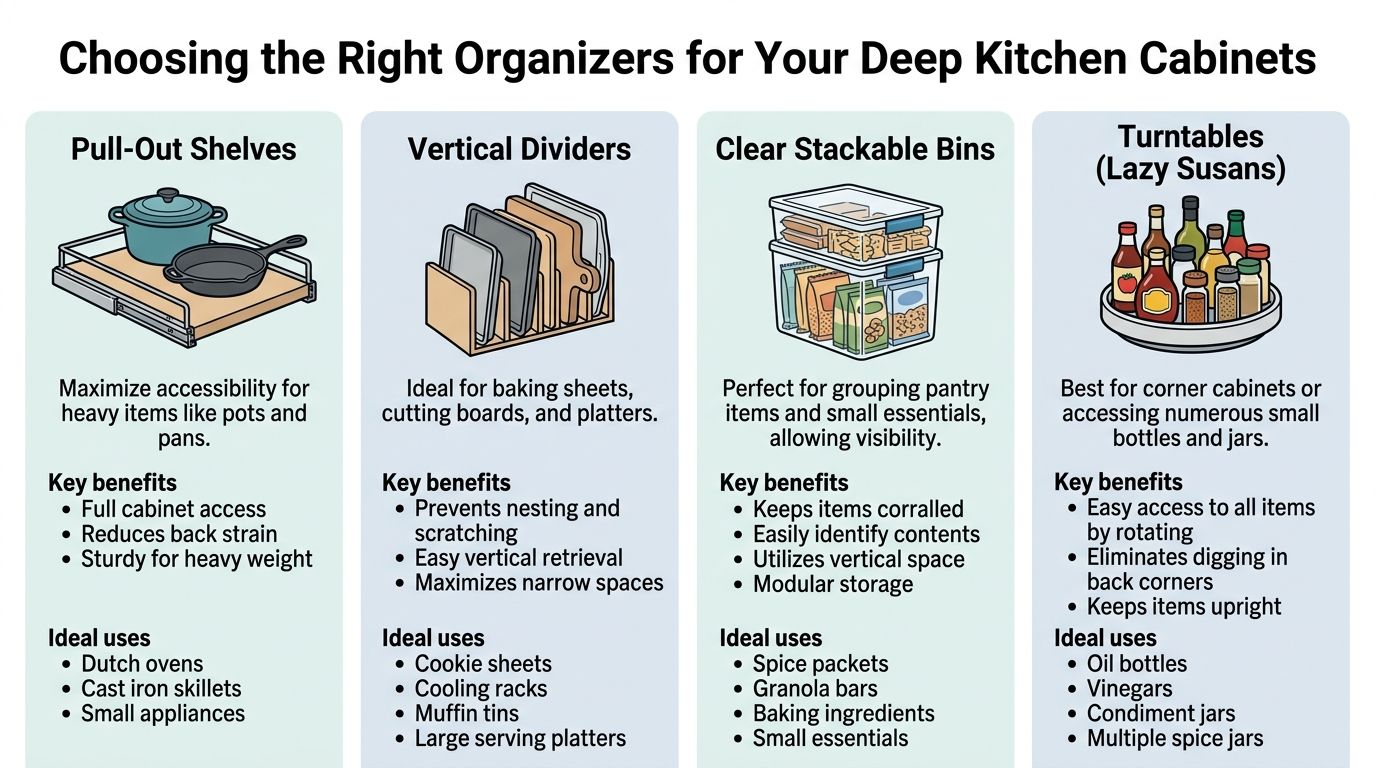
Pull-out shelves solve the biggest complaint I hear in South Jersey kitchens. Homeowners are tired of kneeling down and unloading the front of the cabinet just to reach one Dutch oven in the back. The National Association of Home Builders lists pull-out shelving among the kitchen features buyers want most because it improves day-to-day function and accessibility (kitchen features buyers want, including pull-out shelves). Rev-A-Shelf also lays out the practical benefit clearly. A pull-out brings the cabinet contents to the user instead of forcing the user into the cabinet, which is exactly why it works for pots, pans, mixing bowls, and small appliances (pull-out shelf storage options from a cabinet hardware manufacturer).
There is a trade-off. Good pull-outs cost more than bins, and poor fit is common in older cabinets with face frames, hinge interference, or slight interior variations. For one problem cabinet, a retrofit pull-out can be a smart DIY upgrade. For several cabinets, or for kitchens where heavy cookware is used every day, custom sizing usually holds up better and wastes less space.
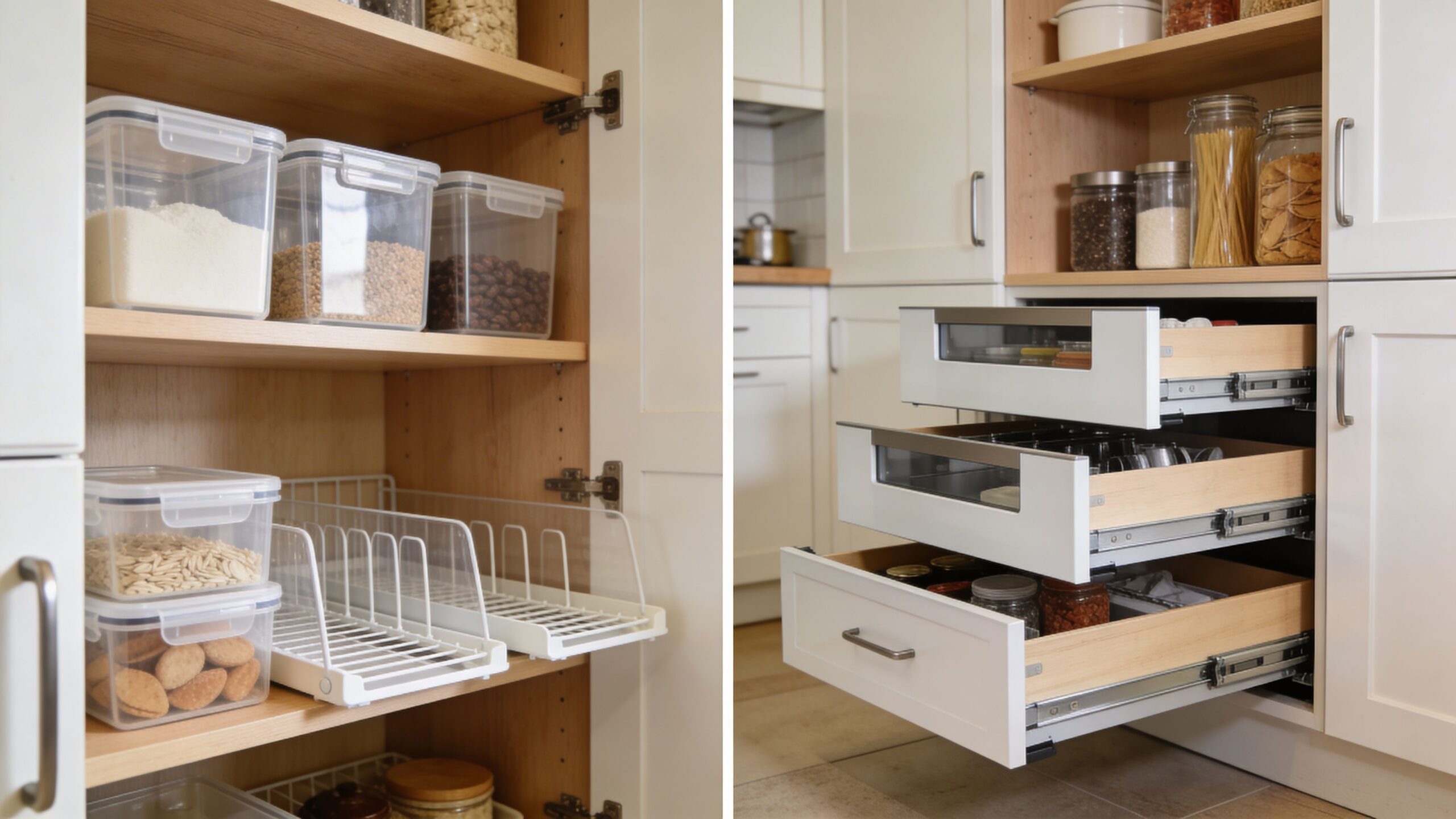
Vertical dividers fix stacking problems. They work best for baking sheets, platters, cutting boards, serving trays, and cooling racks. Instead of lifting a pile to reach the bottom piece, each item gets its own slot. This is one of the simplest upgrades to install, and it often gives an immediate improvement without changing the cabinet itself.
Clear stackable bins contain categories that tend to spread. Use them for snack bags, wraps, tea, lunch supplies, packets, lids, and pantry backstock. The benefit is not strength. The benefit is keeping like items together so the back of the cabinet does not turn into a mixed pile. If you want more ideas in that direction, this roundup of smart space saving kitchen storage solutions is a helpful supplement.
Bins also come with a downside. Too many bins create dead space and force you to maintain a system that is fussy to reset. I usually recommend them only where categories are stable and easy to label.
Turntables or lazy Susans work well for bottles, jars, oils, vinegars, and condiments. In corner cabinets, they can rescue space that would otherwise stay awkward and underused. They are less useful for oversized cookware or anything heavy enough to wobble the tray.
Deep Cabinet Organizer Comparison
| Organizer Type | Best For | Pros | Cons |
|---|---|---|---|
| Pull-Out Shelves | Pots, pans, small appliances, mixing bowls | Brings contents forward, reduces crouching, better for heavy items | Costs more than bins, requires careful fit |
| Vertical Dividers | Baking sheets, platters, boards, lids | Stops stacking problems, easy to maintain | Limited use outside flat items |
| Clear Stackable Bins | Pantry groups, packets, lids, kid snacks | Keeps categories visible, contains loose items | Can create wasted space if over-binned |
| Turntables (Lazy Susans) | Bottles, jars, spices, corner access | Rotates items into view, good for small containers | Not ideal for oversized or very heavy cookware |
Neurodiverse-friendly choices that reduce friction
Many organizing systems look tidy for a photo and fail in real use. The usual problem is hidden storage. If the item disappears from view, it often disappears from the routine too.
That issue matters even more in neurodiverse households. ADDitude’s guidance for ADHD-friendly kitchens recommends visible storage, clear categories, and fewer layered obstacles because recall and task initiation often break down when items are buried or hard to see (ADHD-friendly kitchen organization ideas from ADDitude).
The practical takeaway is simple. Reduce memory load.
Useful choices include:
- Clear bins instead of opaque bins so categories stay visible
- Cabinet lighting so the back of a deep shelf does not disappear
- Pull-outs for high-friction cabinets where retrieval is the recurring problem
- Plain-language labels that any family member can follow
- Color-coded zones when different users need different cues
I often tell clients to judge a cabinet by reset effort. If putting something away takes too many steps, the system will break. That is where DIY and custom work start to separate. A couple of labeled bins may be enough for one snack cabinet. A kitchen used by multiple adults, kids, or someone with ADHD often benefits from built-in structure that removes decision fatigue every single day.
A lot of homeowners also benefit from carrying the same storage rules into nearby utility areas. This guide to custom closet organizing systems that use consistent storage logic shows how that approach can make the whole home easier to maintain.
A cabinet that looks orderly but hides items in layers usually falls apart fast.
A System for Storing and Accessing Everything
Organizers don’t solve much by themselves. They only work when the cabinet follows a repeatable logic.
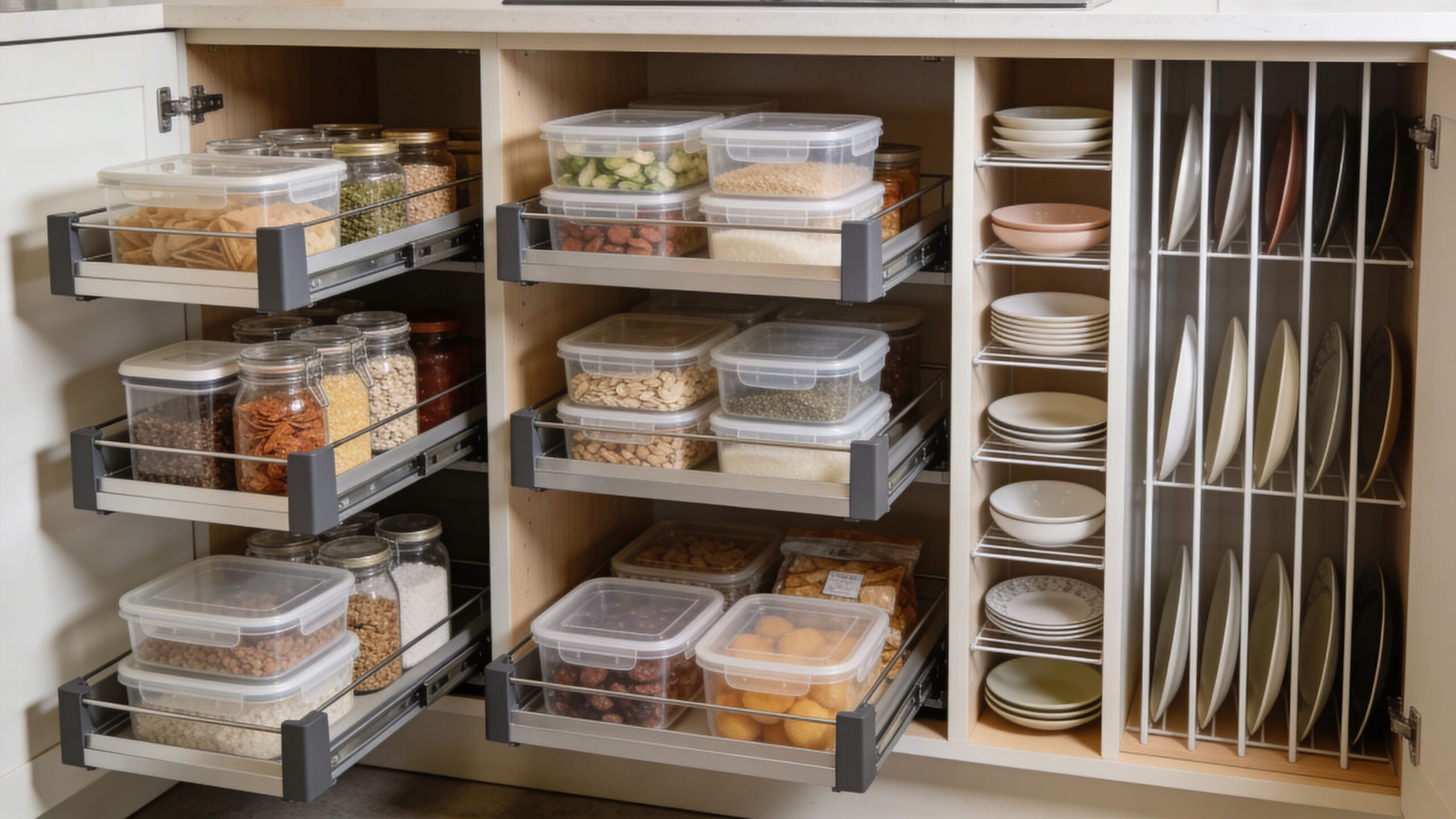
The most reliable method is zone-based storage. Experts report that creating usage zones during the setup process can identify 20 to 30% of redundant items for decluttering, and installing pull-out trays can boost visibility by 90% and access speed by 70% (zone-based method and pull-out tray performance).
Build zones around the way you cook
Think in tasks, not product types.
A well-organized kitchen usually has a few natural zones:
- Cooking zone near the range with pots, pans, lids, oils, and tools
- Prep zone near the main workspace with bowls, strainers, cutting boards, and measuring tools
- Baking zone with mixers, pans, cooling racks, and specialty ingredients
- Overflow or occasional zone for large appliances and entertaining pieces
Here, many deep cabinets finally start making sense. A cabinet near the stove shouldn’t hold random pantry overflow just because it’s large. It should hold the cookware you reach for constantly.
If you like seeing different ways people apply these principles, this guide on how to organize kitchen cabinets is a useful companion read.
Load the cabinet so it stays usable
How you place items matters as much as what organizer you buy.
Store by frequency first, then weight, then size. Daily-use items belong in the easiest reach path. Heavier pieces should stay low and stable. Tall items can sit behind shorter ones only if the front layer still lets you identify everything at a glance.
A few placement rules work in almost every kitchen:
- Front of pull-out shelves: everyday cookware and mixing bowls
- Back of deeper sections: occasional appliances that are still worth keeping
- Vertical slots: trays, platters, cutting boards
- Contained bins: small backstock items, packets, lids, or kid snacks
If one cabinet has to serve three jobs, it needs visible boundaries inside it. Otherwise it turns back into one big category called “miscellaneous.”
For homes where the kitchen connects tightly to mudroom or laundry storage, it also helps to coordinate cabinet logic across spaces. These small-space cabinet ideas for South Jersey homes show how that crossover can reduce clutter migration.
A short demo can help if you’re trying to picture the setup in motion.
Installation Tips and Long-Term Maintenance
A good organizer installed badly becomes another annoyance. Drawers rack, shelves scrape, screws loosen, and homeowners decide the product was the problem when the installation was.
What matters most during installation
Start with the cabinet box itself. If the floor of the cabinet is out of level or the side walls are slightly out of square, a pull-out can bind even when the hardware is fine.
Check these points before fastening anything:
- Slide alignment: both sides need to sit level and parallel
- Door and hinge clearance: especially in framed cabinets
- Shelf load path: heavy cookware needs stable mounting points
- Full extension travel: confirm the organizer clears the opening cleanly
Corner cabinets deserve special attention. Deep corner cabinets can trap 70% of items in dead zones, and specialized hardware such as pull-out swing trays or lazy Susans with 100 to 150 lb capacity can double space utilization and provide 75% faster access (corner cabinet hardware benchmarks).
That’s why I rarely recommend improvising in a corner. Standard bins don’t solve blind access. Purpose-built hardware does.
How to keep the system working
Maintenance is simple, but it matters.
A few habits keep deep cabinet systems functional for years:
- Retighten hardware periodically if the cabinet holds cast iron, stacks of dishes, or appliances
- Vacuum debris from glides so crumbs don’t interfere with motion
- Watch shelf loading because even a strong organizer performs poorly when overloaded
- Reset categories quickly after holidays or bulk shopping trips
Fixed shelves often look fine on day one. A true test is whether you can still reach and return everything easily after a busy month of cooking.
If a pull-out starts rubbing or sagging, deal with it early. Small alignment issues are easier to correct before they stress the hardware or cabinet box.
DIY Fix vs. Professional Remodel When to Get Help
A lot of deep cabinet projects fail for one reason. The homeowner buys organizers for a cabinet that is fighting the organizer from the start.
I see it all the time in South Jersey kitchens. Someone spends a few hundred dollars on bins, risers, and a retrofit shelf, then still has to kneel on the floor to reach the stockpot or dig past three layers of food storage containers. The problem was never just clutter. The cabinet itself was the wrong shape, the access was poor, or the storage plan did not match the way the household functions.
When DIY is enough
A DIY fix is usually the right call when the cabinet box is in good condition and access can improve without rebuilding anything.
That often applies when:
- You need clearer categories for snacks, wraps, baking supplies, or pantry backstock
- The cabinet opening is standard enough to accept an aftermarket pull-out or bin system without binding
- The frustration is limited to one cabinet or one item type
- You want to test a routine first before paying for permanent upgrades
In those cases, a simple fix often gives solid results. Bins can separate categories. A retrofit pull-out can bring everyday items forward. Shelf dividers can stop piles from collapsing.
For some households, that is enough.
It can be especially effective for renters, newer homeowners still figuring out their kitchen habits, or families who need a low-cost reset before a larger project. It also works well for neurodiverse households that benefit from visible categories and fewer decision points, as long as the system stays simple enough to maintain.
When custom work creates better long-term value
Professional help makes more sense when access, fit, and daily use are all working against you.
Look closely at these situations:
- The cabinet openings are narrow or inconsistent because of face frames, hinges, fillers, or older construction
- You have blind corners or extra-deep bases that waste space no matter how often you reorganize
- The kitchen layout fights your routine and items are stored far from where they are used
- Several cabinets need to work together instead of being fixed one at a time
- You want storage that fits the household permanently, not a mix of temporary inserts
This is also where long-term cost matters. A cheap fix that gets replaced twice is often more expensive than a well-planned upgrade installed once. The National Association of Realtors notes in its Remodeling Impact Report that homeowners report strong satisfaction from kitchen upgrades, and cabinetry improvements often carry resale appeal because buyers notice function as quickly as they notice finishes.
I also look at cognitive load, not just square footage. In a neurodiverse-friendly kitchen, the best solution is often the one that reduces searching, stacking, and remembering. Full-access drawers, labeled zones, and consistent storage locations usually outperform deep fixed shelves stuffed with containers, even if the shelf technically holds more.
If you are unsure which direction makes sense, start by defining the scope before you buy anything else. This guide on getting started before hiring a contractor helps you sort out whether you need a targeted upgrade or a larger remodel.
A simple rule helps. If one cabinet annoys you, try DIY first. If the same frustration shows up at prep, cooking, cleanup, and storage, the better investment is usually custom cabinetry or a coordinated retrofit plan.
Start Your South Jersey Kitchen Upgrade with The Cabinet Coach
Homeowners in Cherry Hill, Voorhees, Haddonfield, Moorestown, and across Camden and Burlington Counties often start with the same complaint. The cabinets technically hold plenty, but daily use still feels cramped, inconvenient, and chaotic.
That usually means the issue isn’t just storage volume. It’s cabinet function.
The Cabinet Coach helps South Jersey homeowners solve that problem with a mobile showroom approach that brings the design process to your home. Instead of guessing from a store aisle, you can evaluate cabinetry, hardware, finishes, and layout ideas in the space where the decisions matter. The process is built around guided planning, clear material selections, and coordinated execution, which you can review on The Cabinet Coach experience.
A quick checklist for your next step
A professional consultation is probably the right next move if any of these sound familiar:
- You’ve already tried bins or turntables and the cabinet still feels frustrating
- Your corner cabinets waste space no matter how often you reorganize
- You want pull-outs, drawers, or custom inserts that fit properly the first time
- Your kitchen workflow is off and the storage problem is bigger than one cabinet
- You’d rather make one coordinated decision than keep buying temporary fixes
If that’s where you are, it’s worth getting expert eyes on the room before spending more on stopgap products.
If you’re ready to turn deep, frustrating cabinets into storage that works, schedule a consultation with The Cabinet Coach.