

You're probably standing in your kitchen with a tape measure, a notepad, and a growing suspicion that this should be simpler than it is. Then you check one wall, measure again near the window, and realize the numbers don't match. That's normal, especially in older South Jersey homes where floors settle, walls bow, and soffits show up exactly where you don't want them.
That's why how to measure kitchen cabinets isn't just about writing down wall lengths. It's about measuring the room the way cabinets have to fit into it. If you're planning a full replacement, the empty space matters. If you're refacing, the openings and overlays matter. And if your home is older, the smallest measurement usually matters most.
Table of Contents
- Gather Your Tools and Sketch Your Layout
- Mastering Your Kitchen's Overall Dimensions
- Measuring for Base Wall and Pantry Cabinets
- Avoiding Costly Mistakes in Older South Jersey Homes
- Measuring for Cabinet Refacing vs New Cabinets
- When a Tape Measure Is Not Enough The Cabinet Coach Solution
Gather Your Tools and Sketch Your Layout
A clean measurement starts before the first number. If your notes are messy, your order will be messy too. The best installers I know don't begin with cabinetry. They begin with a clear map of the room.
Use the right tools from the start
You don't need a truck full of gear, but you do need more than a tape measure tossed in a junk drawer.
Use this checklist:
- Steel tape measure: A solid tape stays straight and gives cleaner readings on long wall runs.
- Level: A short level is useful, and a longer one is even better for checking walls, floor variation, and cabinet lines.
- Notepad or graph paper: You need one place for every dimension.
- Pencil: Use pencil, not pen. Measurements get corrected.
- Step stool: Useful for checking soffits, upper cabinet zones, and trim details.
- Painter's tape: Good for labeling walls or marking utility locations temporarily.
If you're collecting ideas before final sizing, it also helps to look at a proper design process so you understand how measurements turn into a workable plan. A kitchen design consultation usually starts with the same thing a good installer wants. A complete, readable field sketch.
Practical rule: If you can't hand your notes to someone else and have them understand the room, your sketch isn't done yet.
Draw a simple plan you can trust
Draw the kitchen from above. It doesn't have to be pretty. It does have to be legible.
Start by drawing each wall in order around the room. Label them clearly, such as Wall 1, Wall 2, Wall 3, and so on. Mark every doorway, window, cased opening, soffit, and major appliance location.
Then add the fixed items that will affect cabinet placement:
- Sink and plumbing area: Mark where the sink sits now and where the plumbing comes through the wall or floor.
- Range or cooktop location: Note the vent path if there's one.
- Refrigerator space: Include nearby walls or trim that could interfere with door swing.
- Electrical outlets and switches: These often land right where upper cabinets or backsplash features need to go.
A lot of homeowners skip this and start writing measurements on scraps of paper. That works for about ten minutes. Then one window dimension gets mixed up with another and the whole plan starts drifting.
Keep each measurement on the sketch where it belongs. Don't trust memory. Don't assume you'll sort it out later.
Mastering Your Kitchen's Overall Dimensions
You can measure a 12-foot wall in an older South Jersey kitchen and still end up with cabinets that do not fit the way you expected. I see it all the time in houses with settled floors, plaster over patchwork framing, and soffits that were built around old ductwork. One number for each wall is not enough. You need the room the way it exists.
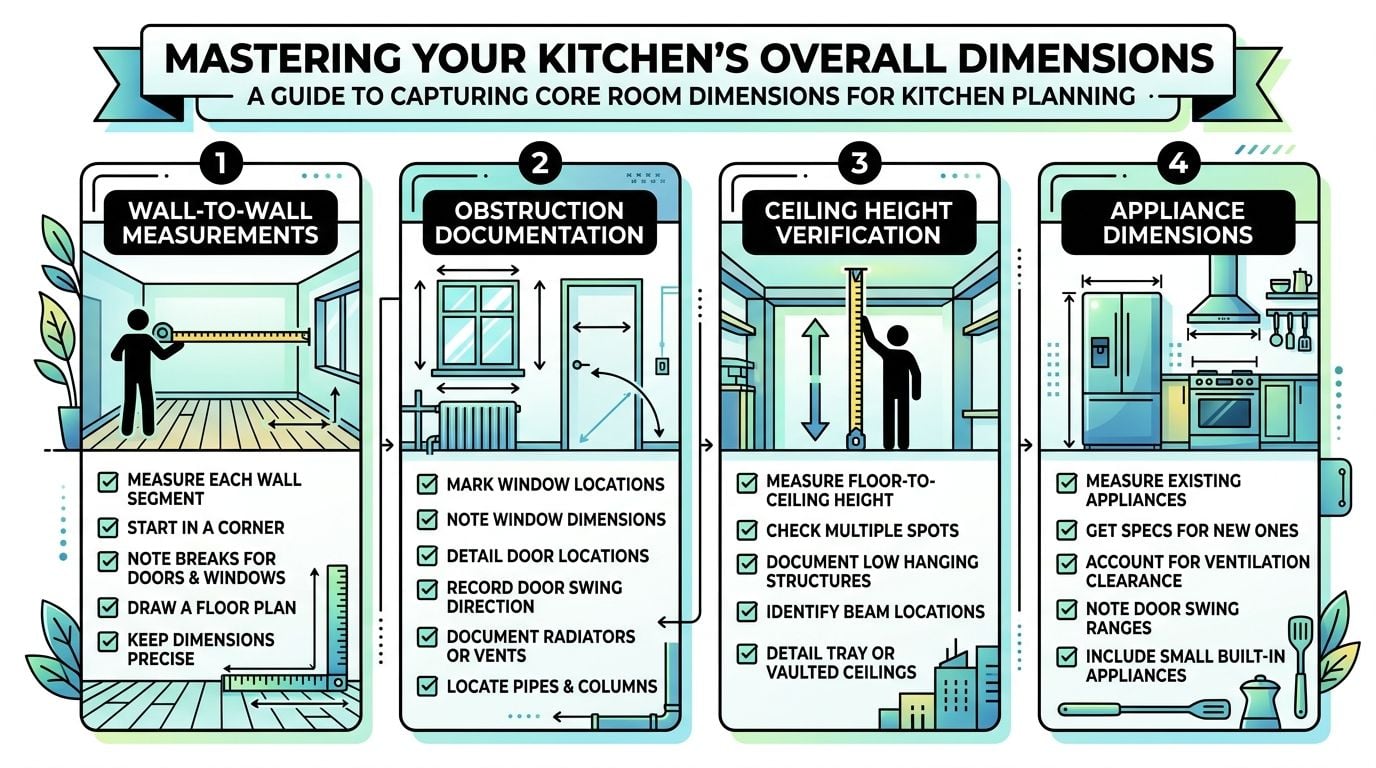
Measure the room as a real, imperfect box
Start with the full length of every wall, then check each wall again at three heights: near the floor, around countertop height, and near the ceiling. That middle measurement matters because standard base cabinets are typically 34.5 inches high before tops, and the finished work surface usually lands at 36 inches, as explained in this guide to standard kitchen dimensions from The Spruce.
Write all three numbers on the sketch where they belong. If the wall changes from bottom to top, the cabinets, fillers, and countertop all have to deal with that change.
Do not average the measurements.
That shortcut causes trouble on both replacement jobs and refacing jobs. With new cabinets, it can force last-minute filler changes or leave an appliance opening too tight. With refacing, it can leave you ordering new doors and panels for cabinet fronts that looked straight until you checked the run properly.
A simple field table keeps the notes usable:
| Wall area | What to measure | Why it matters |
|---|---|---|
| Near floor | Corner to corner | Shows where base cabinets may run into a belly in the wall or a floor that rises |
| Countertop height | Corner to corner | Reflects the line your bases and finished tops have to follow |
| Near ceiling | Corner to corner | Helps plan uppers, crown, and any adjustment needed below a soffit |
Check more than wall length
Room width matters just as much as wall length. Measure across the kitchen in at least two places. Older homes often pinch in the middle or open up near one end, especially where one wall was furred out years later.
That affects aisle space, appliance clearance, and whether a new layout will function. If you are changing cabinet locations, review the kitchen work triangle before you assume the room can support a better setup.
Homeowners planning extras such as appliance garages should also account for how those features use corner space and countertop depth. Some of the best luxury kitchen organization ideas look clean on paper but need precise wall and counter measurements to work in an older kitchen.
Mark openings from the outside edges that affect cabinets
Doors, windows, and cased openings need exact locations, not estimates. Measure them from the outside edge of the trim to the outside edge of the trim, then record the distance from the nearest finished corner. Prime Cabinetry's accurate kitchen measurements guide makes the same point because casing, sills, and projection details are what interfere with cabinets in the field.
Record these on the sketch:
- Doorways: full width with casing, plus distance from corner
- Windows: trimmed width and height, plus sill height from the finished floor
- Pass-throughs and half walls: exact width, depth, and where they begin and end
- Pipes, vents, and outlets: location from a fixed corner or wall end
- Soffits: depth, drop, and how far they run
Soffits deserve special attention in older South Jersey kitchens. Many are not centered, not level, and not the same depth from one end to the other. A soffit that drops only a little at one corner can decide whether a 42-inch wall cabinet fits cleanly or has to be reduced.
A cabinet plan can survive a crooked wall. It usually does not survive a bad opening measurement.
Measure ceiling height in several spots
Take ceiling height at both corners of each wall and at least one point near the middle. Then check any area under a soffit or bulkhead separately.
Use the smallest height on your working plan. That number protects you from ordering wall cabinets, stacked moldings, or reface end panels that fit only in the tallest part of the room.
Measuring for Base Wall and Pantry Cabinets
Once the room is measured, the next job is matching that room to real cabinet sizes. Homeowners often get tripped up at this stage. They design around what they wish existed, instead of what cabinets are built in.
The cabinet industry works from repeatable dimensions. If you understand those building blocks, your layout gets easier fast.
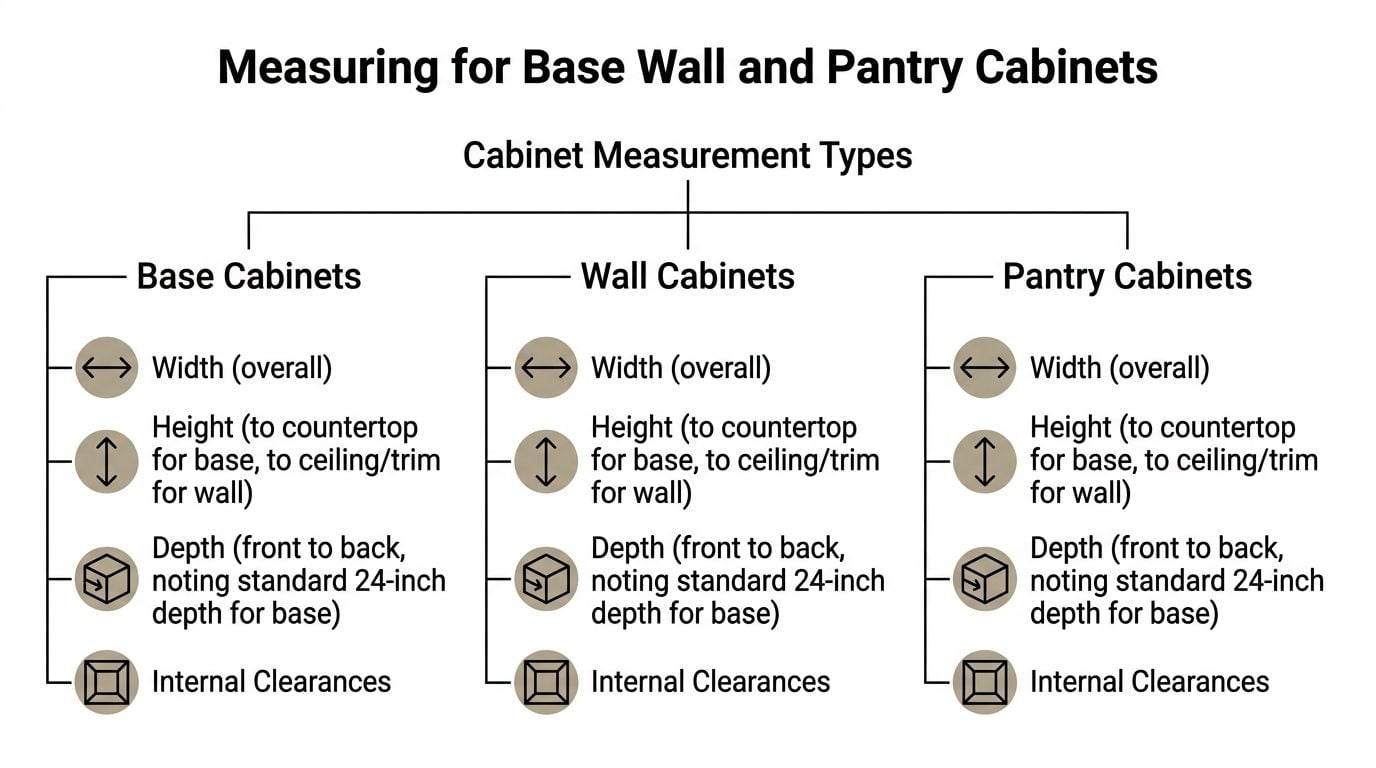
Know the standard cabinet sizes before you plan
Standard kitchen base cabinets have a 24-inch depth and a 34.5-inch cabinet height, reaching a 36-inch finished height once a standard countertop is installed, according to this overview of standard kitchen cabinet sizes. That same source notes that wall cabinets are typically 12 inches deep, and wall cabinet heights commonly come in 30, 36, and 42 inches for homes with ceilings from 8 to 9 feet.
Base cabinet widths are built in 3-inch increments from 12 inches to 48 inches, which is why exact room measurements matter so much. You're fitting a room to a manufactured system.
Base cabinets and why depth matters
Base cabinets do most of the heavy lifting. They carry the countertop, hold the sink, support appliances, and set the working line for the whole kitchen.
A few points matter more than people expect:
- Depth controls walkway comfort: A base run that projects where it shouldn't makes the kitchen feel tight immediately.
- Finished height must stay consistent: If one cabinet ends up high or low, the countertop installer has a problem.
- Width increments shape the layout: Since cabinets are made in 3-inch steps, a wall that looks close on paper may still need fillers or a layout adjustment.
If you're thinking beyond basic box placement and into access and storage, these luxury kitchen organization ideas are useful because they show how appliance garages and internal features change the space you need to reserve inside a run.
A lot of toe-kick confusion also starts here. If you want to understand how that lower recess affects comfort and installation, this guide on cabinet toe kick height is worth reviewing before you finalize dimensions.
Wall and pantry cabinets
Wall cabinets aren't just picked by style. They have to work with ceiling height, window trim, backsplash space, and visual balance.
The standard depth of 12 inches creates the typical relationship between upper and lower cabinets. Wall cabinet placement also needs to respect the working space below, not just fit above.
For tall storage, pantry cabinets generally run 84 to 94 inches high with depths from 12 to 24 inches, based on the same cabinet sizing reference above. In a taller cabinet wall, that height can work beautifully. In an older kitchen with a low soffit or uneven ceiling, it can become the first place the plan breaks.
Here's a good habit. Pick the cabinet type first, then confirm the available space around it. Don't force a pantry cabinet into a location that only works on paper.
This video gives a useful visual overview of how cabinet measurements relate to the room:
Avoiding Costly Mistakes in Older South Jersey Homes
A lot of online measuring advice assumes your kitchen is a neat rectangle with level floors and straight walls. In Haddonfield, Collingswood, Moorestown, and plenty of other older South Jersey neighborhoods, that assumption falls apart fast.
Plaster can hump out behind a cabinet run. Floors can drift enough that one end of the base line sits visibly off. A soffit can look harmless until it cuts into the only height that worked for your uppers.
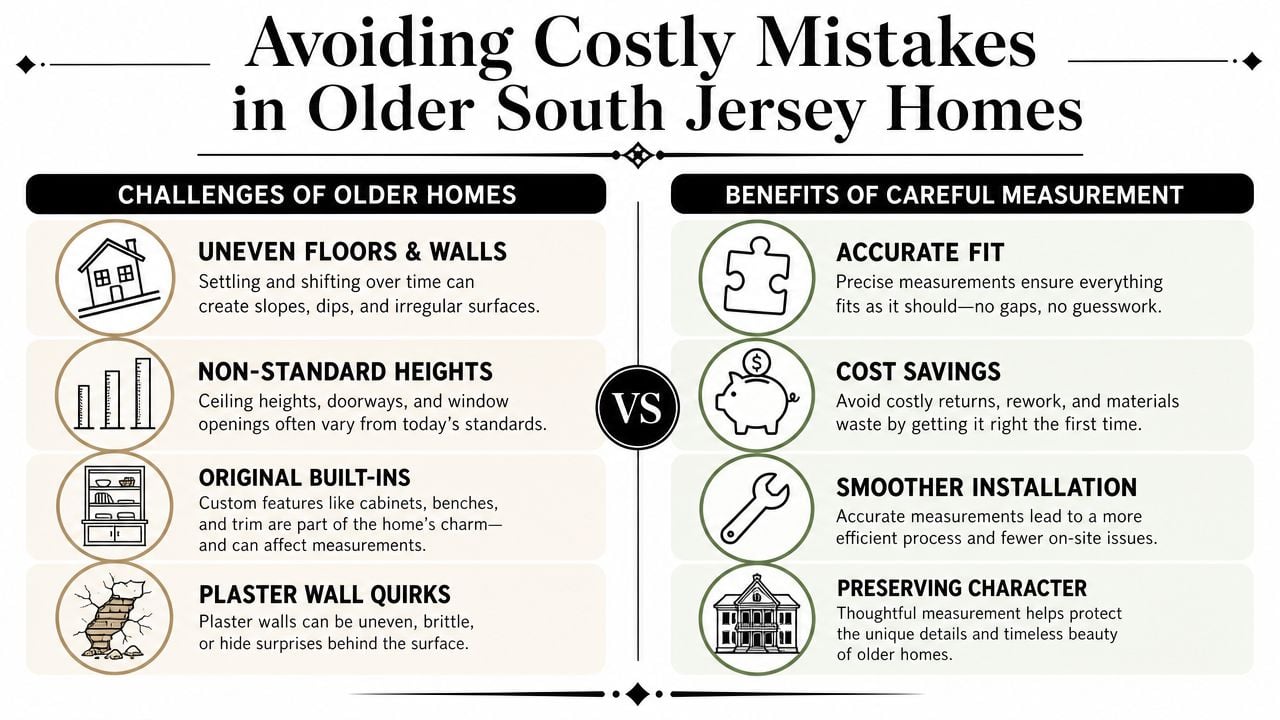
Older homes change the measuring process
In New Jersey, 54% of kitchen remodels in older homes from 1950 to 1980 require custom cabinet height adjustments due to non-level surfaces, and 37% of cabinet installation failures in older homes happen when those conditions aren't accounted for, according to this piece on measuring kitchen cabinets in uneven spaces.
That lines up with what installers see in the field. The room may look close enough until a long cabinet run exposes every dip and twist.
Use a stricter process in older homes:
- Measure wall height at several points: Don't rely on one floor-to-ceiling number.
- Check around windows and trim: Older trim work is often proud of the wall.
- Record the smallest usable measurement: It's the one that decides fit.
- Expect filler pieces: They're part of a clean installation, not a sign of failure.
If you're working in a compact older kitchen, this article on an old house small kitchen remodel is a practical look at why older layouts need more careful planning than new construction.
Field note: In an older home, the prettiest rendering in the world won't help if the left wall leans and the ceiling drops over the pantry.
For homeowners dealing with structurally quirky houses in other older-city markets, these remodeling architects for Chicago housing show the same bigger lesson. Older homes reward careful measuring and punish assumptions.
How to handle soffits slopes and filler space
Soffits deserve their own line on the sketch. Measure their height from the floor and their depth out from the wall. Don't round. Don't estimate. If an upper cabinet run ends under a soffit, that soffit becomes the controlling limit.
Sloped floors create a different problem. Your base cabinets still have to finish level even when the floor doesn't. That means the high point in the floor matters more than the low point.
A simple checklist helps here:
| Condition | What to do | What happens if you ignore it |
|---|---|---|
| Soffit over upper run | Measure height and projection exactly | Wall cabinets may not fit |
| Floor slope | Identify the highest point before planning base run | Countertop line can end up uneven |
| Bowed wall | Compare measurements at multiple heights | Cabinet faces can bind or leave odd gaps |
| Out-of-plumb corner | Leave room for filler or scribe work | Doors and drawers may not clear properly |
In old homes, perfect symmetry is rarely the goal. A clean fit is the goal.
Measuring for Cabinet Refacing vs New Cabinets
Many homeowners frequently mix up two completely different jobs. Measuring for new cabinets means measuring the room. Measuring for refacing means measuring the cabinet boxes you already have.
If you use the wrong method, the order goes wrong.
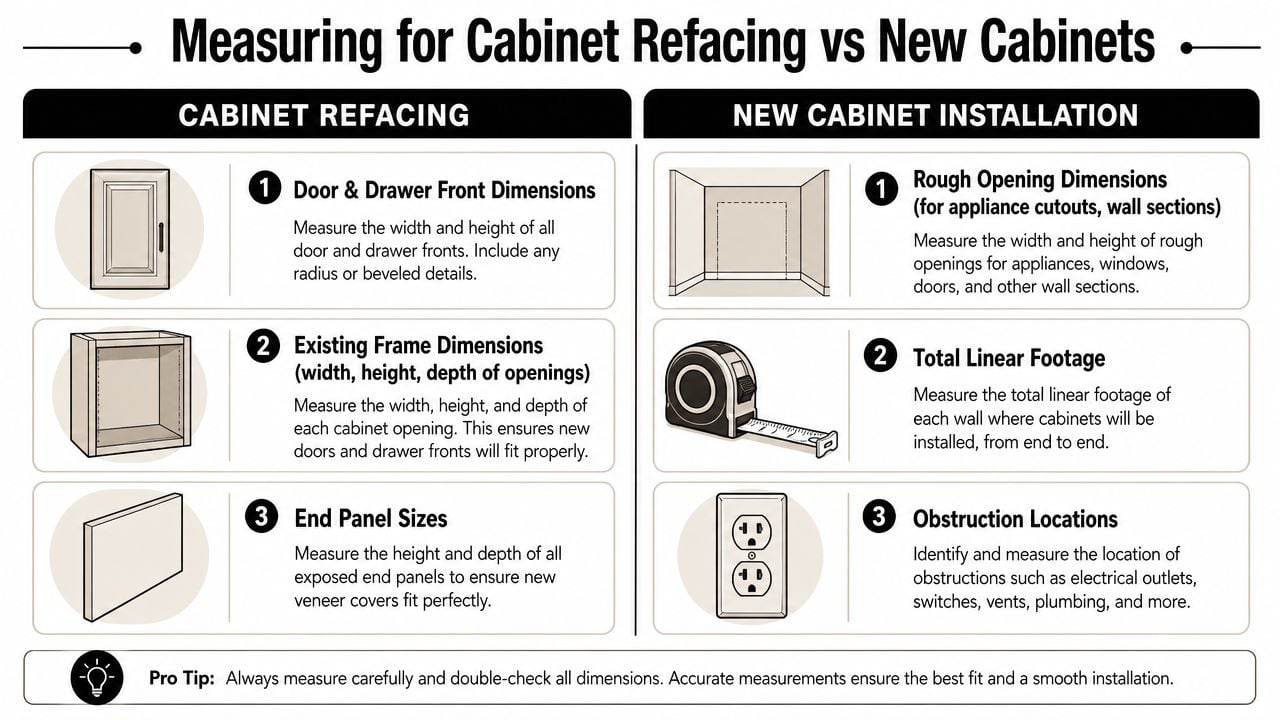
Full replacement measurements
With a full replacement, you're working from the room outward. The key numbers are wall lengths, ceiling conditions, openings, utilities, appliance locations, and the cabinet sizes that can realistically be assembled into those spaces.
That process gives you freedom to change the layout, but it also means every site condition matters. One missed pipe location or one bad soffit height can change the plan.
Refacing measurements and overlay
Refacing is different. You're keeping the cabinet boxes and replacing doors, drawer fronts, panels, or hardware. That means the box opening and overlay become critical.
Overlay is how much the door covers the cabinet frame beyond the opening. If you're ordering replacement doors, measure the cabinet opening width and compare it to the existing door width. The difference between those numbers, divided by two, gives the overlay on each side.
That step gets skipped all the time. According to this guide on measuring kitchen cabinets for refacing, 68% of U.S. kitchen remodels under $10k involve refacing rather than full replacement, yet 43% of homeowners ordering replacement doors report incorrect sizes due to missing overlay steps.
Here's the side-by-side difference:
| Project type | What you measure first | Main risk |
|---|---|---|
| New cabinets | Room dimensions and obstacles | Cabinets don't fit the space |
| Refacing | Existing openings, doors, and overlays | New doors don't cover correctly |
If you're deciding which path makes sense for your kitchen, this comparison of cabinet refacing vs replacement can help you weigh the practical differences before you order anything.
Measure the room for replacement. Measure the openings for refacing. Mixing those two is where a lot of expensive errors start.
When a Tape Measure Is Not Enough The Cabinet Coach Solution
A lot of South Jersey kitchens look simple until the install starts. Then the back wall bows in half an inch, the floor drops across the sink run, or a soffit is found to be lower on one end than the other. By that stage, a rough sketch and a few tape measurements are no longer enough.
Homeowners should absolutely measure for planning. That gets you closer on budget, layout, and whether full replacement or refacing makes sense. But before cabinets are ordered, someone needs to measure the room the way it will be installed.
Where homeowners usually get stuck
The hard part is not reading the tape. The hard part is choosing the controlling measurement.
In older homes, one wall can give different numbers at the floor, countertop height, and upper cabinet height. Plaster can bulge. Corners can open up. Window and door trim can steal space you thought you had. A refrigerator panel that fits on paper can pinch an appliance opening in real life.
Vertical spacing matters too. Countertops are typically built to a 36-inch finished height, and wall cabinets are commonly installed with about 18 inches of space above the countertop. The National Kitchen and Bath Association lays out those planning standards in its kitchen and bath planning guidelines. In a house with uneven floors or a low soffit, hitting those relationships cleanly takes more than one quick measurement.
Refacing adds another layer. A cabinet box may be staying in place, but face frames, exposed ends, and door swing still have to line up once new materials go on. If the existing boxes are out of level or out of square, those problems do not disappear just because you are not replacing everything.
Why professional measuring changes the outcome
A field measure for cabinets is part layout check, part problem-solving.
It identifies where fillers are needed, where scribes will save a run against a crooked wall, where a soffit should be furred out or trimmed back, and whether a standard cabinet size will leave a bad reveal at the end of a run. It also catches issues homeowners should not have to guess at, like how far a dishwasher door projects, whether an old floor buildup affects toe-kick height, or whether a pantry cabinet will clear crown or casing.
That matters more in older South Jersey homes than it does in newer construction. The room you have is rarely perfectly square, flat, or plumb. Good measuring accounts for that before materials are cut and ordered.
If you want a kitchen that fits the house you live in, bring in someone who measures with the installation in mind.
If you're ready for expert help, The Cabinet Coach brings the showroom and the measuring process to your home. Their South Jersey team handles the practical details that cause cabinet projects to go sideways, from uneven older-house conditions to layout planning, material selection, and final fit. A complimentary consultation is a smart next step if you want clear answers before ordering anything.