
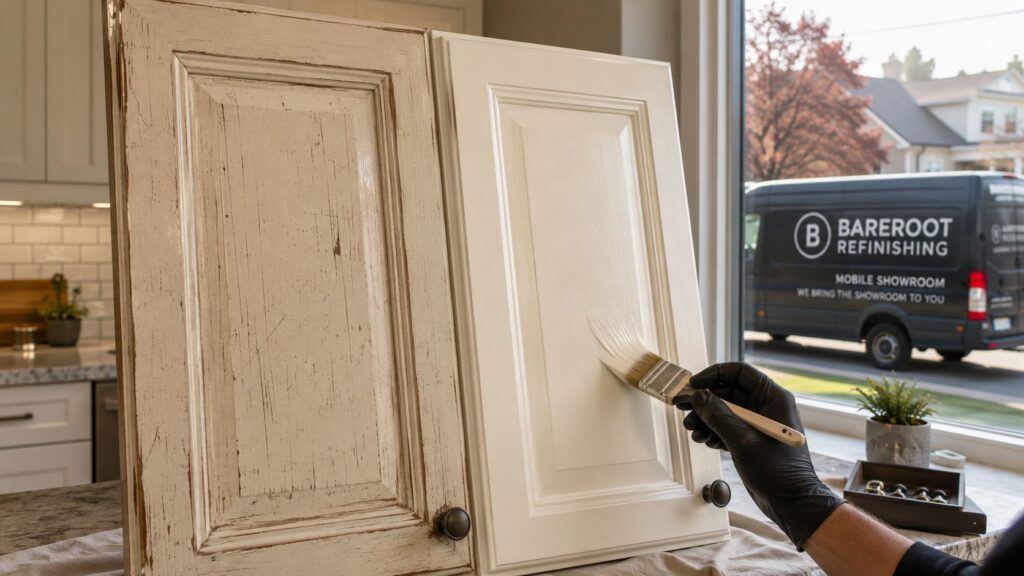
You're probably standing in a kitchen that still works fine, but doesn't feel like yours anymore. The cabinet boxes are solid. The layout still makes sense. But the doors look tired, the finish has dulled, and every time you search for cabinet refinishing near me, you get the same vague promises, broad price ranges, and stock advice that could apply anywhere in the country.
That's frustrating if you live in South Jersey, especially in Camden County or Burlington County, where labor costs, home styles, and renovation expectations don't always match generic national articles. A kitchen in Cherry Hill, Moorestown, Haddonfield, Mount Laurel, or Voorhees needs local guidance. You need to know what this project involves, what affects the price, and whether your kitchen will be out of commission while the work happens.
This guide is written from the practical side of the trade. It focuses on what works, what causes problems later, and how South Jersey homeowners can evaluate cabinet refinishing with clear eyes before they spend a dollar.
Table of Contents
- Is a Full Kitchen Remodel Really Necessary
- What Professional Cabinet Refinishing Actually Means
- Refinish Reface or Replace Your Cabinets
- The Cabinet Refinishing Process From Start to Finish
- Estimating Cabinet Refinishing Costs in South Jersey
- How to Choose a Pro in Camden or Burlington County
- Your South Jersey Kitchen Transformation Questions Answered
Is a Full Kitchen Remodel Really Necessary
A common South Jersey scenario goes like this. The homeowner hates the cabinet color, hates the worn finish, maybe hates the old hardware too. But they don't hate the kitchen enough to tear out walls, replace every box, and live through a major renovation.
That distinction matters.
If the cabinet structure is sound and the layout still functions, a full remodel often solves problems you don't have. It brings demolition, new installation, longer timelines, and a much bigger budget. By contrast, professional refinishing can deliver up to 75% of the visual impact of brand-new cabinets at a significantly lower price point, according to New Jersey cabinet refinishing data.
For a lot of homes in Camden and Burlington Counties, that's the sweet spot. You keep the bones of the kitchen, avoid unnecessary disruption, and put the money into the surfaces people see every day.
When the cabinets are dated but the kitchen still works
An older maple or oak kitchen in Medford, Collingswood, or Cinnaminson may not look current, but that doesn't mean the cabinets need to be replaced. If doors close properly, boxes are stable, and the room flows well, refinishing can make more sense than starting over.
That's also why planning matters before anyone picks a color. If you're still weighing whether to refinish, reface, or remodel more broadly, this kitchen planning guide on how to plan a kitchen remodel helps organize the decision before the first estimate comes in.
Practical rule: Replace cabinets because they've failed structurally or functionally. Refinish them when the problem is mostly visual.
Budget pressure changes the decision
Homeowners aren't the only ones who think this way. Investors and sellers often look at kitchen updates through return, timing, and financing flexibility. If you're evaluating a property with resale in mind, it helps to understand tools like investor loans using After Repaired Value from New American Funding, LLC., because kitchen appearance can influence how people budget rehab work without automatically committing to full replacement.
For many South Jersey homes, refinishing is the practical middle path. It updates what buyers and guests notice first, without forcing a full gut job just to escape an outdated stain color.
What Professional Cabinet Refinishing Actually Means
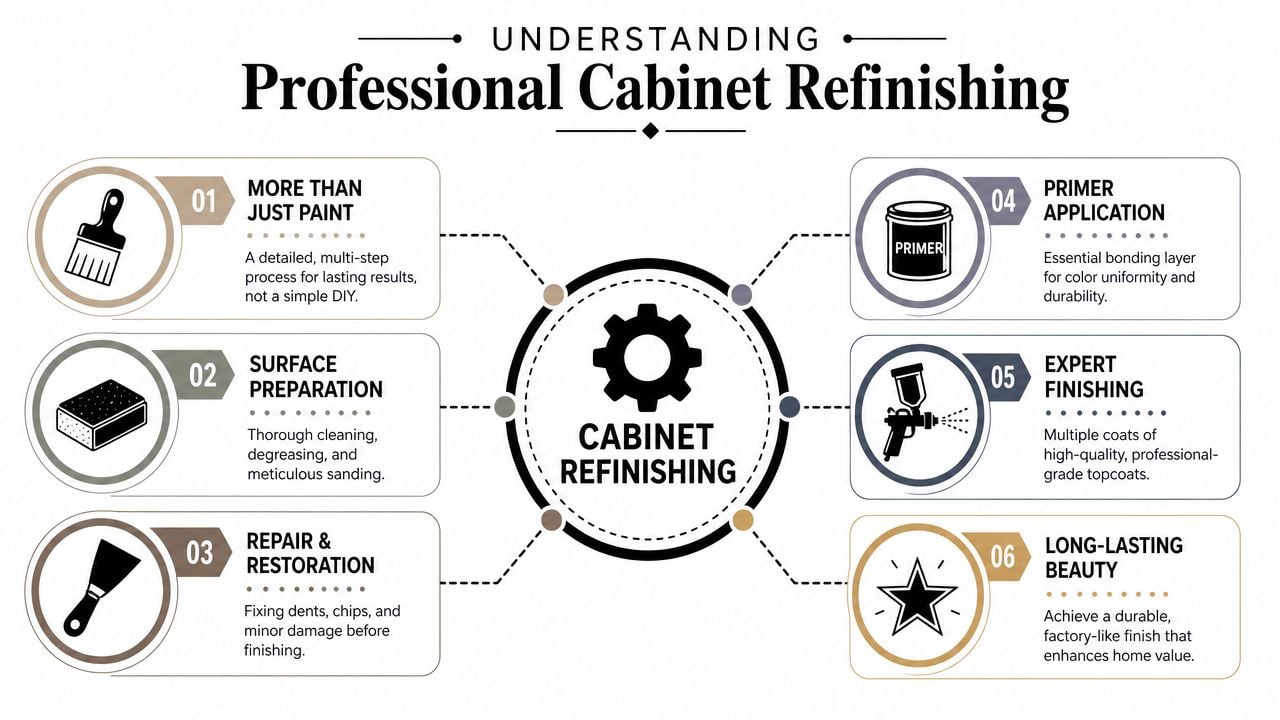
Professional cabinet refinishing is not rolling wall paint onto cabinet doors and hoping for the best. It's closer to giving your existing cabinets a new finished skin through a controlled, multi-step coating process.
That difference is where most homeowner confusion starts. People hear “painting cabinets” and picture a quick cosmetic job. In the trade, a durable result comes from prep, repairs, primer selection, spray application, and cure time. Miss any one of those, and the finish usually tells on you later.
What the service usually includes
A proper refinishing job usually starts with removing doors, drawer fronts, and hardware. After that, the surfaces are cleaned to strip off kitchen grease, hand oils, wax residue, and anything else that can interfere with adhesion.
Then comes the mechanical work:
- Cleaning and degreasing so coatings don't bond to cooking residue instead of the cabinet.
- Sanding or abrasion to create tooth for the primer and finish coats.
- Repairs for dents, chips, worn corners, and old hardware holes if layouts are changing.
- Priming with products chosen for the cabinet material and the old finish.
- Spray finishing for a smoother, more factory-like appearance on doors and drawer fronts.
- Reassembly and adjustment so the kitchen looks finished, not just painted.
If you want a good visual primer on finish choices and appearance differences, this resource on paint and stain cabinets is useful before you compare bids.
What it is not
It isn't a shortcut for damaged cabinetry. If cabinet boxes are swollen from leaks, joints are loose, or door styles are wrong for the look you want, refinishing won't fix those deeper problems.
It also isn't just about color. A professional refinisher has to manage sheen, adhesion, grain telegraphing, edge coverage, and how the finish will behave around handles, sink bases, trash pullouts, and other high-touch areas.
A cabinet finish can look great on day one and still be a bad job. Durability shows up months later at the edges, around knobs, and near the sink.
Why DIY and professional results look different
The biggest visual gap usually comes from application method and prep discipline. Homeowners often focus on the topcoat color. Professionals focus first on whether the surface is clean enough, dull enough, dry enough, and stable enough to accept that coating.
That's why a shop-finished door typically looks tighter and feels smoother than a brushed-on DIY panel. The finish is built in stages, not rushed into a weekend.
Refinish Reface or Replace Your Cabinets
A lot of South Jersey homeowners start in the same place. The kitchen feels tired, the finish looks dated, and online searches make every option sound like the right one. The key question is simpler. Are the cabinets structurally worth keeping, and how much change do you want?
Refinishing keeps your existing doors, drawer fronts, and boxes, then updates the finish.
Refacing keeps the cabinet boxes but replaces the visible fronts, usually with new doors, drawer fronts, and veneer on exposed ends.
Replacement removes the old cabinets and starts over with a new layout or new cabinetry throughout.
For cabinet refinishing near me in Camden County or Burlington County, this is usually the decision point. The wrong choice costs money. The right choice gives you the look you want without taking on a bigger project than your kitchen needs.
Cabinet update options compared
| Method | Typical Cost | Project Time | Disruption Level | Best For |
|---|---|---|---|---|
| Refinishing | Varies by kitchen size, condition, finish choice, and repairs | Often measured in days, depending on scope and workflow | Lower than full replacement when much of the work is handled off-site | Solid cabinets with a dated finish |
| Refacing | Mid-range between refinishing and full replacement | Moderate | Moderate | Homeowners who want new doors without replacing cabinet boxes |
| Replacement | Highest, with demolition, new cabinetry, and installation included | Longest | Highest | Kitchens with layout, storage, or structural cabinet problems |
When refinishing is the right call
Refinishing works best when the cabinet layout already serves the household and the cabinet parts are still sound. That describes a lot of homes in Cherry Hill, Voorhees, Marlton, and Mount Laurel, where the boxes are usable but the oak stain, old glaze, or worn paint makes the whole kitchen feel older than it is.
It is also the least disruptive option. If the doors and drawer fronts can be removed, finished off-site, and brought back ready to install, the kitchen stays far more functional than it would during a tear-out. That matters for busy households, especially when school, work, and family schedules do not leave much room for a long remodel.
The limit is design flexibility. Refinishing changes color, sheen, and overall appearance. It does not change door style, cabinet depth, or storage design.
When refacing earns the extra spend
Refacing makes sense when the cabinet boxes are worth keeping but the fronts are not. Maybe the door profile feels too busy for the cleaner look you want. Maybe several doors are warped, cracked, or have old hinge patterns that will still show after paint. In those cases, paying more for new fronts can make better sense than trying to revive parts that were never going to look right.
It also gives homeowners more style range. You can move from arched raised-panel doors to shaker or slab, update hinge styles, and get a more noticeable visual change without opening the full can of worms that comes with replacement.
Homeowners who are comparing those two bigger choices can use this guide on cabinet refacing vs replacement to sort out where each option fits.
When replacement is the honest answer
Some cabinets should be replaced. Water-swollen sink bases, failing particleboard sides, broken drawer systems, and boxes that are pulling away from the wall are not good candidates for finish work. Neither is a kitchen with a layout you already know you dislike.
I tell homeowners to be honest about whether they hate the color or hate the kitchen. Those are different problems.
Replacement is also the right move when the job includes changing appliance locations, adding an island, improving pantry storage, or correcting traffic flow. Finish work cannot solve those issues, no matter how good the paint looks.
The trade-off that matters in real homes
Refinishing usually gives the best return when the cabinets are solid and the goal is visual improvement. Refacing costs more, but it buys more style change. Replacement gives the most freedom, but it also brings demolition, longer scheduling, and more decisions.
For many South Jersey kitchens, the best answer is the one that fixes the problem without turning a manageable update into a full remodel. That is why an on-site consultation matters, especially when a mobile showroom can bring door samples, painted finishes, and hardware options right to the driveway. It is easier to choose confidently when you can compare material samples against your flooring, counters, and lighting in your own home.
The Cabinet Refinishing Process From Start to Finish
Homeowners usually worry about two things more than anything else. First, how long the project will take. Second, whether the kitchen will be unusable the whole time.
A professional workflow addresses both by splitting the work between what happens in the home and what happens off-site. That's where the project starts to feel manageable instead of overwhelming.
A simple visual helps show how that sequence works in real life.

The first visit and job setup
The process starts with evaluating the cabinet material, current finish, wear patterns, and any repairs needed before coating begins. During this initial assessment, a pro should notice things that affect the outcome later, like grease buildup around the range, swollen sink-base edges, old hinge shadows, or grain patterns that may show through certain paints.
Before any finishing work starts, doors and drawer fronts are usually labeled and removed. Hardware comes off. The remaining cabinet boxes in the kitchen are protected with masking materials so nearby counters, floors, appliances, and walls don't catch dust or overspray.
The prep work that determines whether the finish lasts
This is the part homeowners don't see much of, but it decides whether the finish holds up.
According to industry standards for cabinet refinishing, thorough degreasing, mechanical abrasion through sanding, and complete dust removal are foundational. Skipping those steps directly causes chipping, peeling, and flaking over time.
In practical terms, good prep means:
- Degreasing first so the finish bonds to the cabinet, not to cooking residue.
- Sanding or scuff abrasion to create adhesion.
- Vacuuming, blowing out, and wiping down dust so particles don't get trapped under the coating.
- Spot repairs before primer and topcoats lock every flaw in place.
Surface prep isn't where you save time. It's where you earn durability.
What gets done off-site
The biggest quality upgrade comes when doors and drawer fronts are sprayed off-site rather than coated in the middle of a busy kitchen. A controlled space usually gives better finish consistency, cleaner edges, and less in-home disruption.
Here's the project video if you want to see the workflow in motion.
While those parts are being finished, the cabinet boxes in the house can be prepped and coated in a more contained way. That reduces chaos and helps the kitchen remain at least partly usable.
What the homeowner experiences day to day
A professional job should feel organized, not invasive. The kitchen may be inconvenient for stretches of the project, but it shouldn't feel like a demolition zone if the work is planned correctly.
Typical homeowner experience includes:
- Access to essentials if the crew stages the work carefully
- Less mess indoors when doors and drawer fronts leave the house for finishing
- Shorter periods of full interruption around masking, spraying, and reinstallation
- A final adjustment phase when doors are rehung, hinges tuned, and hardware aligned
That's why the phrase “minimal disruption” only means something when the contractor can explain exactly how they stage the work.
Estimating Cabinet Refinishing Costs in South Jersey
A Cherry Hill homeowner gets two quotes for what sounds like the same cabinet refinishing job, and the gap is wide enough to make the lower number tempting. Then the questions start. Are both contractors removing doors and drawer fronts? Are repairs included? Is hardware reinstallation part of the price, or an add-on after the job starts?
That is usually what drives confusion around cabinet refinishing costs in Camden and Burlington County. The main issue is not just the final number. It is whether the estimate explains the work in a way you can compare.

What usually changes the price
Two kitchens can have the same footprint and still price differently because cabinet work is labor-driven. Small details add up fast, especially in older South Jersey homes where prior paint jobs, grease buildup, and worn edges are common.
The factors that usually move the quote are:
- Cabinet count and door style. More doors, drawer fronts, panels, and trim details mean more prep, spraying, and reassembly.
- Existing surface condition. Grease, peeling coatings, chips, swelling, and failed caulk lines all take correction before finishing starts.
- Material type. Solid wood, MDF, laminate, and previously painted parts each require a different prep and primer approach.
- Finish expectations. Dark colors and cleaner, furniture-like finishes call for tighter prep and better spray control.
- Hardware changes. New pulls, filled holes, hinge swaps, and alignment work can change the labor significantly.
Cost transparency matters because homeowners want to understand the scope, not just hear a number. That concern shows up clearly in this discussion about transparent, variable-based cabinet pricing, where people are trying to figure out why bids vary so much.
Using local pricing to set expectations
Refinishing and refacing are different services, but local refacing prices still help frame the decision because they compete for the same renovation budget. In South Jersey, that matters. Labor rates, travel, material handling, and homeowner expectations in towns like Haddonfield, Moorestown, Medford, and Mount Laurel are not the same as a generic national average.
As noted earlier, local refacing costs often land above national pricing. That does not mean a refinishing quote should match a refacing quote. It means low bids should be examined carefully, especially if they are missing repairs, hardware work, pickup and delivery of doors, or finish details that affect durability and appearance.
If you want a local benchmark for comparison, this guide to the cost of kitchen cabinets refacing gives homeowners a useful reference point for how cabinet upgrade pricing is usually structured.
A practical note from the field. South Jersey homeowners often make decisions faster when they can see color, sheen, and door samples in person. A mobile showroom helps with that. Instead of choosing from a tiny fan deck at the kitchen counter, you can compare samples under your home's lighting and make cleaner decisions before the estimate is finalized. That reduces change orders later.
How to compare estimates without getting misled
A good proposal should show where the labor is going. If it only gives a lump sum, you are left guessing whether the contractor included the parts that determine quality.
Ask whether the estimate breaks out:
- Door and drawer front finishing
- Cabinet box preparation and coating
- Repairs and surface correction
- Primer and topcoat system
- Hardware removal and reinstall
- Optional upgrades or change-order items
If you are balancing cabinet work against counters, flooring, or a larger rental renovation, tools that help accurately estimate property rehab can help you compare priorities across the full budget.
The best estimate is specific, calm, and easy to follow. If a contractor can explain why your kitchen costs what it costs, that usually tells you as much about their process as the number itself.
How to Choose a Pro in Camden or Burlington County
You call three cabinet companies, and all three say they can "paint your cabinets." The difference shows up in the details. One walks the kitchen, checks door condition, asks about worn corners and old hinge holes, and explains how the doors will be sprayed. Another gives a round number in ten minutes and leaves. In Camden and Burlington County, that gap usually predicts the final result.
Local homeowners in Cherry Hill, Haddonfield, Moorestown, Mount Laurel, Medford, and Voorhees tend to care about the same things. They want the kitchen protected, the schedule explained clearly, and the finish to look consistent with the rest of the home. A good cabinet refinisher should be able to explain all of that without dodging basic process questions.
Questions worth asking before you sign
Start by finding out whether cabinet refinishing is a core service or just something added to a general painting calendar. Cabinets demand tighter prep, better dust control, and more finish discipline than walls or trim.
Ask these questions:
- Where are doors and drawer fronts finished? Off-site spray finishing usually gives better control and keeps more mess out of the kitchen.
- How is prep handled? Look for a clear answer that includes cleaning, sanding or surface abrasion, minor repairs, and dust management.
- What primer and topcoat are being used? Specific product systems matter more than broad promises about "premium paint."
- How will the kitchen be protected during the job? Masking, floor protection, containment, and daily cleanup should already be part of the plan.
- How are hardware changes handled? New pulls, patched holes, concealed hinges, and alignment work can affect both labor and appearance.
- Are you insured, and can you show cabinet-specific work? Photos are helpful. Clear explanations are better.
Pricing matters, but clarity matters just as much. If a contractor cannot explain why one kitchen costs more than another, it usually means the estimate is not detailed enough yet.
Why the showroom experience matters
Material selection is where many projects drift off course. Homeowners pick a color from a tiny sample, then realize the sheen looks different at night, or the hardware finish fights with the faucet and lighting.

A mobile showroom solves that problem in a practical way. It brings door styles, finish samples, hardware, and related materials to the house so you can compare them against your flooring, wall color, counters, and natural light. That is especially useful in South Jersey homes where warm wood floors, mixed metals, and existing stone can shift how a paint color reads.
It also speeds up decision-making. Instead of visiting multiple stores and trying to remember what matched what, homeowners can narrow choices during the estimate and approve a direction with more confidence.
If you want a benchmark for what that kind of process should look like, review how a painting cabinets company explains its service. The best pros make the scope, options, and trade-offs easy to understand before any work starts.
Your South Jersey Kitchen Transformation Questions Answered
A cabinet project doesn't have to turn into a full remodel to make the kitchen feel new again. For many South Jersey homeowners, refinishing is the practical answer when the layout still works and the cabinets are structurally worth keeping. The value is in the combination of appearance, lower disruption, and a process that focuses effort where people see it.
One of the biggest myths is that refinishing means losing your kitchen for days with no workaround. In reality, with proper planning and off-site spray work, 70% to 80% of homeowners can maintain partial kitchen functionality throughout the project, according to this overview of kitchen cabinet refinishing timelines and disruption.
Common questions
How should you clean newly refinished cabinets
Use mild soap, a soft cloth, and avoid excess moisture or aggressive scrubbing. Gentle maintenance protects the finish far better than harsh degreasers.
Can laminate cabinets be refinished
Sometimes, but the material and existing surface condition matter a lot. Therefore, adhesion testing and product selection become important.
Should you change hardware during refinishing
Often, yes. New pulls or knobs can sharpen the finished look, but they also affect labor if holes need to be drilled or patched.
Is refinishing enough if the kitchen feels outdated
If the primary issue is color, sheen, or worn surfaces, often yes. If the room has storage problems or layout problems, refinishing alone won't solve that.
If you're ready to sort out whether refinishing, refacing, or a broader kitchen update makes the most sense, The Cabinet Coach offers a practical next step. Their South Jersey mobile showroom brings the design conversation to your home, and their complimentary video consultation makes it easy to start without pressure.