
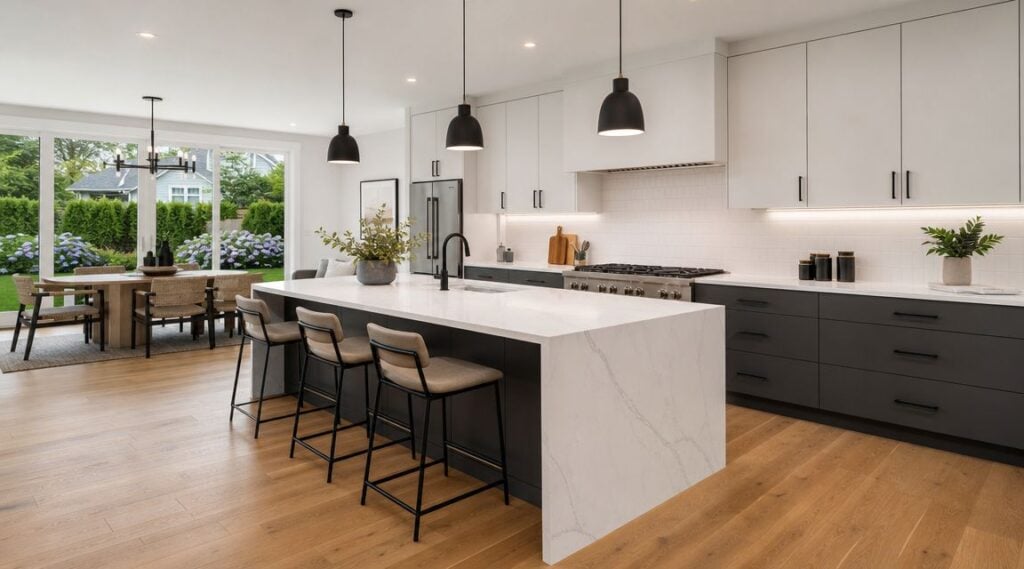
You're probably already doing what most South Jersey homeowners do at the start of a renovation. Saving photos, comparing cabinet colors, wondering whether an island will really fit, and trying to figure out how to make the kitchen feel current without making it cold. That tension is real, especially in homes around Cherry Hill, Haddonfield, and Moorestown where layouts, architecture, and daily routines vary so much from one block to the next.
Modern contemporary kitchen ideas work well here because they're flexible. They can feel crisp and architectural in a newer Moorestown build, softer and more layered in a Haddonfield home, or open and social in a Cherry Hill family renovation. They also line up with where the market is headed. In Statista's U.S. kitchen style survey, about 25% of respondents in 2025 said they changed or were planning to change to a transitional kitchen, which reinforces how strong blended contemporary looks remain.
The challenge isn't finding inspiration. It's choosing ideas that will still work on a busy Tuesday morning, during a holiday gathering, and years after the remodel is done. That's where guided design matters. If you're also thinking through finishes beyond cabinetry, this guide on durable kitchen wood flooring is worth reading alongside your layout plans.
Table of Contents
- 1. 1. The Open-Concept Hub Seamless Living and Entertaining
- 2. 2. The Minimalist Sanctuary Clean Lines and Hidden Storage
- 3. 3. The Industrial Modern Loft Mixed Materials, Raw Character
- 5. 5. The Warm Contemporary Natural Materials and Biophilic Design
- 6. 6. The Transitional Bridge Classic Comfort, Contemporary Edge
- 6. 6. The Transitional Bridge Classic Comfort, Contemporary Edge
- 7. 7. The Luxury Statement Bespoke Details and Premium Finishes
- 8. 8. The Sustainable Build Eco-Friendly and Energy-Efficient
- 8-Style Comparison: Modern Contemporary Kitchens
- Ready to Bring Your Vision to Life?
1. 1. The Open-Concept Hub Seamless Living and Entertaining
In many Cherry Hill renovations, the kitchen isn't just a cooking zone anymore. It's where homework happens, guests gather, coffee gets poured, and someone always ends up leaning on the island. That's why open-concept planning remains one of the most effective modern contemporary kitchen ideas for busy households.

A well-designed open kitchen can make an older South Jersey home feel larger without chasing a trendy look. In Moorestown new builds, this often means a generous island that connects kitchen, dining, and family room. In older homes, it may mean widening an opening and reworking cabinetry so the room feels visually lighter.
Why it works in South Jersey
The island does most of the heavy lifting. A recent Houzz-based statistic reported by Kitchen Design Concepts found that 42% of homeowners chose islands 7 feet or longer, which tracks with what works in family-centered spaces where prep, seating, storage, and serving need to happen in one zone.
The mistake is treating open concept like “remove walls and hope for the best.” The better approach is to create quiet structure through cabinet runs, lighting, flooring transitions, and circulation space. The Cabinet Coach often helps homeowners sort out this exact issue when refining kitchen island layout ideas before any materials are finalized.
What to get right
- Protect the sightlines: Use deep drawers, pull-outs, and integrated trash so daily clutter stays off the island.
- Manage odors early: Invest in strong ventilation if the kitchen opens directly to the family room.
- Keep walkways clear: Around an island, cramped spacing makes even a beautiful kitchen frustrating to use.
Practical rule: If an island blocks the dishwasher, oven, or refrigerator path during real cooking, it's too big for the room.
This layout works especially well in homes near Mount Laurel and Moorestown where entertaining is part of the brief. It works less well when homeowners oversize the island and undersize perimeter storage. Open concept should feel easier, not more performative.
2. 2. The Minimalist Sanctuary Clean Lines and Hidden Storage
Some homeowners want the kitchen to feel calm the moment they walk in. No visual noise. No heavy ornament. No countertop clutter fighting for attention. Minimalist contemporary design delivers that, but only when the storage plan is stronger than the styling.

This look fits well in Cherry Hill condos, Collingswood townhomes, and newer Haddonfield additions where a clean envelope makes the footprint feel more spacious. Flat-panel doors, integrated pulls, slab backsplash treatments, and restrained color are all part of the formula. But the visual success comes from what you don't see.
Minimal doesn't mean empty
A lot of sleek inspiration kitchens ignore a key question. Where do the toaster, mixer, coffee gear, charging cords, food storage containers, and recycling bins go? Practical guidance consistently points toward appliance garages, hidden outlets, pull-out shelves, deep drawers, and base-cabinet appliance lifts as the solutions in kitchens that need to stay clean-looking while still supporting real cooking, as noted in this piece on luxury modern kitchen storage ideas.
That's why minimal kitchens fail when homeowners reduce visible storage without adding concealed storage. A bare counter is only useful if the tools you need are one move away, not buried three cabinets deep.
Storage details that save the design
In projects like these, The Cabinet Coach can help homeowners think through the hard-working interior side of cabinetry, especially when planning how to organize deep kitchen cabinets.
A few details usually make the difference:
- Choose drawers over lower shelves: Drawers bring contents to you and reduce the need to kneel and dig.
- Use texture sparingly: Matte laminate, oak grain, or warm stone keeps the room from feeling sterile.
- Hide the charging mess: Add outlets inside a drawer or appliance garage where possible.
Minimalist kitchens look effortless only after someone solves the storage math.
For South Jersey professionals who want a clean, low-maintenance look, this style is strong. Just don't confuse minimal styling with minimal planning. They aren't the same thing.
3. 3. The Industrial Modern Loft Mixed Materials, Raw Character
Industrial modern works best when it feels edited, not theatrical. In a Camden conversion, a Riverside renovation, or a Haddonfield home with exposed brick from an older structural wall, the appeal is obvious. Brick, blackened metal, wood, concrete-look surfaces, and open shelving can give a kitchen real identity.
The problem is that many industrial kitchens lean too hard on roughness. They end up feeling dark, noisy, and less refined than the rest of the home. Good contemporary industrial design keeps the grit, then balances it with cleaner cabinetry and better light.
Where this style fits locally
This look can be compelling in homes with architectural bones already in place. A brick chimney wall in Haddonfield, visible beams in a Berlin Township remodel, or loft-like ceiling height in parts of Cherry Hill gives the style something honest to build on.
If those features don't exist, I'd use industrial touches selectively rather than trying to fake an entire loft vocabulary. Metal-framed glass doors, dark hardware, or a concrete-look island can do enough without making the room feel staged.
What keeps it from feeling harsh
- Warm the palette: Pair black metal with walnut, white oak, or a warm greige cabinet finish.
- Limit open shelves: A few shelves can show character. Too many put visual clutter on display.
- Seal porous materials: Concrete, brick, and raw wood need proper finishing near cooking and prep zones.
Raw materials look great in photos. In a working kitchen, they need protection, cleanability, and a reason to be there.
This style usually works best for homeowners who want personality and don't mind a little edge. It works less well for families who want every surface hidden and easy to wipe down. In that sense, industrial modern is a commitment. It can be beautiful, but it shouldn't fight the way you live.
5. 5. The Warm Contemporary Natural Materials and Biophilic Design
A lot of South Jersey homeowners want a kitchen that still feels current at 7 a.m. on a school day and warm enough for friends to gather around at 7 p.m. That is why this style keeps gaining traction in Cherry Hill, Haddonfield, and Moorestown. It keeps the clean profile of contemporary design, then softens it with wood grain, natural light, plants, and finishes that feel comfortable instead of stark.
Why warm contemporary is gaining ground
Houzz reports in its kitchen trends coverage that white remains the most common cabinet color, with wood tones and gray still holding a meaningful share of homeowner selections in renovated kitchens. That matters because it confirms what many designers are seeing on the ground. Homeowners have not abandoned light kitchens. They are asking for more texture and less visual chill. You can see that pattern in Houzz's kitchen cabinet color trend reporting.
In Moorestown and Medford, that often translates to white oak, maple, walnut accents, warm quartz, and muted paint colors instead of bright white lacquer and sharp black contrast. In Haddonfield, where older homes carry more architectural character, warm contemporary usually works best when the kitchen respects that context rather than trying to erase it.
The practical appeal is simple. Natural materials age better visually than trend-driven finishes, but they also ask for smarter specification. Light woods can yellow if the finish is wrong. Real stone needs maintenance. Too many indoor plants near a prep area can become clutter instead of a benefit.
What makes the look work
Biophilic design sounds academic, but in kitchen planning it usually comes down to a few grounded choices. Use real wood or convincing wood veneer where people touch the room most. Preserve daylight. Add natural texture in controlled amounts. Keep the palette quiet enough that the materials do the work.
For many South Jersey remodels, I prefer a restrained mix such as these:
- Wood-forward cabinetry: Rift-cut white oak, maple, or walnut accents bring warmth without making the room feel rustic.
- Soft stone visuals: Warm white or greige quartz gives you easier upkeep than marble while keeping the palette natural.
- Organic contrast: Handmade-look tile, woven stools, and matte finishes add depth without crowding the room.
- Targeted greenery: Herbs by a window, a single large plant, or a view to the yard usually works better than filling every shelf.
Homeowners considering a softer wood palette can see how that approach plays out in a modern kitchen with maple cabinets. The Cabinet Coach uses that kind of material planning to help clients balance warmth, durability, and the level of upkeep they are comfortable with.
Where South Jersey homes benefit most
This style is especially strong in homes where the kitchen opens to a family room, backyard, or breakfast area with good natural light. That is common in Cherry Hill additions and Moorestown renovations where homeowners want a more relaxed, high-function space without giving up a polished look.
It also helps older homes feel updated without turning them cold. In Haddonfield, for example, warm contemporary cabinetry can sit comfortably beside original millwork, traditional windows, or oak flooring. The room feels renewed, not disconnected from the rest of the house.
The main trade-off is discipline. Natural materials bring variation, which is part of the appeal, but too many competing wood tones, textures, and plant elements can make the kitchen feel busy. The best versions edit hard. They keep the lines contemporary, then let warmth come from fewer, better choices.
6. 6. The Transitional Bridge Classic Comfort, Contemporary Edge
A Cherry Hill family might want cleaner sightlines and better function, while a Haddonfield homeowner wants the kitchen to respect original trim, older windows, and the tone of the rest of the house. Transitional design works well in both cases because it gives you room to modernize without forcing the kitchen into a style that feels disconnected from the home.

Why transitional keeps showing up in real renovations
The National Kitchen and Bath Association's 2024 Kitchen Trends Report notes continued demand for kitchens that balance updated function with a more enduring look. That lines up with what gets selected across South Jersey. Homeowners in Moorestown, Haddonfield, and established parts of Cherry Hill often want a kitchen that feels current on day one and still makes sense ten years from now.
That usually means using contemporary discipline in the layout and material palette, then keeping a touch of classic structure in the cabinetry or trim details.
What makes the style work
The strongest transitional kitchens are edited carefully. A slim shaker door, restrained crown treatment, warm painted cabinetry, and quieter hardware often do more than ornate detailing or ultra-flat slab doors in houses with traditional bones.
I usually advise clients to pick one or two places for character and keep the rest calm. Good examples include a framed hood, a furniture-style island, or a backsplash with a little variation. If you want inspiration for a more polished finish, these luxury kitchen splashback ideas show how statement surfaces can stay refined when the rest of the kitchen is controlled.
Construction quality matters here too. Transitional kitchens invite closer inspection because they look simple at first glance. Well-made drawers, clean reveals, and durable joinery are part of why the room feels precise, which is why many homeowners compare cabinet construction details such as dovetail drawer joinery before finalizing a cabinet line.
Where South Jersey homes benefit most
This approach is especially effective in colonials, center hall homes, and older properties where a fully minimalist kitchen can feel abrupt. In Haddonfield, transitional cabinetry can sit comfortably beside original casings and hardwood floors. In Moorestown, it often helps larger renovations feel more settled and less trend-driven. In Cherry Hill, it is a practical answer for families who want better storage, easier circulation, and a resale-friendly look without making the room feel overly formal.
The trade-off is restraint. Add too many traditional details and the kitchen starts to feel dated. Push too far toward stark minimalism and the room can lose the warmth that made transitional the right choice in the first place. The Cabinet Coach helps clients make those calls cabinet by cabinet, finish by finish, so the final mix suits the house instead of fighting it.
6. 6. The Transitional Bridge Classic Comfort, Contemporary Edge
For many South Jersey homeowners, transitional is the safest smart choice. That doesn't mean bland. It means a kitchen can borrow the efficiency and restraint of contemporary design while keeping some of the familiarity that suits traditional neighborhoods and older architecture.
That matters because this style isn't niche. In the broader kitchen-style trend data cited in the verified research, contemporary kitchens were reported at over 25% of surveyed homes, second only to traditional at 32%, while transitional accounted for just over 15%. That balance helps explain why transitional kitchens remain such a strong fit in towns like Haddonfield, Cherry Hill, and Moorestown where homeowners want broad appeal without looking generic.
A strong fit for resale and older homes
Transitional kitchens are especially effective in homes with colonial, center hall, or historic character. A slim shaker or simple framed cabinet, quieter hardware, and a restrained palette can respect the house while still feeling updated. You don't have to install ultra-minimal slab cabinetry in a Haddonfield home for the kitchen to read current.
This is also where The Cabinet Coach's local approach helps. In South Jersey, the right answer often isn't “go more modern.” It's “decide where contemporary lines improve the room and where classic detailing should remain.”
How to keep it current
- Simplify the door style: Skip ornate moldings and heavy embellishment.
- Use mixed finishes carefully: Painted perimeter cabinets with a wood island often lands well.
- Modernize the function: Drawers, pull-outs, and integrated lighting matter more than decorative trim.
The mistake with transitional kitchens is drifting too traditional and calling it updated. If the room keeps bulky details, busy stone movement, ornate hardware, and dated light fixtures, it won't read contemporary at all. Transitional works best when the edit is disciplined.
7. 7. The Luxury Statement Bespoke Details and Premium Finishes
Luxury in a kitchen isn't about adding more materials. It's about adding the right ones, in the right places, with better detailing. In Haddonfield estates, Moorestown custom homes, and high-end Cherry Hill renovations, the kitchens that feel expensive usually have restraint, craftsmanship, and consistency.
The broader market supports that direction. A market study cited in the verified data values the kitchen cabinet market at USD 80.72 billion in 2023, rising to USD 143.96 billion by 2030 at a 7.5% CAGR, driven by renovation and customized cabinetry demand. That points to a buyer mindset focused on upgraded storage, finish quality, and customized cabinet systems rather than decorative excess.
Where luxury pays off
Cabinet construction, drawer quality, appliance integration, and stone fabrication are usually where money shows up in a lasting way. Full-height cabinetry, tighter reveals, better interior fittings, and cleaner panel alignment are what make a kitchen feel custom when you stand in it.
The Cabinet Coach can help homeowners evaluate quality details that are easy to miss in a showroom, including what dovetail drawers are. That sort of detail matters because luxury should improve durability and function, not just appearance.
The details that separate custom from expensive-looking
Good luxury kitchens feel calm. Bad luxury kitchens feel crowded with upgrades.
A few choices usually age well:
- Choose cabinetry first: Cabinet quality has more day-to-day impact than decorative add-ons.
- Use premium surfaces strategically: A full-height splash or waterfall edge can be enough when detailed well.
- Keep focal points clear: One exceptional hood treatment, stone slab, or appliance wall is stronger than five competing moments.
If you're refining the backsplash side of a higher-end design, these luxury kitchen splashback ideas can help you compare statement options with a more polished eye.
Luxury is worth pursuing when it improves the lived experience. If it only adds maintenance, fingerprints, and fragile finishes, it isn't luxury. It's stress.
8. 8. The Sustainable Build Eco-Friendly and Energy-Efficient
Sustainable kitchens are at their best when they don't look like a special category. They just look well designed, well built, and easier to live with over time. In South Jersey, that usually means durable cabinetry, longer-lasting finishes, low-toxicity materials, efficient lighting, and appliances chosen for performance rather than trend appeal.
This approach also connects to a practical question many homeowners ask late in the process, when they should ask it early. How do you keep a modern kitchen sleek without sacrificing light, ventilation, and maintenance? Guidance on concealed kitchens and panel-ready appliances has highlighted that hidden cooking zones still need carefully planned ventilation and task lighting, especially when clean sightlines are the priority, as discussed in this article on invisible kitchen designs for modern living.
Sustainability that feels practical
A sustainable kitchen in Moorestown or Medford doesn't have to announce reclaimed everything. Often, the most responsible choices are quieter. Cabinet boxes that hold up for years, finishes that don't off-gas heavily, LED lighting planned correctly from day one, and layouts that avoid wasteful rework later.
This style also overlaps naturally with contemporary design because contemporary kitchens already favor cleaner lines, fewer but better materials, and stronger storage planning.
What to prioritize first
- Start with longevity: Durable products reduce replacement cycles.
- Improve lighting efficiency: Good LED planning can improve both energy use and usability.
- Don't ignore ventilation: Concealed or minimal kitchens still need effective airflow.
For homeowners weighing performance decisions beyond the kitchen itself, it also helps to learn energy efficiency best practices so the renovation supports the house as a whole.
A sustainable build should feel like common sense. Better air, better light, durable finishes, less waste, and fewer regrettable choices. That's the version that lasts.
8-Style Comparison: Modern Contemporary Kitchens
South Jersey homeowners usually narrow the field faster once they compare style against daily use, renovation complexity, and the kind of house they live in. A minimalist kitchen that looks right in a newer Cherry Hill build may need different cabinet planning in a Haddonfield colonial or a Moorestown home with more traditional architecture. That is where The Cabinet Coach adds value. The work is not just choosing a look. It is matching that look to layout limits, storage needs, finish durability, and installation realities.
| Style | 🔄 Implementation Complexity | ⚡ Resources & Cost | ⭐ Expected Outcomes | 📊 Ideal Use Cases | 💡 Key Tips |
|---|---|---|---|---|---|
| 1. The Open-Concept Hub | Medium to High, often includes structural review and circulation planning | $$ to $$$, island, integrated appliances, possible structural work | ⭐⭐⭐⭐, brighter shared space, better social connection, strong resale appeal | Families, frequent hosts, smaller homes that need one connected gathering space | Define zones clearly, keep circulation generous, prioritize ventilation and storage from the start |
| 2. The Minimalist Sanctuary | High, requires cabinet precision and flush-fit appliance planning | $$ to $$$, custom handle-less cabinetry and integrated appliances | ⭐⭐⭐⭐, calm visual order, easier upkeep, long-term style appeal | Busy professionals, condos, owners who want disciplined storage and a quieter look | Use dependable hardware, layer concealed lighting, and add texture so the room does not feel flat |
| 3. The Industrial Modern Loft | Medium, depends on material balance and selective exposure of structural elements | $ to $$, reclaimed materials may lower costs, custom metalwork can raise them | ⭐⭐⭐, strong personality, selective resale appeal depending on the buyer | Loft conversions, older homes with character, homeowners drawn to raw finishes | Warm up metal and concrete with wood tones, seal porous surfaces, and keep open shelving limited |
| 4. The Smart Kitchen | High, requires electrical planning, system coordination, and careful specification | $$ to $$$, smart appliances, infrastructure upgrades, installation costs | ⭐⭐⭐⭐, convenience, energy management, strong appeal for the right buyer | Tech-oriented households, accessibility-focused renovations, new builds or premium remodels | Choose one compatible system early, install reliable high-speed Wi-Fi, keep manual controls, and plan for future service or updates |
| 5. The Warm Contemporary | Medium, success depends on finish restraint and good material pairing | $$ to $$$, quality wood and stone increase cost | ⭐⭐⭐⭐, inviting modern character with broad long-term appeal | Homeowners who want comfort without giving up a current look | Use natural materials with discipline, keep lighting warm, and let one focal finish carry the room |
| 6. The Transitional Bridge | Low to Medium, easier to execute if proportions and details stay consistent | $ to $$, often cost-effective and resale-friendly | ⭐⭐⭐⭐, familiar comfort with a cleaner edge, dependable market appeal | Mixed-style homes, resale-minded projects, owners who want flexibility | Keep the contrast balanced, avoid over-decorating, and give the space one clear visual anchor |
| 7. The Luxury Statement | Very High, bespoke detailing requires longer lead times and specialized trades | $$$, premium materials, pro-grade appliances, custom fabrication | ⭐⭐⭐⭐⭐, standout craftsmanship, strong daily performance, lasting prestige | Estate homes, showpiece kitchens, clients focused on custom detailing | Allow schedule and budget contingency, visit samples in person, and choose materials that will still look right in ten years |
| 8. The Sustainable Build | Medium to High, depends on sourcing, detailing, and proper installation | $$ to $$$, better materials may cost more upfront but reduce replacement cycles | ⭐⭐⭐⭐, healthier indoor environment, lower waste, lower operating costs over time | Eco-conscious homeowners, long-term investors, households renovating with durability in mind | Prioritize efficient appliances, verify material certifications, and choose products that hold up instead of chasing novelty |
The comparison matters because the best choice is rarely the most photogenic one. In South Jersey, the right kitchen style depends on how your house is built, how your family uses the space, and how much disruption you are willing to take on during construction.
A Cherry Hill homeowner may benefit from an open-concept or smart kitchen plan if the goal is better flow and easier entertaining. A Haddonfield project often calls for more restraint. Transitional or warm contemporary usually respects the character of the home while still improving storage and function. In Moorestown, luxury statement kitchens and refined minimalist designs can work well, but only when the finish palette, appliance choices, and cabinet proportions are handled with discipline.
That is the practical side of style selection, and it is where The Cabinet Coach helps homeowners make better decisions. Cabinet design, storage configuration, finish coordination, and installation planning all affect whether a kitchen feels resolved once it is built. The style sets the direction. The details determine whether it works.
Ready to Bring Your Vision to Life?
Choosing among modern contemporary kitchen ideas gets easier once you stop designing for the photo and start designing for the way your household lives. That's the turning point for most successful renovations in South Jersey. The style matters, but the ultimate result comes from how well the layout, storage, lighting, finishes, and construction details work together.
An open-concept kitchen can transform the rhythm of a Cherry Hill home, but only if circulation and ventilation are handled properly. A minimalist kitchen can feel calm and elegant, but only if hidden storage is planned with real discipline. Warm contemporary spaces can feel inviting for years, especially in Moorestown and Haddonfield homes, when the wood tones, stone selection, and lighting are balanced carefully instead of layered at random.
The same principle applies at every budget level. Transitional kitchens need editing. Luxury kitchens need restraint. Sustainable kitchens need durable, realistic specifications, not just good intentions. What works on a mood board doesn't always work in a South Jersey home with older framing, active family life, and a renovation budget that has to be spent wisely.
That's why guided product selection matters so much. Cabinet style, drawer construction, island proportions, appliance integration, and finish coordination all affect whether the kitchen feels cohesive when it's done. Homeowners often start with one idea, then realize they want a blend. A little less stark than minimal. A little warmer than industrial. A little cleaner than traditional. That's normal, and it's usually where the best kitchens land.
The Cabinet Coach is one option for homeowners who want that process to feel more manageable. As a mobile cabinet showroom serving South Jersey, the company works directly with homeowners on cabinetry, countertops, hardware, tile, and layout decisions in a more personalized setting. That can be especially helpful when you're trying to compare modern contemporary directions in the actual context of your home, not under generic showroom lighting.
If you're still narrowing the vision, that's fine. You don't need every answer before starting. You need a clear direction, honest guidance on trade-offs, and a design process that helps you make confident decisions without second-guessing every finish.
If you're planning a kitchen renovation in Cherry Hill, Haddonfield, Moorestown, or nearby South Jersey communities, The Cabinet Coach offers a mobile showroom experience that brings cabinetry and design guidance directly to your home. Schedule a complimentary video consultation to start shaping a modern contemporary kitchen that fits your space, priorities, and daily life.