
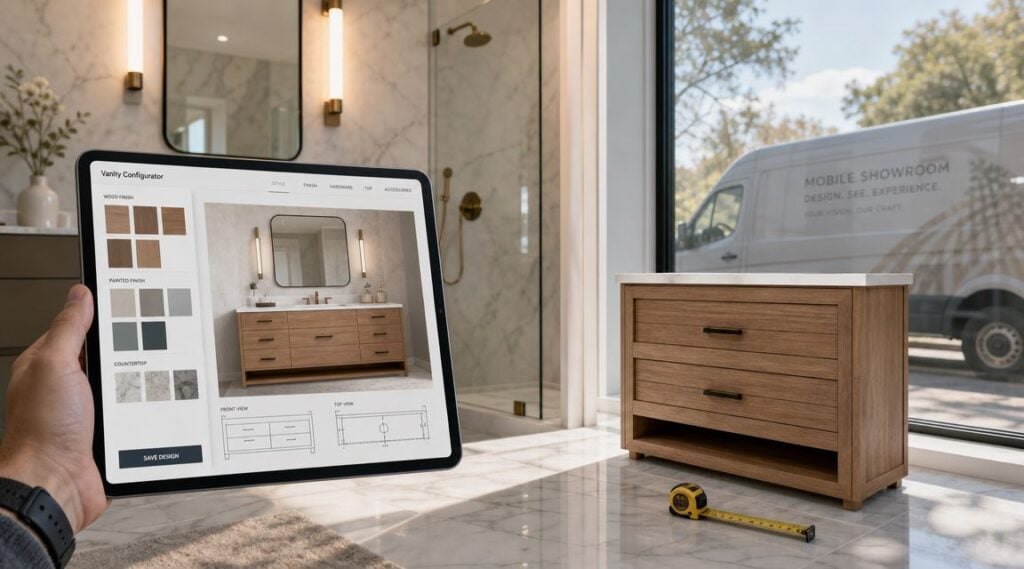
You're probably there right now. One browser tab has a white oak vanity with a quartz top. Another has a sleek floating style that looks perfect until you realize you have no idea whether your plumbing, mirror height, or bathroom door will cooperate. Then Pinterest gives you ten more ideas, and suddenly a simple upgrade feels like a puzzle.
That's why bathroom vanity design online has become such a useful starting point for homeowners. You can compare styles, widths, sink options, and storage layouts from your couch. You can save ideas fast, narrow the look you want, and begin shaping a remodel before anyone swings a hammer. The challenge is that a bathroom isn't a mood board. It's a real room with tight clearances, existing plumbing, lighting conditions, and daily habits that matter.
For South Jersey homeowners, the smartest path usually isn't fully online or fully old-school showroom shopping. It's a mix of both. You use digital tools to explore, then you ground those choices in real measurements, real materials, and local guidance that fits your house.
Table of Contents
- Your Journey into Bathroom Vanity Design Online
- Understanding Your Online Vanity Design Options
- How to Prepare for a Successful Online Design
- The Pros and Cons of a Purely Online Approach
- The Hybrid Model The Best of Both Worlds
- From Online Dream to a Stunning New Bathroom
- Frequently Asked Questions About Online Vanity Design
Your Journey into Bathroom Vanity Design Online
A lot of homeowners start the same way. They're brushing their teeth in a bathroom that works fine, but it feels dated, cramped, or just off. Then one evening they start scrolling. Maybe they save a few photos, compare drawer fronts, and wonder whether a single sink with better storage might beat a larger double vanity that eats up floor space.
That online browsing isn't a side trend. It's tied to a very large remodeling category. One market report estimates the global bathroom vanities market at USD 39,515.2 million in 2024, with North America accounting for over 40% of revenue, driven largely by home renovation and improvement projects, according to this bathroom vanities market report. In plain terms, homeowners are spending real money in this category, and the vanity is often one of the first items they research online because it affects style, storage, sink setup, and room layout all at once.
The vanity usually becomes the visual anchor of the whole bathroom. Change that one piece, and the room can feel brighter, calmer, more custom, or more practical. That's why it helps to look at examples before making any hard decisions. If you need a place to warm up your eye, these bathroom cabinet ideas from Pinterest can help you sort out what you like versus what just looks nice in someone else's house.
Practical rule: Save images in small groups. One folder for colors, one for vanity styles, one for storage ideas. That keeps inspiration from turning into clutter.
Online design works well when you treat it like the first part of the job, not the whole job. The screen helps you dream. The room still gets the final vote.
Understanding Your Online Vanity Design Options
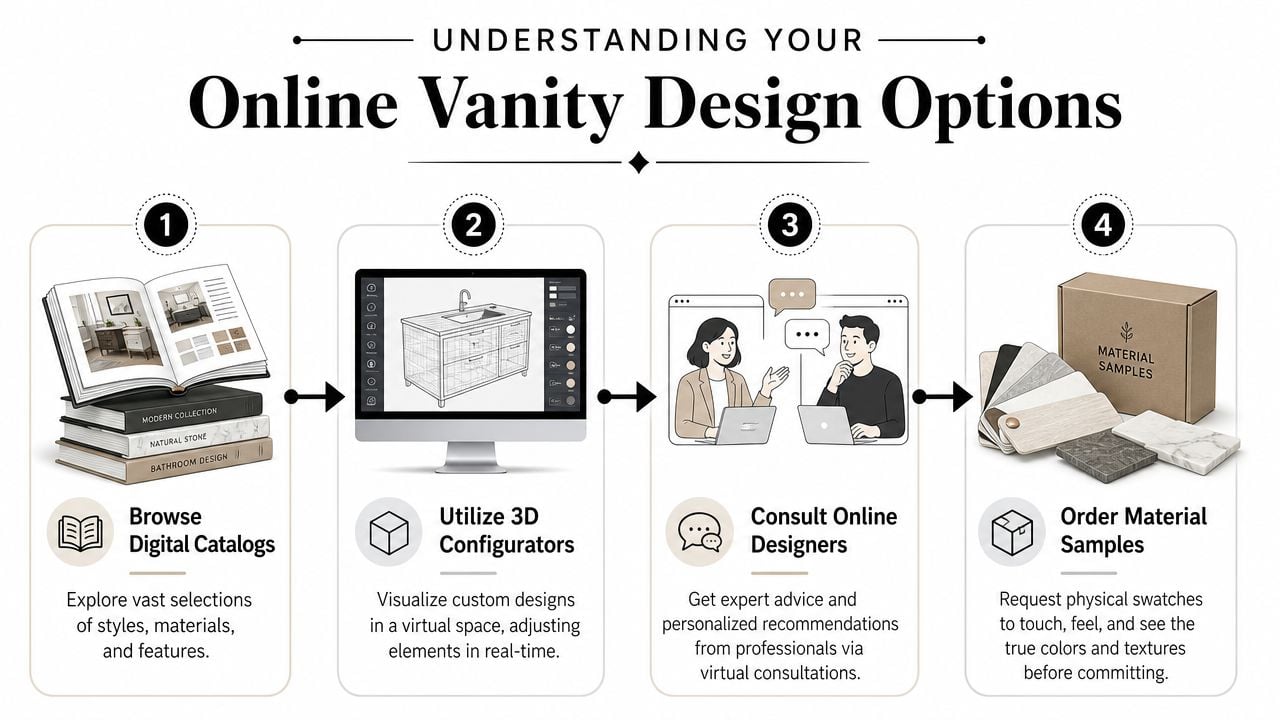
Some homeowners think online vanity design means one thing. It doesn't. You've got a few different tools available, and each one solves a different part of the problem.
Start with inspiration, not commitment
Pinterest, Houzz, Instagram, and brand galleries are useful for one reason. They help you notice patterns in your own taste. You may think you want modern, then realize you keep saving warm wood, framed mirrors, and furniture-style legs. Or you may assume double sinks are a must, then notice every favorite photo has one generous sink and more counter space.
This stage should stay loose. Don't worry yet about exact specs. Focus on questions like these:
- What mood feels right: Calm spa-like, classic, modern, coastal, or something more transitional.
- What storage style fits your routine: Deep drawers for hair tools, open shelving, or mostly hidden storage.
- What visual weight works: A floating vanity feels lighter. A furniture-style vanity feels more rooted.
Use configurators for size and layout
Once you have a style direction, retailer configurators and product filters become more useful. Bathroom vanity design online then starts getting practical. You can filter by width, sink count, finish, mounting type, and countertop option.
A cabinetry guide notes that bathroom vanity cabinets commonly range from 18 to 96 inches wide, with small vanities at 18 to 30 inches, medium at 36 to 48 inches, and large at 54 to 96 inches. The same source notes a standard depth of 21 inches, with 18-inch-depth options common in compact spaces, according to this guide to bathroom vanity cabinets. That's why filters matter. They quickly eliminate pieces that may look great but won't fit your room.
If you're planning a shared bath or primary suite, it also helps to review what a double vanity size standard typically looks like before you fall in love with a layout that needs more wall space than you have.
Bring in a real person when choices start colliding
This is the point where many homeowners get stuck. The vanity itself seems clear, but the surrounding decisions start bumping into each other. Will the faucet reach correctly into the sink bowl? Will the mirror width feel undersized? Will side sconces land in awkward spots because the vanity height changed?
Virtual consultations can help at this stage because they add judgment, not just options. A good designer can look at your inspiration, your room photos, and your measurements, then tell you whether your plan is cohesive or just attractive in pieces.
Online tools are good at showing products. They're not always good at showing consequences.
That's the difference. A configurator can help you build a vanity. A human can help you build a bathroom.
How to Prepare for a Successful Online Design
Saturday night, you find a vanity online that looks perfect. By Sunday morning, you notice the drawers might hit the door trim, the mirror could land under the window casing, and you still are not sure whether the plumbing lines up. That kind of second-guessing is common, especially when the screen shows a beautiful product but not the whole room.
A good online design process starts the same way a careful South Jersey remodeler starts on site. Get the room facts first, then narrow the choices. That is what turns online browsing from guessing into planning.
Measure the room before you shop the style
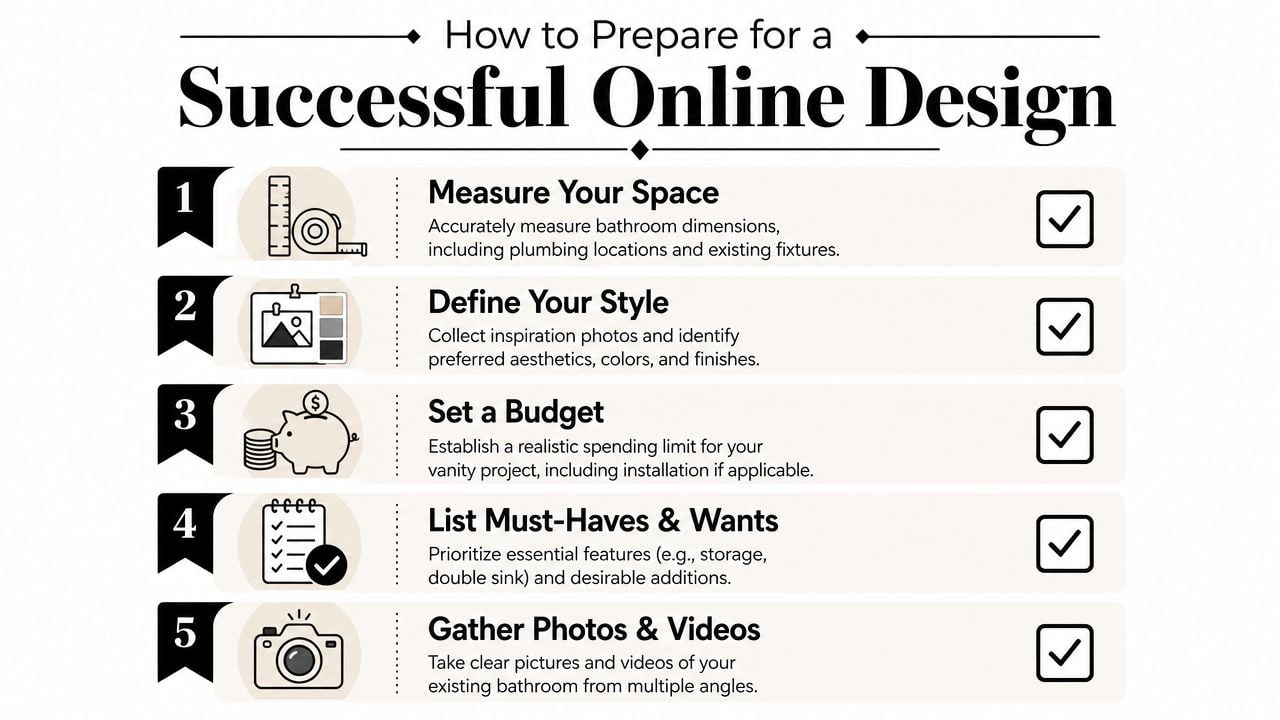
Start with the full width of the vanity wall. Then measure the distance to anything that can affect fit or comfort, such as side walls, trim, the toilet, the tub edge, and the shower opening. Note where the plumbing comes through the wall or floor, too.
This part works like laying out a parking space before buying the car. A vanity can be beautiful and still be wrong for the room.
Basic clearance rules help keep the bathroom comfortable to use every day. The NKBA bathroom planning guidelines overview from CRD Design Build explains common spacing recommendations around toilets, vanities, and front clearances. Those numbers matter because a vanity is not a stand-alone piece of furniture. It has to work with the rest of the bathroom while people are opening doors, brushing teeth, and moving around in a hurry.
A simple hand sketch is enough. Label every measurement. Mark door swing. If a mirror or faucet may sit near a window, include the window stool height.
Know your sizing before the options get noisy
Online catalogs can make every vanity look like it belongs in your house. The actual fit is narrower.
You do not need to memorize every possible dimension. You just need a practical range so you can rule out bad fits early. The Vanity Buying Guide from Build with Ferguson gives a helpful overview of common widths, depths, sink setups, and style categories.
Here is a simple way to stay oriented:
| Vanity type | Common sizing guidance |
|---|---|
| Single vanity | Often 24 to 48 inches wide |
| Double vanity | Usually 60 to 84 inches wide |
| Standard depth | Commonly 21 to 24 inches |
| Powder room depth | Often 12 to 16 inches |
| Larger bath depth | 24+ inches can work in roomy layouts |
Height deserves the same attention. A taller vanity can feel more comfortable for adults, but the finished height depends on more than the cabinet itself. Countertop thickness changes it. Sink style changes it. Vessel sinks, especially, can push the usable height up fast. The bathroom vanity dimensions reference is useful for comparing typical proportions before you commit.
Check the finished height, not just the cabinet box. That one detail changes how the vanity feels every day.
Build a project file before your first consult
Online design gets much easier when your information is organized. A designer cannot give clear guidance from one blurry photo and a rough guess at width. Good input leads to good advice.
Take photos like a remodeler would. Get one shot from the doorway, one straight-on shot of the vanity wall, and one from each corner. Then add close-ups of plumbing, outlets, baseboard trim, windows, and any crooked walls or floor transitions.
A short phone video helps even more. Walk through the room slowly and explain what is bothering you. Say what is not working now. Maybe the drawer blocks the doorway. Maybe two people share the sink area every morning. Maybe you need better storage for chargers, hair tools, or kids' bath supplies. Those real-life notes are often more helpful than a folder full of inspiration images.
Before any online consultation, gather these items:
- Room sketch: Wall lengths, fixture locations, and door swing
- Photo set: Wide shots and close-up details
- Must-haves: Storage, sink count, easier cleaning, more counter space, or better lighting alignment
- Wish-list items: Floating style, warm wood tone, tower storage, furniture legs, or built-in outlets
- Inspiration images: A small set that shows a consistent direction
If your project still feels scattered, this article on how to get started before hiring a contractor can help you organize the early decisions before they start affecting price and layout.
Plan for access and comfort now, not after ordering
Accessibility is another area where online-only planning can miss the mark. If you are remodeling for aging in place, a family member with mobility needs, or long-term comfort, vanity height and open knee space need attention early.
The ADA guide for bathrooms from ADA National Network outlines key accessibility principles for lavatories and clear floor space. Those requirements can affect cabinet style, sink placement, plumbing protection, and storage choices right away.
That is one reason the hybrid approach works so well for South Jersey homeowners. You can do the fun online research at your own pace, then bring in local, hands-on judgment before you buy something that only works on a screen.
Good preparation does not make the project rigid. It makes the online part more accurate, and the in-person decisions more confident.
The Pros and Cons of a Purely Online Approach
A purely online vanity project often starts the same way. You find a style you love, save three favorites, compare sizes, and feel like you are close. Then the practical questions show up. Will the drawers clear the door trim? Will the finish look too yellow under your bathroom lights? Will the sink and faucet work well together once everything arrives?
Where online shopping helps
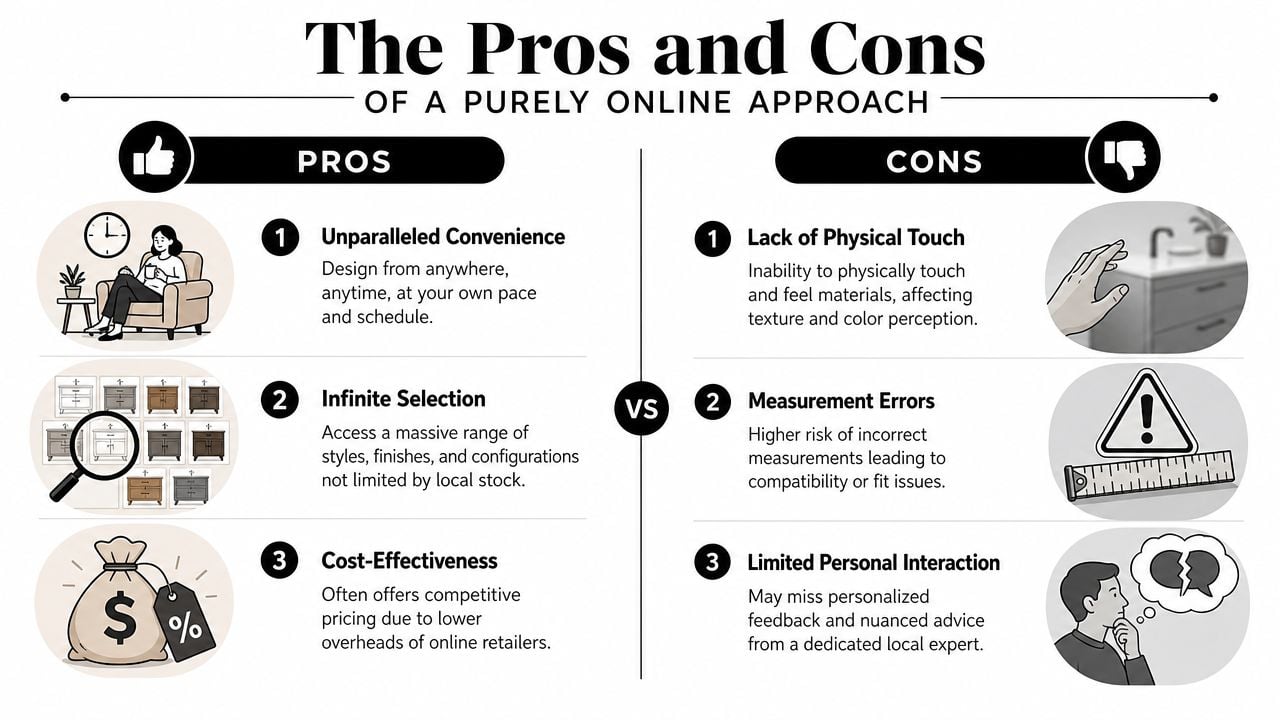
Online design works well for the early part of the process. It gives you time to compare styles, widths, sink layouts, storage options, and finishes without spending a Saturday driving from showroom to showroom. For busy households in Cherry Hill, Voorhees, or Haddonfield, that alone can make the project feel manageable.
You also get a wider field of options. A local display can only show so much at once. Online, you can line up floating vanities, furniture-style pieces, narrow-depth models for tight powder rooms, and double-sink layouts in a few minutes. That makes online research a good sorting tool.
It also helps careful shoppers narrow the field fast. Filters for width, mounting type, finish, and sink count can save a lot of time before you ever step into a showroom or schedule a visit.
Where online-only planning gets risky
The problem is not the browsing. The problem is treating the screen like the room.
A website can show dimensions, but it cannot show how a vanity feels once you are standing in front of it. A 60-inch cabinet may fit on paper and still make the bathroom awkward to use. A finish that looks crisp online may turn muddy beside your floor tile. Hardware that seems subtle in a product photo can read heavy in a small space.
Bathrooms work like a chain. One choice pulls on the next. The vanity affects faucet reach, mirror height, lighting placement, outlet locations, drawer clearance, and how easily two people can use the room at the same time.
Purely online planning tends to miss problems like these:
- Finish uncertainty: Paint, stain, countertop pattern, and sheen often look different in your home's lighting.
- Fit problems: A vanity can fit wall to wall and still create crowding at the toilet, door, or walkway.
- Coordination gaps: Sink depth, faucet height, mirror width, and sconces need to work as a set, not as separate purchases.
- Older-home surprises: Out-of-level floors, proud baseboards, off-center plumbing, and walls that are not quite square rarely show up in an online cart.
That is why many South Jersey homeowners do best with a middle path. Online tools are great for narrowing choices, but real confidence usually comes from seeing samples and checking the room in person. A local, mobile review can close that gap, which is part of why a mobile cabinet showroom model works so well for South Jersey remodeling decisions.
If your bathroom is simple and standard, online-only may get you most of the way there. If the room is older, tight, or tied to custom details, online planning usually needs a real-world check before you order.
The Hybrid Model The Best of Both Worlds
A lot of South Jersey homeowners reach the same point in this process. The online part has gone well enough. You have a few vanity styles saved, maybe two finish options, and a rough idea of size. Then the questions get more real. Will the drawers clear the door trim? Will the white cabinet look clean in your bathroom light or too cold? Will the sink and top feel comfortable every morning, not just look good on a screen?
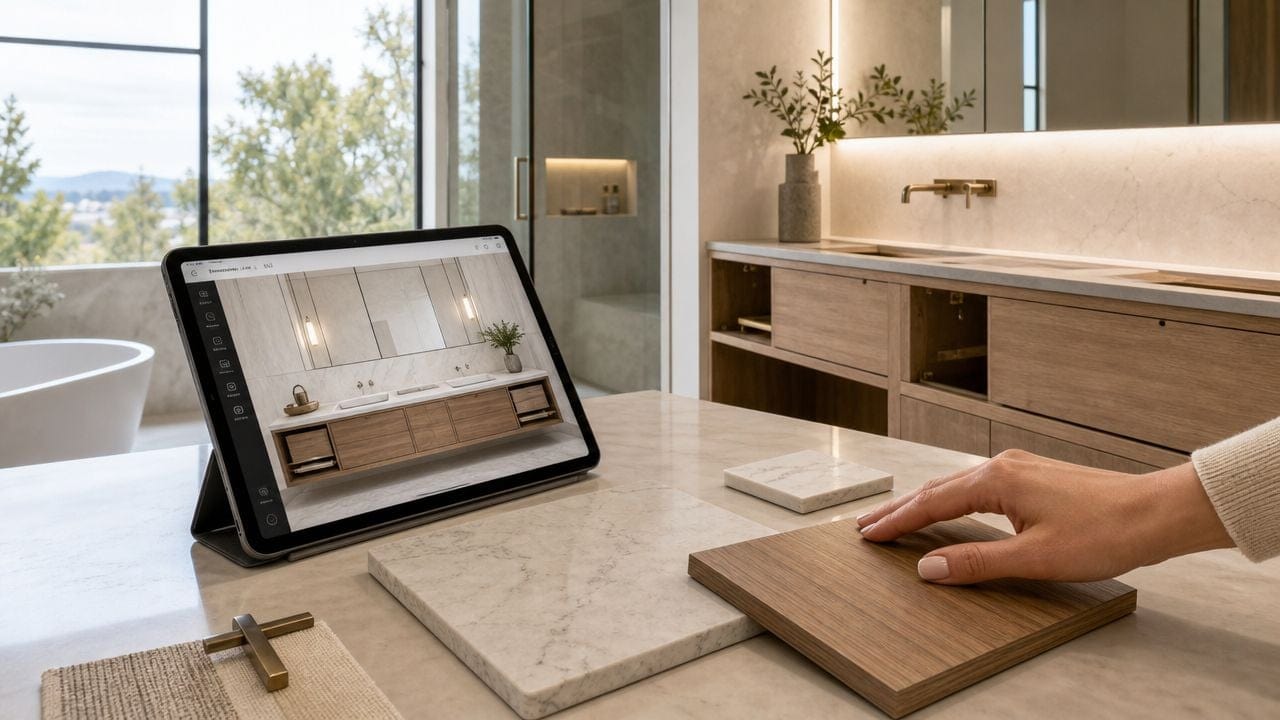
That is where a hybrid process earns its keep. Online tools are excellent for collecting ideas and narrowing choices. Local, in-person review helps you confirm that those choices fit the room, the light, and the way your household uses the space.
Why the hybrid process works better in real homes
Bathroom design works a lot like buying paint. A color chip gets you close. The sample on your wall tells the truth. Vanity planning follows the same pattern.
Online planning helps you compare widths, door styles, sink layouts, and price ranges quickly. In-home review adds the part a screen cannot give you. You can hold finishes next to your tile, check how a top looks under your actual lights, and confirm that the vanity feels right in the room instead of just fitting on paper.
It also helps with practical use over time. Comfort height, reach, drawer access, and aging-in-place concerns are easier to judge while standing in the bathroom itself. Accessibility guidelines can affect cabinet height, knee space, sink selection, and plumbing layout, and those details are easier to work through in person than inside a style configurator. If you want a broader planning framework around those choices, this guide on how to plan a bathroom remodel is a helpful companion.
What that looks like for a South Jersey homeowner
In practice, the process often starts straightforwardly. You share inspiration photos, a few rough measurements, and the problems you want the new vanity to solve. Maybe you need better storage for two people, a top that is easier to wipe down, or a layout that makes a tight hall bath feel less cramped.
From there, an online discussion can narrow the field fast. You can sort out whether a floating vanity makes sense, whether one sink or two is realistic, and which finish family fits the rest of the home. Then the local review steps in to verify the plan, look at samples in the room, and catch the small details that cause big frustration later.
For South Jersey homes, that middle path often brings the most confidence. Older houses especially tend to have enough quirks that a room should be checked before anything is ordered.
One local example is The Cabinet Coach, which uses a mobile showroom approach for kitchen and bathroom projects. Homeowners who want that mix of digital planning and real-world verification can explore local bathroom renovation contractors near you and look for a team that can connect online selections to actual installation conditions.
A key advantage is peace of mind. You still get the convenience of browsing online at your own pace. You also get the reassurance that someone has tested those choices against your existing bathroom, not the perfect room in a product photo.
From Online Dream to a Stunning New Bathroom
Bathroom vanity design online works best when you treat it as a tool, not a shortcut. It's excellent for gathering ideas, comparing styles, and narrowing the field. It gets much more useful when those digital choices are checked against room dimensions, traffic flow, lighting, plumbing, and day-to-day habits.
That's why the smartest remodel path usually blends online convenience with local expertise. You don't have to choose between speed and confidence. You can explore widely, then verify carefully.
If you're still organizing your thoughts, this guide on how to plan a bathroom remodel is a practical companion because it helps frame the larger renovation decisions around layout, priorities, and project timing.
For South Jersey homeowners who want help turning digital inspiration into a workable plan, it's worth looking at local bathroom renovation contractors near you who can connect design decisions to real installation conditions. That step often saves more stress than people expect.
The exciting part is this. You don't need every answer before you begin. You just need a better process.
Frequently Asked Questions About Online Vanity Design
A few questions come up in almost every conversation about bathroom vanity design online. Here are the practical answers homeowners usually need most.
| Question | Answer |
|---|---|
| What if my measurements are a little off? | Small measurement mistakes can create big install problems, especially in tight bathrooms. That's why it's smart to treat your first round of measurements as planning numbers, then verify everything before ordering. |
| Can I design online if I already bought a mirror or faucet? | Yes, but those items need to be part of the design conversation early. The vanity, sink, faucet reach, mirror width, and lighting all affect each other. |
| Is a double vanity always better for resale or daily use? | Not always. In many bathrooms, one larger sink with more counter space and better storage works better than squeezing in two bowls. The room layout should decide. |
| Do online vanity photos show true color? | Not reliably. Screen settings, room lighting, and photography all shift color. Samples and in-room review help prevent finish regret. |
| How do I know what vanity height to choose? | Start with who uses the bathroom most. Adult bathrooms often lean toward comfort-height setups, while accessibility or sink style may change the right finished height. |
| Can online planning help with older South Jersey homes? | Yes, especially for early idea gathering. Older homes often have quirks, though, so field verification becomes more important before purchase. |
| What should I have ready for a first consultation? | A rough sketch with dimensions, clear photos, a short list of must-haves, and a few inspiration images are usually enough to begin productively. |
One last point is worth keeping in mind.
Good online planning should reduce uncertainty, not hide it. If a question feels unresolved, that's a sign to slow down and verify before ordering.
A bathroom vanity is one of those purchases that looks simple from the sofa and becomes technical fast. The more your process combines visual inspiration with real-world checking, the better your result usually feels once the bathroom is in daily use.
If you're in South Jersey and want a calmer way to sort through vanity choices, layouts, and materials, The Cabinet Coach offers a straightforward place to start. A complimentary video consultation can help you turn online ideas into a plan that fits your bathroom, your style, and your day-to-day life.