

Beyond the Clutter: Reclaim Your Bathroom Sanctuary
It's a busy morning. You open the medicine cabinet, reach for a bandage or cold medicine, and a jumble of bottles shifts forward. Half-used tubes block what you need. Expired products linger in the back, and the cabinet that should make life easier ends up slowing you down.
That scene is common because most medicine cabinets weren't designed for how families live. A shallow mirrored box above the sink has to hold first aid, prescriptions, vitamins, dental care, skincare, and travel items, often all at once. Older cabinets make it worse because they don't separate categories well, and many bathrooms in South Jersey homes don't have extra space to absorb the overflow.
Good medicine cabinet organization ideas solve more than clutter. They reduce daily friction, make shared bathrooms easier to manage, and help you spot what doesn't belong. They also create a cleaner path to a future remodel. If you're planning a bathroom update, smart storage decisions now can shape better cabinetry later. If you're not remodeling yet, a few well-chosen organizers can still make a dramatic difference.
Below are practical, design-minded ways to organize a medicine cabinet so it works in real life. Some are simple DIY upgrades. Others make the most sense when you're already reworking a vanity, wall cabinet, or recessed medicine cabinet. If you're also tightening up your work-from-home setup, these efficient desk organization tips apply the same principle: less visual noise, easier access, better routines.
Table of Contents
- 1. Vertical Drawer Dividers and Stackable Trays
- 2. Clear Acrylic Stackable Containers and Bins
- 3. Lazy Susan and Rotating Corner Organizers
- 4. Magnetic Strips and Wall-Mounted Storage Systems
- 5. Pull-Out Shelves and Sliding Drawer Systems
- 6. Labeled Tiered Shelf Riser Systems
- 7. Medication Lock Box and Secure Storage Systems
- 8. Expiration Date Tracking and Inventory Management Systems
- 8-Item Medicine Cabinet Organization Comparison
- Ready for a Custom Solution? Your Organized Bathroom Awaits
1. Vertical Drawer Dividers and Stackable Trays
A crowded bathroom drawer usually fails for one reason. It was never assigned zones.
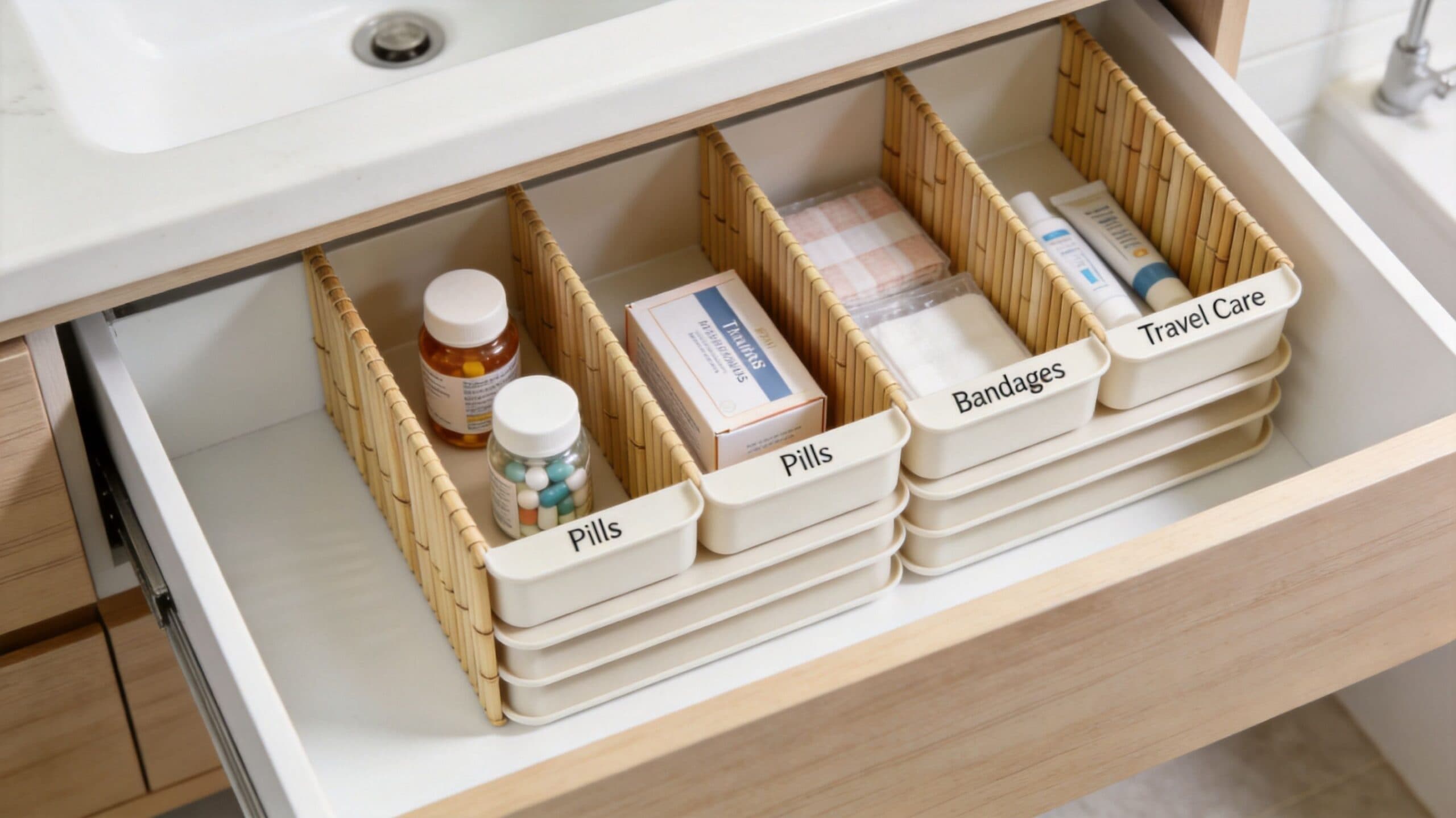
Vertical dividers and stackable trays fix that fast. They turn one open cavity into a set of controlled sections, so pain relievers, bandages, thermometers, and backup dental items stop sliding into each other. For South Jersey homeowners working with older vanities, this is often the easiest upgrade to make before committing to a larger bathroom remodel.
An organized drawer needs a fixed layout, but it also needs flexibility. Product sizes change. Family needs change. Adjustable dividers from brands like The Container Store or IKEA VARIERA hold up better than one-piece plastic inserts because you can rework the layout without replacing the whole system.
Why drawers beat deep shelves
Deep shelves waste usable space because small items get buried behind tall bottles and duplicate purchases start to pile up. A drawer gives you a top-down view, which is better for quick access and easier to maintain over time.
Stackable trays add another layer of control. Use them for short categories that tend to scatter, such as blister packs, ointment tubes, nail tools, or travel-size first aid supplies. In a shallow drawer, one low tray is usually enough. In a deeper drawer, two tray levels can work well, but only if the top tray lifts out easily and the bottom layer still stays visible.
That trade-off matters. Over-stack the drawer, and you create the same frustration you were trying to solve.
For custom cabinetry, I usually recommend planning for at least one shallow top drawer near the sink for daily-use health items and one deeper drawer below for back stock. Soft-close slides help keep bottles upright, and full-extension hardware makes the back of the drawer usable instead of forgotten. If you're already replacing a vanity, this is the point to build organization into the cabinet instead of adding inserts after the fact.
A few setup rules keep this system practical:
- Measure the interior, not just the drawer front: Hinge arms, plumbing, and curved drawer boxes can reduce usable space.
- Group by use case: Cold and flu, first aid, daily medication support, and travel care are easier to maintain than vague catch-all sections.
- Keep daily items nearest the front: Save the back half for duplicates and less-used supplies.
- Use trays for small loose items: Dividers alone work for bottles and boxes, but trays do a better job with tiny items that shift.
Practical rule: If products have to be stacked to fit, you don't have an organization system yet. You have overflow.
For many homes, this DIY fix is enough. But if the drawer box is too shallow, too narrow, or poorly placed, inserts can only do so much. That is usually the moment to talk with a local cabinet specialist like The Cabinet Coach about a vanity layout that supports how your household stores and uses everyday health items.
2. Clear Acrylic Stackable Containers and Bins
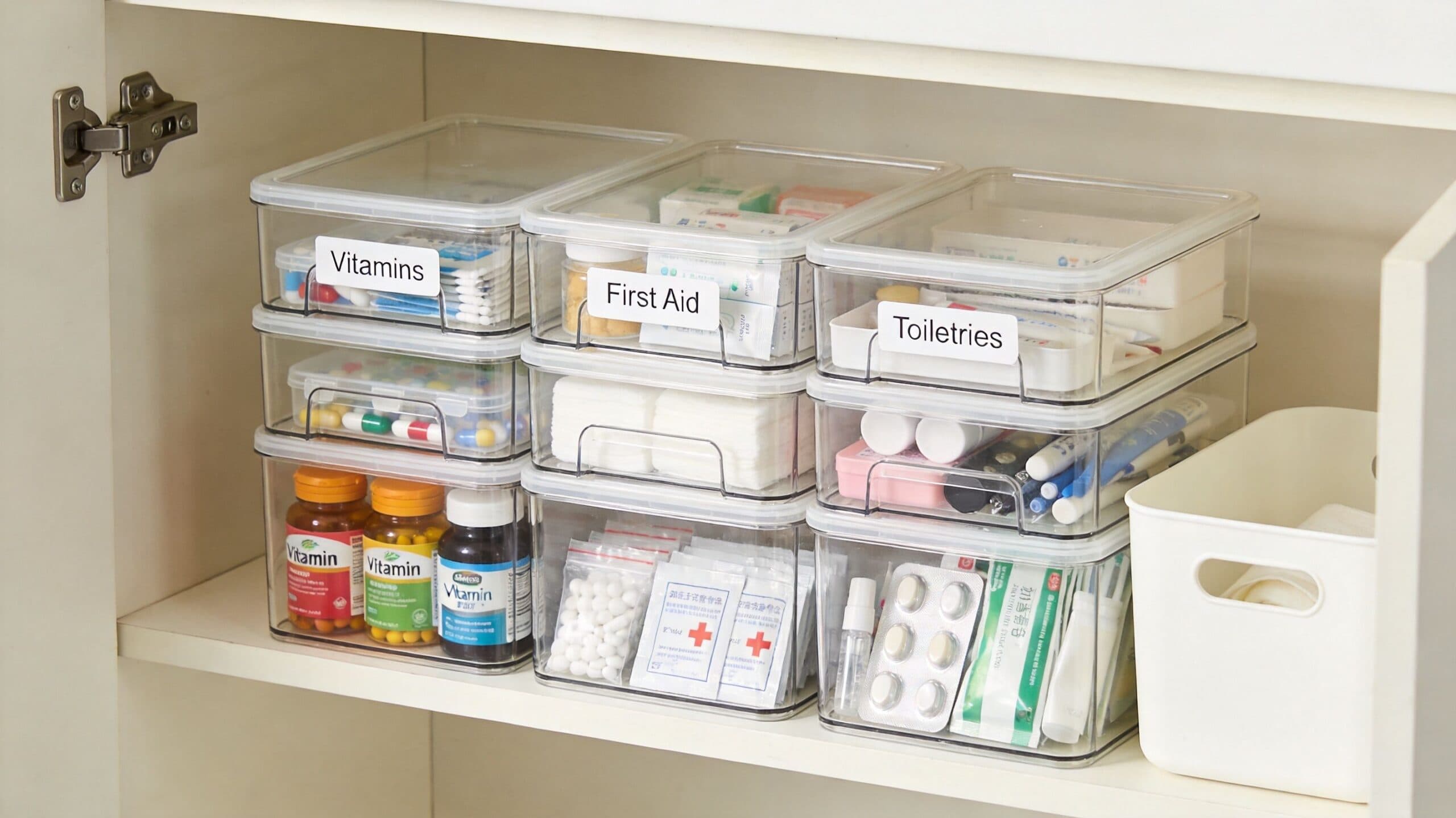
A cabinet looks organized until one small bottle tips over and takes half the shelf with it. Clear acrylic bins solve that daily-use problem better than loose shelving because they create boundaries without hiding what you own.
That matters in South Jersey bathrooms, where shared vanities, tight storage, and humid conditions wear down cardboard packaging fast. Clear containers keep categories visible even after outer boxes get soft, torn, or tossed. They also make restocking easier because duplicates and low inventory are easy to spot.
Set up bins by category and cabinet depth
The best results come from assigning each bin a single purpose. Keep first aid together. Keep cold and flu items together. Keep dental extras, contact lens supplies, and daily wellness products in their own containers. Mixed bins become junk drawers quickly, even when they look neat from the front.
Shallow recessed medicine cabinets usually work better with low-profile bins that let you see contents at eye level. Deeper vanity cabinets can handle stackable bins, but only if the top container can be lifted out easily. If access feels awkward, people stop using the system correctly.
I also recommend removing products from bulky retail cartons when the label on the bottle or tube is clear enough to identify safely. That saves space, but it is not always the right call. Prescription items, anything with dosage instructions you check often, and products with lot or expiration details should stay in packaging or be stored with that information attached.
Acrylic is popular for good reason. It wipes clean, handles moisture better than fabric organizers, and keeps a small cabinet from feeling visually crowded. Retailers such as The Container Store's bathroom organizers collection show how many size options are available, which is useful when you are fitting around outlet plates, shallow shelves, or narrow mirrored cabinets.
- Choose straight-sided bins: Curved shapes waste space in narrow cabinets.
- Label the front, not the lid: Labels should stay visible when bins are stacked.
- Use small inserts for tiny items: Tweezers, thermometer covers, and sample packets need their own corral.
- Avoid overstacking: Two usable layers beat three awkward ones.
Clear bins work best when every item can be identified and returned in seconds.
For a DIY upgrade, this is one of the fastest wins. For a remodel, I often use the bin sizes a homeowner already likes to help determine shelf spacing, drawer depth, and interior cabinet width before a vanity is built. If your current cabinet almost works but never stays in order, that is usually the point to call a local pro such as The Cabinet Coach and plan storage around the products you keep.
3. Lazy Susan and Rotating Corner Organizers
Open a crowded under-sink cabinet and the same problem shows up fast. Tall bottles collect in the back corner, smaller items disappear behind them, and every morning starts with digging.
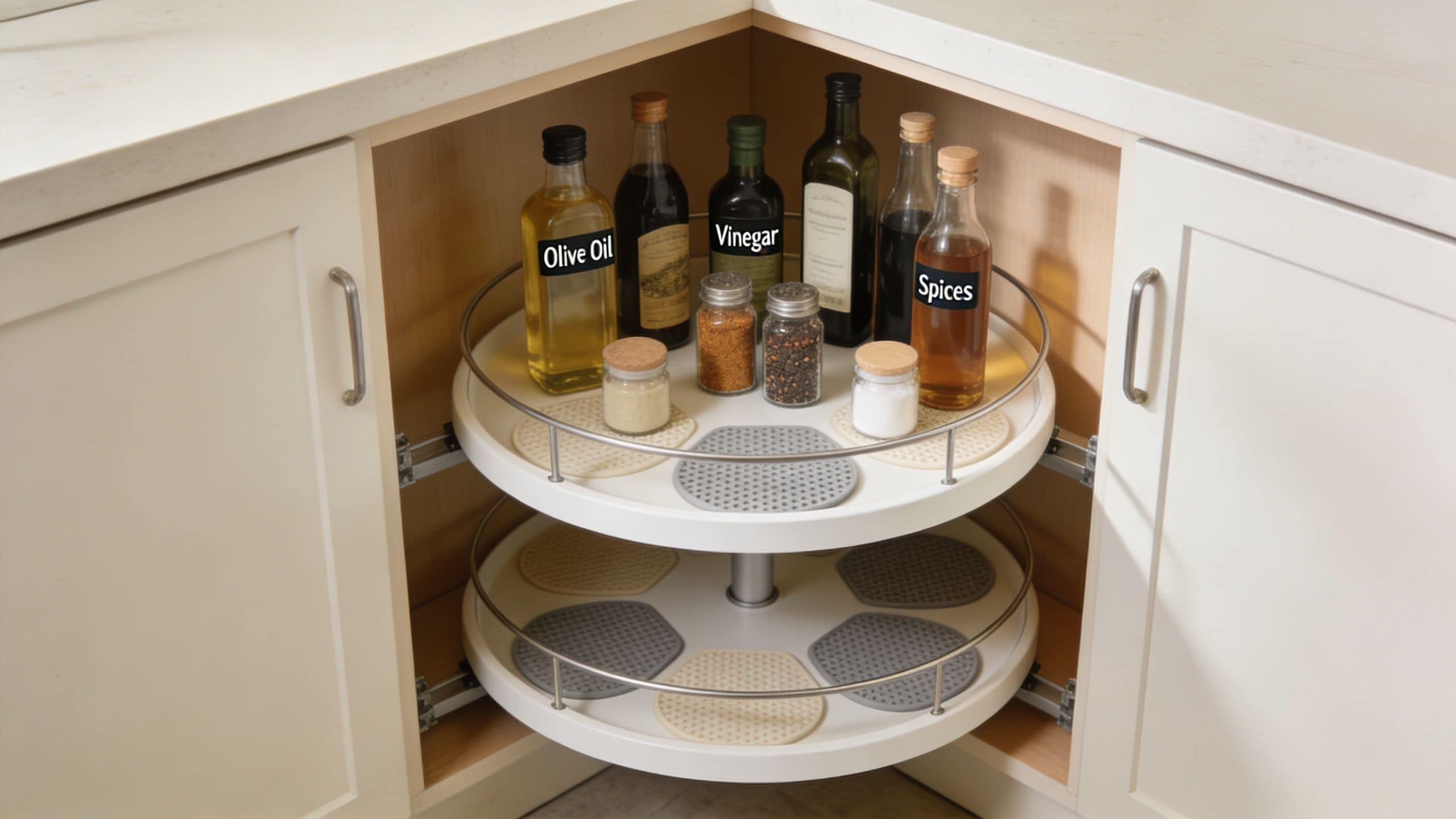
A rotating organizer fixes that access problem in the right cabinet. In a narrow mirrored medicine cabinet, it usually creates more frustration than order because the tray steals usable width and can block taller items. In a lower vanity cabinet, side compartment, or extra-deep drawer, it can turn a hard-to-reach corner into storage you will use.
Where rotation helps and where it fails
Rotating trays work best with upright products that share roughly the same height and get used often. Backup shampoo, mouthwash, contact lens solution, allergy medication, and dental care items are good candidates. Tiny loose items, first aid supplies, and mixed categories usually perform better in divided bins because they stay put and are easier to sort at a glance.
South Jersey bathrooms often have one of two conditions: a shallow medicine cabinet upstairs and a cramped vanity below. In homes around Cherry Hill, Moorestown, and Haddonfield, I usually see turntables earn their keep below the sink or inside a linen side cabinet, not behind the mirror. The trade-off is simple. You gain reach, but you give up some fixed footprint and vertical flexibility.
A few setup details matter more than the organizer itself:
- Leave clearance: Measure the tray and the cabinet interior so the organizer turns freely without rubbing hinges, plumbing, or face frames.
- Match the tray to the category: Taller two-tier units suit bottles. Low-profile single trays suit shorter containers and tubes.
- Keep weight near the center: Heavy glass bottles at the outer edge make rotation clumsy and increase tipping.
- Use a non-slip liner if the base is slick: That helps prevent bottles from sliding when the tray spins.
- Limit each tray to one category: A dental tray or an allergy tray stays organized longer than a catch-all tray.
For custom cabinetry, this is one of those features that should be planned, not forced in later. A vanity can be built with the right shelf height, door swing, and side-cabinet depth so a rotating organizer fits cleanly and clears plumbing. If your current bathroom has awkward blind spots that never stay usable, that is usually the point to bring in a local cabinet expert such as The Cabinet Coach and design storage around the products your household keeps.
4. Magnetic Strips and Wall-Mounted Storage Systems
Open a crowded medicine cabinet in the morning and the smallest items usually cause the most frustration. Tweezers slide behind bottles, bobby pins collect dust in the back corner, and grooming tools end up loose on the shelf. Door-mounted storage fixes that problem by giving those small pieces a defined spot that stays visible.
Magnetic strips, slim rails, and lightweight wall-mounted cups work best for tools, not bulk storage. Reserve them for metal items you grab often, such as tweezers, nail clippers, small scissors, and hair pins. That clears shelf space for taller bottles, boxed medications, and other items that need a stable, upright position.
The trade-off is clearance. A strip or cup that projects too far from the door can hit shelves, mirrors, or products when the cabinet closes. In the older South Jersey bathrooms I see most often, that matters because many recessed medicine cabinets are shallower than homeowners expect.
A good setup follows a few simple rules:
- Keep door storage light: Heavy tools and full containers put stress on hinges and make the door feel sloppy over time.
- Measure depth before mounting: Account for the organizer, the item stored on it, and the shelf contents opposite the door.
- Use moisture-resistant hardware: Adhesive strips can work for light-duty DIY installs, but lower-cost adhesives often fail in humid bathrooms.
- Group by task: Keep nail tools together, hair accessories together, and daily grooming tools together.
- Test the door swing fully: Open and close the cabinet several times before final placement to check for collisions.
Custom cabinetry makes this approach much cleaner. I usually recommend planning door storage during the design phase if the client wants mirrored cabinets, shallow uppers, or a vanity tower with interior organizers. That allows the cabinet depth, shelf setbacks, and hinge selection to support the organizer instead of fighting it later.
For a DIY upgrade, keep the intervention small and specific. One magnetic strip inside the door often does more good than covering every available surface with hooks and cups. The goal is to remove clutter from the shelf, not create a second clutter zone on the door.
Designer's note: Door-mounted storage should support the main cabinet layout. It should not become the primary place for everything.
This option looks especially polished in bathrooms with simple cabinet fronts and minimal hardware, but the primary benefit is practical. Small tools stop drifting, shelves stay easier to wipe down, and the cabinet is faster to use every day. If you are planning a bath update and want these details to feel built in instead of added on, it makes sense to bring in a local cabinet specialist such as The Cabinet Coach early and size the storage around what your household uses.
5. Pull-Out Shelves and Sliding Drawer Systems
Open a lower vanity cabinet in a busy South Jersey bathroom and the problem shows up fast. Daily items sit in front, backup products disappear in back, and anything stored near plumbing gets awkward to reach. Pull-out shelves solve that access problem better than almost any loose organizer.
They work best in vanities, linen towers, and deeper side cabinets where shelf depth exceeds what you can comfortably reach in one motion. Instead of stacking baskets and hoping the right item stays visible, a sliding tray brings the full contents forward. Brands like Blum, Hettich, and Rev-A-Shelf make hardware that holds up well under repeated daily use, but the hardware is only part of the solution. Cabinet sizing and clearance decide whether the system feels smooth or frustrating.
Here's a quick visual on the kind of mechanism that makes this work well in practice:
When custom hardware is worth it
Retrofit kits can work in an existing vanity if the cabinet box is square and the interior is clear. Many are not. Face frames reduce opening width, drain assemblies interrupt tray travel, and low-quality slides sag once bottles, tools, and refills start adding weight.
That is why I usually recommend pull-outs during the cabinet design stage for remodels. The drawer width, slide rating, shelf depth, and plumbing layout can be planned together. In a custom vanity, even a small pull-out beside the sink often improves daily function more than adding another fixed shelf.
A few details make the difference:
- Choose full-extension slides: You need the back of the tray to clear the cabinet opening.
- Use shallow sidewalls: Tall tray sides hide small items and waste sightlines.
- Measure around plumbing: Under-sink pull-outs often need U-shaped cutouts or narrower trays.
- Sort before you install: Pull-outs improve access, but they do not fix overbuying or expired products.
- Match the tray to the load: Metal slides and plywood trays hold up better than light plastic inserts in hard-use family baths.
Depth matters here too. Recessed medicine cabinets built into a standard wall cavity have limited room, so sliding systems usually make more sense in the vanity below or in a nearby tall cabinet than inside the wall cabinet itself. For many homeowners in Camden County and Burlington County, that is the better trade-off. Keep the wall cabinet simple for daily essentials, and put bulkier categories on pull-outs where they are easier to reach.
For a DIY upgrade, start with one problem zone. First-aid supplies under the sink, backstock skincare in a vanity drawer bank, or grooming tools in a side cabinet are good candidates. If you are already replacing cabinetry, ask a local specialist like The Cabinet Coach to build the pull-outs into the plan from the start. The result looks cleaner, works better around plumbing, and feels like part of the bathroom instead of an add-on.
6. Labeled Tiered Shelf Riser Systems
You open the medicine cabinet during a rushed weekday morning, and the item you need is hiding behind three others. Tiered shelf risers fix that visibility problem fast. They turn one flat shelf into clear rows, so shorter bottles, ointments, and small cartons stay in view instead of disappearing behind tall containers.
This approach works best in shallow wall cabinets with enough vertical clearance to create two levels without crowding the shelf above. Bamboo, acrylic, and coated metal risers can all work. The right choice depends on the cabinet width, the weight of what you store, and how polished you want the result to look in a primary bath versus a kid's bath.
Label by use, not by product type
Labels matter as much as the riser itself. Households find items faster when categories match real problems to solve. "Allergy," "cold and flu," "pain relief," and "first aid" are usually more useful than "tablets" or "ointments." In shared bathrooms, daily medications can be sorted by person, while common-use items stay grouped by purpose.
That pharmacy-style logic is practical because it cuts decision time. It also makes restocking easier. If one shelf is for seasonal allergy care, misplaced products stand out right away.
A few setup choices improve the system:
- Place taller items on the back row: The front row stays visible.
- Keep heavier products on the lower level: Risers feel more stable and less top-heavy.
- Use simple shelf-edge labels: They are easier to spot than labels buried on small bins.
- Stop at two tiers in most medicine cabinets: Extra levels often make retrieval harder in tight spaces.
Organize around the moment of use. A good system should help someone find what they need in seconds.
For South Jersey homeowners, this is also a useful test before committing to custom cabinetry. If labeled categories hold up for a few months, that pattern can inform a better built-in solution later. I often recommend starting with an inexpensive riser setup in the existing cabinet, then using what works to guide shelf spacing, divided compartments, or mirrored storage zones in a remodel. If you're already planning a bathroom update, a local cabinet specialist like The Cabinet Coach can build those category widths and heights into the design from the start, which usually looks cleaner and wastes less space than retrofitting organizers after installation.
7. Medication Lock Box and Secure Storage Systems
Organization without safety is incomplete. If you have children in the house, frequent young visitors, or an aging parent with multiple prescriptions, secure storage needs to be part of the plan.
A lock box is the simplest upgrade. It gives sensitive medications a defined location and reduces the odds that they get mixed into everyday products. In some homes, that means a compact portable box in a cool, dry closet. In others, it means integrating a locked compartment into a custom vanity or wall cabinet.
Safety belongs in the design
Bathrooms aren't always the best place for every medication because of moisture and temperature swings. Even so, families often keep everything there because it's convenient. If that's your setup, separate what must stay secure from what can remain in standard cabinet storage.
This is one area where off-the-shelf fixes only go so far. A loose lock box is better than nothing, but custom cabinetry can do more. Hidden locks, controlled-access compartments, and dedicated prescription storage make the room safer without making it look institutional.
The safety case is real. The Just a Girl and Her Blog medicine cabinet organization article highlights a gap in most organizing advice around childproofing and lockable solutions, and notes that the Poison Prevention Packaging Act has prevented over 50% of child poisoning deaths since 1970 per CDC data. It also points out that 25% of households have kids under 18 based on U.S. Census 2020 figures. For many South Jersey families, that alone is enough reason to treat secure medication storage as a design requirement, not a bonus.
If a product could harm a child or be confused by an older adult, don't rely on “out of reach” as your only system.
A few practical options make sense:
- Portable lock box: Good for renters or short-term fixes.
- Combination lock compartment: Better than a key if multiple adults need access.
- Built-in locked drawer: Best for remodels where you want safety without visual clutter.
8. Expiration Date Tracking and Inventory Management Systems
A familiar South Jersey scenario. Cold and flu season hits, someone reaches into the cabinet for relief, and the bottle in the back expired months ago. The cabinet may look tidy, but if no one can tell what is current, what needs replacing, and what is already overstocked, the system is incomplete.
Good organization includes a maintenance plan. For most households, that does not mean an app, spreadsheet, or color-coded overhaul. A dated label, a simple first-in-first-out rule, and a scheduled cabinet check usually handle the job well.
This step matters even more in custom cabinetry projects. Once storage is built around your routines, inventory control gets easier. I often recommend a shallow note area inside a door, a dedicated refill bin, or labeled zones that separate daily-use items from backup stock. Those small decisions reduce waste and cut down on duplicate purchases.
Build a routine you will actually keep
Start with visibility. Put the earliest-expiring items at the front, keep only one category per bin, and label products with either the expiration date or the month you opened them, depending on the item. If your family buys in bulk from warehouse clubs or keeps seasonal backups, this prevents the common problem of newer purchases getting used first while older items disappear in the rear.
A workable system usually includes:
- One date format: Keep labels consistent so every adult in the house reads them the same way.
- A fixed review schedule: Check contents on the same date each month or at the start of each season.
- A backstock limit: Keep one backup per item category unless there is a clear medical reason to store more.
- A discard plan: Remove expired products during each review so they do not drift back into circulation.
For bins, baskets, and family-specific categories, this ultimate guide to storage labels offers practical labeling ideas that adapt well to bathroom storage.
The trade-off is simple. More tracking creates more upkeep, so the best system is usually the lightest one your household will follow. In a standard medicine cabinet, a label and monthly check may be enough. In a remodel, built-in dividers, refill zones, and clearly assigned shelf space make the routine easier to keep without adding visual clutter.
Homeowners who say they have "tried organizing before" usually did the sorting part. What was missing was the reset. Expiration tracking solves that, and if you are already planning new bathroom cabinetry, it is smart to design for that habit from the start.
8-Item Medicine Cabinet Organization Comparison
| Solution | Implementation Complexity 🔄 | Resource Requirements ⚡ | Expected Outcomes 📊 | Ideal Use Cases ⭐ | Key Advantage & Tip 💡 |
|---|---|---|---|---|---|
| Vertical Drawer Dividers and Stackable Trays | Low, plug-and-play; requires accurate measurements and occasional reorganization | Low, modular plastic or bamboo dividers and trays, labels | Increases usable drawer capacity and visibility; prevents shifting of items | Small-to-medium cabinets; budget-conscious remodels, ⭐⭐⭐⭐ | Affordable, customizable solution; tip: measure before buying and label compartments |
| Clear Acrylic Stackable Containers and Bins | Low, simple stacking and placement; careful stacking to avoid tipping | Medium, durable acrylic/polycarbonate bins, waterproof labels, optional cabinet lighting | Excellent instant visibility and moisture resistance; clean aesthetic | Shared medicine cabinets, design-forward projects, users needing visual inventory, ⭐⭐⭐⭐ | Instant content visibility; tip: use waterproof labels and locking lids for stability |
| Lazy Susan and Rotating Corner Organizers | Low–Moderate, drop-in or simple install; choose correct size for clearance | Low, rotating platforms/carousels, non-slip liners | Maximizes corner space and access to rear items; may need careful placement | Corner cabinets and deep shelves where rear access is difficult, ⭐⭐⭐⭐ | Turns dead corner space into usable storage; tip: place heavy items near center and allow clearance |
| Magnetic Strips and Wall-Mounted Storage Systems | Low, easy door/drawer mounting; depends on cabinet door condition | Low, magnetic strips/rails, metal containers, quality fasteners | Frees internal shelf space and keeps frequently used items accessible; limited to lighter items | Frequently accessed small items; modern/visible organization, ⭐⭐⭐ | Uses vertical door surfaces efficiently; tip: choose humidity-rated magnets and group by category |
| Pull-Out Shelves and Sliding Drawer Systems | High, requires professional installation and precise measurement | High, heavy-duty slides (Blum/Hettich), soft-close hardware, installation labor | Best accessibility and ergonomic gains; eliminates dead space and supports heavy loads | Deep cabinets, accessibility-focused remodels, premium cabinetry, ⭐⭐⭐⭐⭐ | Full-extension, ergonomic access; tip: specify soft-close hardware and verify cabinet depth |
| Labeled Tiered Shelf Riser Systems | Low, tool-free setup; stack and label as needed | Low, tiered risers (plastic/bamboo), waterproof labels | Multiplies visible shelf levels and improves categorization; may look cluttered without upkeep | Standard shelves needing inexpensive vertical organization, ⭐⭐⭐ | Affordable vertical expansion; tip: group by category, place heavy items low, and label each tier |
| Medication Lock Box and Secure Storage Systems | Moderate, standalone boxes easy; integrated systems may need pro install | Medium–High, locking mechanisms, secure cabinetry, possible climate features | High safety and controlled access; protects medications from unauthorized use and moisture | Homes with children, seniors, controlled substances, rental properties, ⭐⭐⭐⭐ | Prioritizes safety and compliance; tip: store in a cool, dry place and manage access (keys/codes) carefully |
| Expiration Date Tracking and Inventory Management Systems | Medium, setup of labeling or digital system and ongoing household discipline | Low–Medium, labels, inventory logs or apps (possible subscription), initial time investment | Reduces expired-medication use and waste; improves safety and supply planning | Households with many prescriptions, caregivers, safety-conscious users, ⭐⭐⭐⭐⭐ | Prevents unsafe/expired use and waste; tip: schedule quarterly audits and use high-contrast labels or app reminders |
Ready for a Custom Solution? Your Organized Bathroom Awaits
Organizing your medicine cabinet is one of those small home projects that pays you back every day. You waste less time searching. You spot expired products faster. Shared bathrooms feel calmer, and everyday routines become more predictable. Even a few targeted changes, like clear bins, shelf risers, or drawer dividers, can make a cramped cabinet feel far more useful.
But there's also a point where better organizers can't fully solve a bad layout. If the cabinet is too shallow in the wrong places, too deep in others, or missing the right combination of drawers, shelves, and door storage, you're working around the design instead of benefiting from it. That's where custom cabinetry starts to make sense.
For South Jersey homeowners, this is especially relevant in older homes where bathroom storage often wasn't built for modern routines. Families now store more products, juggle more schedules, and need cabinetry that supports real use. A good custom plan can incorporate the medicine cabinet organization ideas that already work for you, then build them into a more integrated layout. That might mean a recessed cabinet with better interior spacing, a vanity with divided drawers, a pull-out first aid section, or a locked medication compartment that keeps safety and access in balance.
The biggest advantage of custom work isn't just appearance. It's fit. Properly designed storage accounts for your actual product mix, the way your family uses the bathroom, and the constraints of the room itself. In a compact hall bath, that may mean making every inch count. In a primary bath remodel, it may mean creating dedicated zones so daily care, backups, and secure medications don't compete for the same shelf.
If you live in Cherry Hill, Moorestown, Haddonfield, Voorhees, or nearby communities, working with a local design expert can save a lot of trial and error. Instead of buying organizers that almost fit, you can plan cabinetry around the routines you already know you need. That's the difference between a cabinet that looks organized for a week and a bathroom that stays functional for years.
The Cabinet Coach brings that process directly to South Jersey homeowners through a mobile showroom and guided design experience. If you're considering a bathroom remodel, this is the right time to think beyond bins and baskets and build organization into the cabinetry itself. A complimentary consultation can help you evaluate what should stay DIY, what should be upgraded, and what deserves a fully integrated solution.
If you're ready to move from temporary fixes to a bathroom that's organized by design, connect with The Cabinet Coach. Their mobile showroom serves South Jersey homeowners with personalized bathroom and cabinetry planning, helping you turn smart medicine cabinet organization ideas into a clean, built-in solution that fits your home and your routine.