
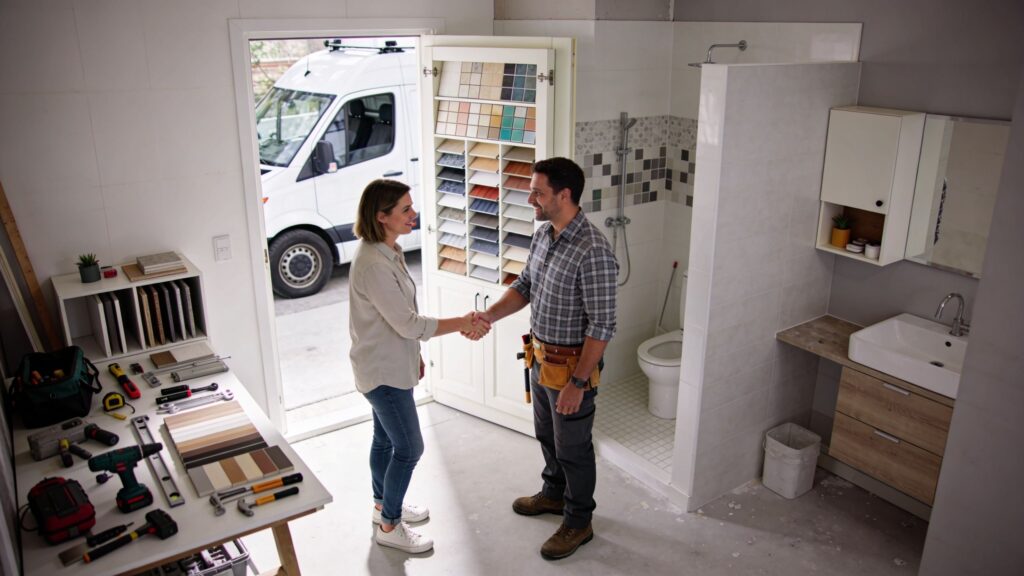
You’re probably doing what most homeowners do at the start of a bath project. You type bathroom renovation contractors near me, open six tabs, save three screenshots, text a neighbor, and still feel no closer to a decision. Every company says it delivers quality. Every gallery looks polished. Every review seems either glowing or suspiciously vague.
That uncertainty is normal, especially in South Jersey where homes vary widely from older borough properties in Haddonfield and Collingswood to newer builds in Voorhees, Medford, and Mount Laurel. A bathroom remodel isn’t just a design purchase. It’s a sequencing, waterproofing, permitting, and communication exercise that happens inside your home. The right hire makes the work feel organized. The wrong one turns a small room into a long problem.
A better approach starts before you compare estimates. It starts with knowing how to build the right shortlist, what local signals matter, where bids usually hide risk, and how modern planning models can save you time. If you’re still collecting ideas for finishes, lighting is one of the easiest early wins, and this guide on how to illuminate your bathroom beautifully is a useful place to sharpen your visual direction before meetings begin. It also helps to get your own priorities in order first, which is why a pre-hire planning checklist like this remodeling project primer can save a lot of backtracking later.
Table of Contents
- The First Step to Your Dream Bathroom
- Finding Potential Contractors in South Jersey
- How to Vet Bathroom Renovation Contractors
- Decoding Bids and Understanding True Project Costs
- The Final Interview Questions Before You Sign
- Streamline Your Renovation with a Modern Approach
The First Step to Your Dream Bathroom
The first real step isn’t calling the first contractor who answers the phone. It’s getting clear on what kind of problem you’re trying to solve.
For one homeowner, the issue is a dated hall bath with builder-grade finishes and no storage. For another, it’s a primary bathroom that never worked well, with poor lighting, weak ventilation, and a shower that feels tight even though the room is large enough. Those are different projects. They need different design decisions, different trade sequencing, and sometimes different permit pathways depending on what’s moving.
In South Jersey, I’d separate bathroom projects into three buckets before talking to anyone: cosmetic refresh, same-footprint remodel, and layout change. A cosmetic refresh usually keeps plumbing where it is and focuses on surfaces and fixtures. A same-footprint remodel upgrades the room more extensively but doesn’t rearrange the working parts. A layout change is where contractor skill really starts to show, because now plumbing, electrical, ventilation, and inspection timing all have to line up.
Practical rule: If you can describe your project in one sentence, you’re ready to start calls. If you can’t, you’re still in planning mode.
The other early decision is practical, not aesthetic. Ask yourself whether you want to manage separate pieces yourself, or whether you want one team guiding design selections, pricing, and construction coordination. Most first-time remodelers underestimate how much time gets lost between those handoffs.
A bathroom remodel in major U.S. markets typically ranges from $8,000 to $25,000, with small powder room projects starting around $2,200 and luxury primary bathrooms reaching $33,000 or more, and projects generally take 3 to 6 weeks according to this bathroom contractor cost overview. That range is wide for a reason. Scope changes everything. So do materials, town requirements, and how much hidden work sits behind the walls.
That’s why the smartest homeowners don’t begin with price shopping. They begin with scope discipline and a hiring strategy.
Finding Potential Contractors in South Jersey

Start with local proof, not search rankings
Search results are useful, but they’re not a quality filter. Some contractors appear prominently because they market well. That’s not the same as saying they manage bathroom projects well.
Start with towns that resemble your own. If you live in Cherry Hill, Moorestown, Haddonfield, Voorhees, or Medford, look for contractors who can show work in those areas or nearby communities in Camden and Burlington Counties. That matters because local familiarity often shows up in small but important ways: permit expectations, supplier relationships, parking logistics, older home surprises, and finish choices that fit the neighborhood instead of fighting it.
Neighborhood groups are one of the better early filters. Local Facebook groups, town forums, and community pages often surface names repeatedly. Not because of advertising, but because residents talk about how a company handled the day-to-day experience. You want comments about schedule reliability, cleanliness, communication, and how they handled problems. Those are stronger signals than compliments about a pretty final photo.
Another good source is adjacent trades. Ask your roofer, painter, plumber, flooring installer, or electrician who they’d trust in their own house. Competent trades know who keeps jobs organized.
If you want a broader picture of how homeowners evaluate local construction companies, that overview is useful because it frames the search around fit, visibility, and service area instead of just ad presence.
Build a list that is broad enough to compare
Don’t build a list of twenty. You won’t vet them properly. Don’t build a list of two either. You won’t see patterns.
A practical starting point is five to seven contractors, then narrowing to two or three after screening calls and portfolio review. To get there, use a mix of sources:
- Town-specific referrals. Ask neighbors in Cherry Hill, Haddonfield, Moorestown, and Voorhees who completed a bath project recently.
- Professional associations. Check remodeling directories and local trade memberships to find companies that operate consistently in South Jersey.
- Supplier intelligence. Visit a tile or plumbing showroom and ask which firms send prepared clients and order accurately.
- Street-level observation. Notice contractor vehicles in your neighborhood, especially on tidy jobsites with posted permits and organized material staging.
A long list should include a range of business models. Some firms are full design-build companies. Some are trade-heavy remodelers with a trusted designer. Some use an in-home product selection process. If you want to understand one version of that model before making calls, the Cabinet Coach experience shows how an in-home planning workflow can be structured around design and coordination from the start.
In South Jersey, “near me” should mean more than geography. It should mean they know how work actually gets done in your kind of house and your kind of township.
Once you have your list, don’t ask for estimates yet. Vet first. Pricing too early creates noise.
How to Vet Bathroom Renovation Contractors

Check the paperwork before the personality
A friendly meeting can hide a sloppy business. Start with the essentials.
In New Jersey, verify the contractor’s home improvement registration and ask for proof of liability insurance and workers’ compensation coverage. Don’t accept a vague “we’re fully covered.” Ask for current documentation. If a company hesitates, move on.
Then look at the contract habits early. A professional bathroom contractor should be able to explain how deposits, progress payments, change orders, and completion payments work before they ever send a formal proposal. Inexperienced companies often sound polished until you ask them to define payment triggers in writing.
Read portfolios like a project manager
A portfolio isn’t there to impress you with the prettiest bathroom. It’s there to prove consistency.
Look for three things.
First, range. Can they handle a traditional bath in Moorestown and a cleaner, more contemporary room in Cherry Hill without making everything look the same?
Second, problem-solving. Before-and-after sets should show more than new tile. You want evidence they corrected awkward layouts, improved storage, upgraded lighting, or made a shower function better.
Third, finish discipline. Zoom in. Check tile alignment, niche placement, vanity proportions, transition details, and how materials meet at corners. Good bathrooms are full of small decisions. Weak contractors lose control there.
A useful side note here is to avoid getting trapped by inspiration images alone. Homeowners often save one dramatic photo and try to reverse-engineer the whole project around it. That usually creates mismatched expectations. A more grounded process starts with your room, your budget, and your daily routines. If you want to avoid common planning errors before hiring, this piece on remodeling mistakes homeowners make is worth reading.
Reviews matter, but patterns matter more
One bad review doesn’t disqualify a firm. One glowing review doesn’t prove much either.
Read for recurring themes. Good signs include comments about punctuality, clean job management, realistic timelines, quick response to field issues, and respectful crews. Concerning patterns include repeated complaints about missed calls, vague pricing, material substitutions, or long stretches where nobody seems to know what’s happening.
Don’t just stay on one review platform. Compare Google, Houzz, Angi, and any local community discussions you can find. A company with years of work behind it should leave a trail that feels consistent.
After reviews, ask for references from projects that resemble yours. A powder room facelift and a full primary bath gut aren’t the same thing. Talk to people whose projects had similar complexity.
Here’s another layer most homeowners miss. Existing content often tells you to “check reviews,” but that doesn’t address who performed the work.
Ask who will actually be in your house
A major risk homeowners overlook is a contractor’s use of random subcontractors. With subcontractor shortages in NJ spiking 15% in the last year, ensuring a contractor has a dedicated in-house team or a rigorously vetted list of trade partners is critical to avoid quality issues and delays, which are cited in 25-30% of negative reviews on platforms like Angi, as discussed in this analysis of bathroom remodeling risks.
That should change how you interview people. Ask direct questions:
- Who are your tile installers, plumbers, and electricians? Ask whether they’re employees or recurring trade partners.
- How long have those people worked with you? You’re looking for stability, not a rotating cast.
- Who supervises them on site? “We check in” is weak. You want a named project lead.
- Can I know in advance who is scheduled each week? Organized companies can answer that.
If a contractor can’t clearly explain who does the work, who supervises the work, and who answers when something goes wrong, you’re not hiring a team. You’re hiring uncertainty.
The best vetting process feels slightly uncomfortable, because you’re asking serious questions. That’s fine. Good contractors won’t be offended. They’ll be relieved you understand what matters.
Decoding Bids and Understanding True Project Costs
A bathroom bid should answer one question clearly: what, exactly, is this company promising to build in your home for this price?
In South Jersey, that answer matters more than the bottom-line number. Two proposals can be thousands apart and still describe very different jobs. One may include permit filing, debris removal, Schluter or comparable waterproofing, fixture installation, and finish carpentry. Another may leave half of that implied. The cheaper one looks attractive until the first change order hits.
A strong proposal breaks the work into pieces you can compare line by line. You should see demolition, disposal, plumbing rough-in, electrical work, wall and floor prep, waterproofing method, tile labor, grout, shower glass if applicable, vanity or cabinetry, countertop, trim, painting, fixture installation, permit responsibility, and punch-list completion. If those items are buried in a single paragraph, the bid is too loose.
Material assumptions matter just as much. A vanity in plywood box construction is priced differently from MDF. A quartz top is different from a cultured marble allowance. A custom tile shower pan is different from an acrylic base, both in cost and in labor. If a proposal does not spell that out, you are comparing guesses.
That is where many homeowners get burned.
Allowances are the usual culprit. An allowance is a placeholder amount for an unfinished selection, such as tile, faucets, sconces, or a vanity. Allowances are normal. Badly defined allowances create arguments later because the homeowner thinks a higher-grade product was included and the contractor priced a builder-grade option.
Review each bid with these questions in front of you:
- What does the tile number cover? Tile only, or tile plus setting materials and labor?
- Is the waterproofing method named? Product and application method should be stated, not left as “prep as needed.”
- Are fixture models or quality levels identified? “Owner to select” is incomplete without a budget range.
- Does electrical include fan replacement, GFCI protection, lighting moves, and mirror or vanity light installation?
- Who is pulling permits, and is that cost included? In South Jersey, township requirements vary, and permit handling should never be left vague.
- How are concealed conditions handled once demolition starts? The contract should point to a written change-order process with pricing and approval steps.
For plumbing-heavy jobs, some firms use estimating platforms to organize labor and material pricing. That can be helpful. It does not make the bid reliable by itself. If you want a sense of how that side of estimating is built, this overview of Exayard plumbing estimating software gives useful background. What matters to you is whether the contractor walked your room carefully enough to adjust for real conditions, especially in older South Jersey homes where out-of-plumb walls, outdated shutoffs, and patched subfloors are common.
Here is a simple way to compare proposals side by side.
| Line Item | Contractor A (Low Bid) | Contractor B (Mid-Range Bid) | Contractor C (High Bid) |
|---|---|---|---|
| Demolition and disposal | Brief mention | Clearly listed | Clearly listed |
| Waterproofing | Generic wording | Product/system specified | Product/system specified |
| Vanity and cabinetry | Allowance only | Material and size specified | Custom details specified |
| Countertop | Not clear | Quartz listed | Quartz listed |
| Electrical | Minimal | GFCI and fixture scope included | Expanded scope included |
| Plumbing changes | Vague | Defined | Defined |
| Permit handling | Unclear | Included | Included |
| Change orders | Not addressed | Process explained | Process explained |
Low bids often stay low by leaving room to charge later. Cleaner bids feel more expensive because they force the hard conversations up front.
Bid test: If you can’t explain to a friend what you’re buying from each contractor, you’re not ready to choose one.
Value is the proposal that matches the scope of your bathroom, your finish level, and the way you want the project managed. Price matters. Clarity matters more. If you want to weigh cost against resale and long-term usefulness, review this guide to bathroom remodel return on investment. That helps frame a smart decision, especially if you are balancing custom work against standard options.
One more point from the field. Bids from firms with a mobile showroom model, including The Cabinet Coach, can be easier to compare because selections are narrowed in a more controlled way before final pricing is issued. That does not guarantee a better contract. It often produces a cleaner one, with fewer fuzzy allowances and fewer surprises after the walls are open.
The Final Interview Questions Before You Sign

The final interview is where experienced contractors separate themselves from good salespeople. At this point, most homeowners have already seen enough photos and pricing to make a rough choice. What they haven’t tested yet is process under pressure.
That matters because construction firms fail early. Twenty-five percent of construction firms fail in their first year, and experienced contractors reduce risk by carrying a 10-15% contingency for unforeseen issues. Hidden water damage affects 20-30% of older bathroom remodels, and proper waterproofing and ventilation are critical to prevent mold and future repairs, according to this contractor methodology guide.
Questions that reveal process
Ask these face to face or on a video call, and listen for specifics.
- How do you handle water damage or framing issues discovered after demolition? Strong firms describe a documented approval process, not a casual verbal update.
- What is your communication rhythm during the project? Weekly updates, a project app, scheduled check-ins, and photo documentation are all reasonable answers.
- Who is my single point of contact? You want one accountable person, not a sales rep before contract and silence after.
- How do you sequence plumbing, electrical, tile, and finish work? The answer should sound practiced.
- How do you manage permits and inspections in my town? In South Jersey, that answer should feel local, not generic.
- What waterproofing system do you use, and how do you detail corners, seams, and penetrations? If they get fuzzy here, be careful.
- What ventilation standard do you design around for bathrooms like mine? Even if you don’t need the exact technical language, the contractor should take moisture control seriously.
If you’re weighing whether to use a more integrated firm or separate professionals, this discussion of the architect versus design-build decision can help frame the trade-offs.
What strong answers sound like
Good answers are concrete. They reference steps, responsibility, and documentation.
Weak answers lean on reassurance. “Don’t worry, we take care of everything” sounds comforting, but it doesn’t tell you how the work is controlled.
“Walk me through the last time a bathroom job went sideways and what you did next” is one of the best questions a homeowner can ask.
That question reveals maturity fast. Every experienced remodeler has dealt with hidden damage, delayed materials, or awkward structural discoveries. You’re not looking for a claim that problems never happen. You’re looking for a calm, organized response when they do.
The contractor you hire should make you feel informed, not managed.
Streamline Your Renovation with a Modern Approach

Why the old contractor hunt wears people out
A South Jersey bathroom project often starts the same way. A homeowner saves photos, calls a few contractors, visits two or three showrooms, then realizes none of the pricing is based on the same scope or the same products. That is where confusion starts.
The old process asks homeowners to make finish decisions out of sequence. You pick tile in one place, vanities in another, hardware somewhere else, and then try to piece the whole room together from memory. By the time estimates come back, people are comparing mismatched allowances, inconsistent layouts, and products they saw under different lighting conditions.
That is hard on any client. It is tougher in South Jersey, where busy family schedules, older housing stock, and township-by-township permit requirements already add enough friction before demolition begins.
How the mobile showroom model changes the process
A better option for many homeowners is the mobile showroom model. Instead of sending you across the region to assemble a bathroom from separate vendors, the design and selection process comes to the house. Cabinetry, countertop options, hardware, and tile can be reviewed in the room itself, under your lighting, against your wall color, flooring, and real layout constraints.
That changes the quality of the decisions. Scale reads more clearly. Finish combinations are easier to judge. Budget conversations get more honest because the person discussing design is looking at the same product choices and site conditions that affect price.
I have seen plenty of projects go off track before the contract was even signed because one showroom quoted a vanity width that did not fit the alcove, or a tile selection looked warm in the store and cold once it was next to the homeowner's existing trim. Reviewing materials on site cuts down on those mistakes.
One South Jersey example is The Cabinet Coach, which offers a mobile showroom approach for kitchen and bathroom remodeling, including design guidance, material selection, and project coordination. For homeowners in towns like Cherry Hill, Haddonfield, and Voorhees, that kind of workflow can simplify the usual handoff problems between designer, supplier, and installer.
The other benefit is accountability. When selections, field measurements, scope alignment, and project management stay under one roof, fewer details get lost between sales, design, purchasing, and installation. Problems can still come up. Hidden water damage behind a shower wall is not prevented by any business model. But the response tends to be faster and clearer when one team owns the full chain of decisions.
A bathroom remodel is still a serious project. It should feel organized from the first meeting onward, not scattered across five appointments and three competing quotes.
If you want a more organized way to plan a South Jersey bathroom renovation, The Cabinet Coach offers an in-home, mobile-showroom process that helps homeowners sort through layout ideas, cabinetry, countertops, hardware, tile, and project coordination without bouncing between multiple vendors. It’s a practical fit for homeowners who want clearer decisions, better continuity, and one guided process from early planning through installation.
Great article! I appreciate how it emphasizes choosing the right bathroom renovation contractor based on experience, communication, and quality workmanship—not just price. These practical tips can help homeowners avoid costly mistakes and achieve a smoother remodeling experience. Thanks for sharing!