

If you're staring at a dated bathroom vanity and trying to decide whether dark grey is a smart move or a risky one, you're asking the right question. In South Jersey, this choice isn't only about style. Humidity, hard water, tight hall baths, and busy family routines all affect how a cabinet color and finish will hold up over time.
Dark grey bathroom cabinets can look polished without feeling fragile. They can also go wrong fast if the finish is too glossy, the cabinet box is built for a dry space instead of a bathroom, or the depth is wrong for a compact layout in Cherry Hill, Haddonfield, Voorhees, or Moorestown. The homeowners who end up happiest usually make this decision with both design and maintenance in mind.
Table of Contents
- Why Dark Grey Cabinets are a Timeless Choice
- Choosing Your Ideal Style and Finish
- Creating the Perfect Palette for Your Bathroom
- Making Dark Grey Work in Small Bathrooms
- Deciding Between Painting and Replacing Cabinets
- Ensuring Durability in South Jersey's Climate
- Your Stress-Free Remodel with The Cabinet Coach
Why Dark Grey Cabinets are a Timeless Choice
A lot of South Jersey homeowners reach the same point. The old white vanity shows every drip, every scuff, and every bit of wear from damp mornings and hard-water splash. They want something darker, but they do not want a bathroom that feels heavy or dated three years later. Dark grey usually solves that better than almost any other cabinet color.
It has enough depth to ground the room, but it stays more forgiving and more flexible than black. In practice, that matters. A dark grey vanity can sit comfortably with polished nickel, matte black, brass, marble-look tops, or warmer stone without forcing the whole bathroom into one narrow style.

Why the color keeps working
Dark grey bathroom cabinets earn their keep in real homes. They hide day-to-day wear better than white, especially around drawer pulls, sink fronts, and lower corners where shoes and cleaning tools tend to leave marks. In Shore-area homes and inland South Jersey bathrooms alike, that lower-maintenance look is a real advantage.
The other reason is design range. I can put dark grey in a Haddonfield colonial, a Washington Township primary bath, or a newer coastal-style home near the water, and it still makes sense if the undertone is right. That is hard to say about trend colors that look sharp online but feel tired once the surrounding tile, paint, and lighting shift.
Dark grey also works across cabinet constructions. A painted shaker vanity, a slab front in a matte finish, or a furniture-style piece can all carry this color well. If you are still deciding on door material, this guide to MDF vs. wood cabinet doors helps clarify which option makes more sense for a bathroom that sees steam and temperature swings.
Dark grey is one of the few cabinet colors that can read tailored in a traditional bath and restrained in a modern one.
What LRV means in a real bathroom
Light Reflectance Value, or LRV, measures how much light a color reflects. That matters more in bathrooms than homeowners expect because vanity colors rarely live in even, natural light. They sit under sconces, ceiling cans, mirror shadows, and whatever daylight the window gives you.
Many of the dark greys designers use for cabinets sit in a lower LRV range, which is one reason they read rich instead of washed out, as shown in Kylie M Interiors' cabinet and vanity grey guide. The practical takeaway is simple. A sample that looks like a clean medium grey on a chip can read almost charcoal once it is installed under bathroom lighting.
That is why I tell homeowners to judge dark grey in the room, beside the top and tile, not in their hand at the paint store.
A few rules help:
- Choose a warmer dark grey if the bathroom has limited daylight, beige tile, or off-white finishes.
- Choose a cooler charcoal grey if the room has crisp white surfaces, marble veining, or chrome fixtures.
- Sample next to the countertop and backsplash because undertones shift fast once grey is surrounded by other materials.
- Be careful with very dark selections in older South Jersey hall baths where a single overhead light can make the vanity read flatter than expected.
Done right, dark grey does not feel trendy or safe. It feels settled, finished, and easier to live with.
Choosing Your Ideal Style and Finish
The color gets the attention, but the door style and finish determine whether the vanity still looks good after years of steam, splashing, and cleaning. A strong dark grey can make a cheap construction method more obvious, not less. That's why style and finish should be chosen together.
Door style first
For most South Jersey bathrooms, three cabinet styles cover almost every need.
Shaker is the safest pick when you want range. It works in colonials, capes, newer builds, and transitional remodels. In dark grey, Shaker doors feel refined and structured, especially with simple hardware.
Flat-panel works best when the rest of the bathroom is quiet. Large-format tile, frameless mirrors, and minimal trim pair well with this look. If the room already has a lot of pattern, flat-panel helps calm it down.
Traditional raised-panel can work, but it needs the right house and the right scale. In a small hall bath, heavier profiles can feel crowded faster than homeowners expect.
Practical rule: If the bathroom is compact, cleaner door lines usually age better than ornate profiles.
Comparing finish types honestly
Homeowners often ask for "painted dark grey" when what they really want is a finish that looks rich and stays stable. Those aren't always the same thing. If you're weighing MDF, wood, and engineered door options, this breakdown pairs well with The Cabinet Coach's guide to MDF vs wood cabinet doors.
Comparing Dark Grey Cabinet Finishes
| Finish Type | Durability | Moisture Resistance | Cost | Best For |
|---|---|---|---|---|
| Painted wood | Good if prep and topcoat are done well | Moderate | Mid to higher | Homeowners who want a furniture-style look and are careful about maintenance |
| Painted MDF | Smooth surface, stable face profile | Moderate | Mid | Clean painted finishes with fewer visible grain distractions |
| Thermofoil | Strong surface consistency | Strong | Often budget to mid | Bathrooms that see frequent steam and need easier wipe-down care |
| High-pressure laminate or PVC-laminated finish | Tough, consistent, practical | Strong | Varies by line | Busy family bathrooms and lower-maintenance remodels |
The trade-off is straightforward. Painted finishes usually give you the most custom look, but they ask more from the material and the installer. Laminated options tend to be more forgiving in bathrooms, especially when daily moisture is part of the routine.
Don’t ignore the cabinet footprint
Before choosing a style, confirm the vanity depth and door swing fit your room. A bulky profile on an oversized cabinet can make a narrow bath feel cramped even if the color is perfect. The best-looking vanity is still the wrong vanity if it crowds the toilet clearance or clips the casing when the drawer opens.
Creating the Perfect Palette for Your Bathroom
A South Jersey bathroom can look right on install day and feel off a month later. Steam hangs around longer in older homes, hard water leaves a film on darker surfaces, and a vanity color that looked perfect under showroom lighting can turn flat under one ceiling fixture. Dark grey cabinets still work well here, but the palette around them has to do more than look good in a photo.

Start with the countertop and wall color
The countertop usually decides whether dark grey reads clean and well-defined or heavy and dull. For most bathrooms I design in South Jersey, white quartz or a marble-look top with controlled veining gives the cabinet enough contrast to stay defined, especially under average builder-grade lighting. It also handles everyday toothpaste, soap, and makeup mess better than many natural stones.
A quieter, moodier palette can work too. Pair dark grey with a softer grey top, warm white walls, and limited pattern. The trade-off is that low-contrast combinations need better lighting and tighter material selection. If the floor, wall tile, and top all sit in the same middle range, the vanity can disappear instead of anchoring the room.
Wall color should steady the cabinet color.
- Soft white works well in bathrooms with weak natural light.
- Warm off-white suits dark grey finishes with taupe or brown undertones.
- Muted green or blue accents fit homeowners who want color without turning the room cold.
For outside inspiration, this overview of Melbourne home bathroom renovation colours shows how neutral cabinetry can be paired with warmer finishes without losing contrast. For a more cabinet-specific approach, The Cabinet Coach's guide to choosing cabinet colors helps translate those ideas into finish, countertop, and hardware choices that make sense in an actual remodel.
Choose hardware that stays looking clean
Hardware is where style meets maintenance. In towns like Cherry Hill and Haddonfield, I often see bathrooms where the cabinet color still looks good but the pulls and faucet show spotting, residue, or finish wear. On dark grey cabinets, that contrast shows up fast.
Brushed metals are usually the safer choice for this region because they forgive water spots better than polished finishes. If a household uses stronger cleaners or the kids leave water around the sink every day, a PVD-finished pull or knob is usually worth the extra cost. Polished chrome can still work in the right bath, but it shows more spotting. Gloss black hardware gives a sharp look at first, yet it often asks for more upkeep than homeowners expect.
Matte cabinet finishes also tend to be easier to live with than high-gloss in a busy bathroom. They soften fingerprints, minor residue, and everyday wear around the sink base. That matters in South Jersey homes where hard water and summer humidity can make a brand-new vanity look tired sooner than it should.
If your current faucet leaves a white film around the sink, choose a forgiving cabinet finish and brushed hardware before chasing a trendier combination.
Use lighting to finish the palette
Light changes dark grey more than homeowners expect. A cabinet sample that reads warm and rich in daylight can turn flat under a cool overhead LED. I recommend judging the full palette together: cabinet sample, countertop sample, wall paint, and hardware, all under the light temperature you plan to install.
Mirror lighting matters too. Side lighting or a well-placed fixture above the mirror gives the vanity color more depth and makes the room easier to use every day. If the bathroom already has limited daylight, keep one major surface as the visual feature. In many South Jersey bathrooms, that should be the vanity, not a competing dark wall tile or heavily patterned floor.
This is one place where a mobile showroom helps. Seeing dark grey door samples beside quartz, hardware, and paint in your own bathroom tells you more in twenty minutes than a stack of store samples ever will.
Making Dark Grey Work in Small Bathrooms
In a typical South Jersey hall bath, the room feels cramped long before the color palette becomes the main problem. I see it all the time. A vanity that projects too far, a swinging door that clips the corner, and a bulky cabinet base that makes a 5×8 bathroom feel tighter than it is. Dark grey can still work well there, but the cabinet has to earn its footprint.
Use the right vanity proportions
The first decision is depth. In many compact bathrooms, a standard 21-inch-deep vanity gives you better walking clearance than a deeper 24-inch cabinet body and significantly reduces wasted, hard-to-reach space at the back of the cabinet. That matters near tub entries, toilet clearances, and narrow door swings.
Homeowners usually feel the difference right away. The room opens up, and the vanity stops acting like an obstacle.
A few layouts handle dark grey especially well:
- Powder rooms where the vanity is meant to stand out.
- Hall baths with light walls and a simple floor.
- Primary baths using a floating vanity or an open-leg furniture base.
For local examples, this guide to small bathroom design ideas in Cherry Hill NJ shows the kind of space-planning choices that make darker cabinetry practical in older South Jersey homes.
Reduce visual weight
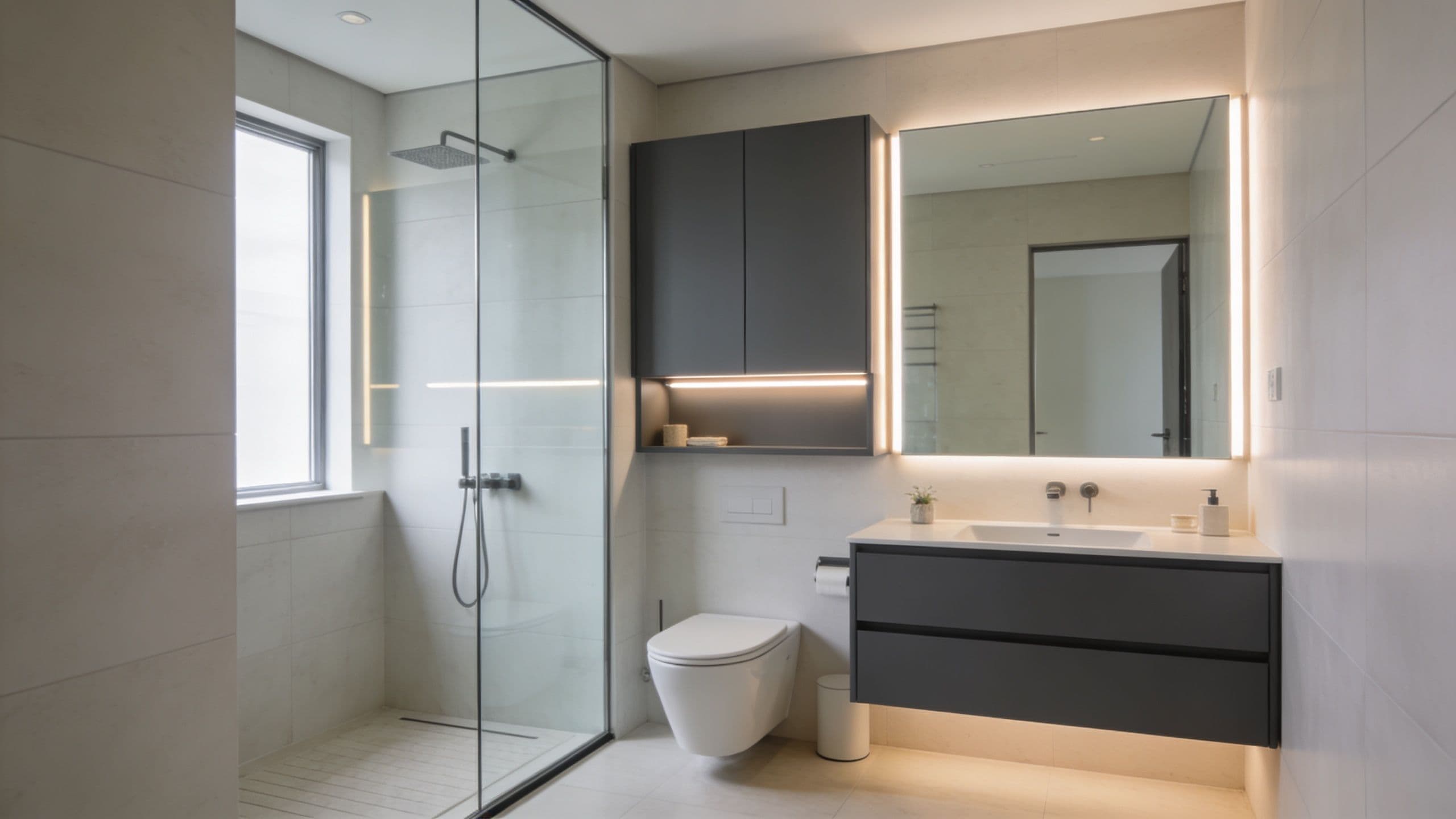
Dark grey looks heavier when the cabinet is boxy, over-detailed, or planted flat on the floor with no relief underneath. The fix is straightforward. Keep the lines clean and let more of the room stay visible.
Use these moves together:
- Choose a floating or legged vanity to expose more floor area.
- Install one larger mirror instead of breaking the wall into smaller pieces.
- Use a simple door style, usually Shaker or flat-panel.
- Keep wall finishes lighter so the vanity reads as the anchor, not the whole room.
A short visual example helps here:
I also recommend being selective with what surrounds the vanity. Glass shower panels keep sightlines open. Closed storage works better than open shelving in a small bath, especially in shore-area homes where humidity can make towels and everyday items look messy fast. Dark cabinetry succeeds in small bathrooms when the layout is disciplined and the cabinet proportions fit the room.
Deciding Between Painting and Replacing Cabinets
Sometimes the existing vanity is structurally sound and only looks tired. Other times, the cabinet is the problem and new paint won't fix a bad layout, swollen sides, failing drawers, or poor storage. That's where the paint-versus-replace decision gets real.
When painting makes sense
Painting can work if the cabinet box is solid, the doors are in good shape, and the size already suits the room. It's also the better route when you like the layout and want a visual update without changing plumbing locations.
But dark paint is not forgiving. Surface prep has to be serious. That means cleaning, sanding, priming, filling old hardware holes when needed, and using a finish designed for cabinetry rather than wall paint. If you want to explore that route, The Cabinet Coach's cabinet painting service page gives a realistic picture of what professional prep involves.
When replacement is the better investment
Replacement makes more sense when function is part of the problem. Common examples include shallow drawers that waste space, doors that rub, water damage near the sink base, or a vanity that's too deep for the room.
A new cabinet also lets you fix issues paint can't solve:
- Better storage with improved drawer configuration
- Updated hardware such as soft-close glides
- Cleaner proportions for a tighter bathroom footprint
- More durable factory finishes than most field-applied paint jobs
Paint changes appearance. Replacement changes performance.
If the bathroom is already being remodeled, replacement is usually the cleaner long-term choice. If the room is staying mostly intact and the cabinet is solid, painting can still be the right call.
Ensuring Durability in South Jersey's Climate
A bathroom in Cherry Hill or Haddonfield can look fine on install day and start showing wear much faster than expected if the cabinet materials are wrong. Steam hangs in the room, summer humidity pushes moisture into every joint, and hard water leaves residue that homeowners scrub off again and again. Dark grey cabinets handle that environment well, but only when the cabinet is built for it.
Construction details that matter
Start with the box. In South Jersey, I steer homeowners toward 1/2-inch solid birch plywood boxes and 5/8-inch dovetailed solid wood drawers because those materials hold their shape better than low-grade particleboard once the room sees repeated moisture swings. The Lily Ann Cabinets' Grey Shaker Elite vanity specifications outline that type of construction.
Skip the unsupported promises about exact drawer weight or a guaranteed year count. What matters in real use is simpler. A well-built cabinet opens cleanly, stays square around sink plumbing, and gives the finish a stable surface so you are not dealing with joint movement, peeling corners, or swollen edges a few seasons later.

You can feel the difference the first week. Drawers track straighter. Doors stay aligned longer. The cabinet has a better chance of delivering a long service life instead of looking tired early.
South Jersey conditions change the material choice
Humidity is only part of the story here. Hard water is the other issue generic cabinet guides usually miss. In towns across Camden and Burlington County, mineral-heavy water leaves spotting around faucet bases and sink rims, and those areas get wiped down with stronger cleaners more often than homeowners expect. That repeated cleaning tests the finish as much as steam does.
Painted wood can still be the right choice in a primary bath with a good exhaust fan and homeowners who wipe standing water off the vanity top. A laminate or other factory-sealed surface often makes more sense in a busy hall bath or kids' bath where damp towels, splashing, and rushed cleanup are part of daily life. Both can work. The better option depends on how the room is used.
A few checks help avoid expensive mistakes:
- Look under the sink base. That area shows quickly whether the interior coating can handle drips and routine cleaning.
- Check exposed edges and inside corners. Those are the first places cheaper cabinets start to swell or peel.
- Confirm the vanity top overhang and sink seal. A good cabinet lasts longer when water is directed away from the door fronts.
- Match the material to the bathroom's habits. Guest baths and kid baths rarely need the same finish strategy.
Homeowners usually make better cabinet decisions when they can compare finishes, door samples, and construction details in their own light instead of under showroom lighting. The Cabinet Coach brings that process to the house through its mobile showroom experience for South Jersey homeowners, which makes it easier to judge what will hold up in the room you use every day.
If you are still shaping the overall look of the remodel, broad bathroom renovation ideas can help you narrow the style before you commit to a cabinet material and finish.
Your Stress-Free Remodel with The Cabinet Coach
A bathroom remodel usually starts getting stressful right after the Pinterest phase. The dark grey vanity looked perfect on your phone, then too blue in your bathroom, too flat against the floor tile, or too delicate for a room that deals with damp towels, hard water spots, and rushed weekday use. South Jersey homeowners run into that every day, especially in older homes where lighting, ventilation, and wall conditions are rarely ideal.
What a guided process solves
Guided selection matters most once the choices start affecting function. Dark grey bathroom cabinets have to do more than look good on sample doors. They need to fit the room, hold up around the sink, work with your countertop and hardware, and make sense for how the bath is used.
That is especially true in South Jersey, where summer humidity and hard water can shorten the life of the wrong finish. Painted wood can be a good fit in the right bathroom, but it asks more from the homeowner and from the installer. Factory-finished laminate, thermofoil, or other moisture-tolerant surfaces usually make more sense in a kid's bath, a busy hall bath, or any vanity area that sees frequent splashing and inconsistent cleanup.
If you're still sorting out the overall look, broad inspiration can help before you narrow materials and construction. A gallery of bathroom renovation ideas can help clarify whether you want the vanity to feel traditional, modern, or more spa-focused before you start comparing door styles and finishes.
Why a mobile showroom fits South Jersey homeowners
Online research helps, but it does not solve color and material decisions inside the room itself. Dark grey is one of the easiest cabinet colors to misread. In one bathroom it looks soft and balanced. In another, the same finish can turn muddy, read blue, or fight with a beige tile floor that is staying.
That is why I like seeing selections in the house, under the actual lights, next to the fixed finishes that are not changing. The Cabinet Coach built the process around that practical step. Their mobile showroom experience for South Jersey bathroom remodels brings curated cabinet, countertop, hardware, and finish options to the home, which cuts down on bad guesses and expensive change orders.
It also helps with installation planning. In towns like Cherry Hill, Haddonfield, Moorestown, and Mount Laurel, I often see bathrooms with tight clearances, out-of-square walls, and older plumbing locations that affect vanity width, drawer layout, and filler needs. Those details matter just as much as color.
The calmest remodels usually start with the right decisions made in the right room.