
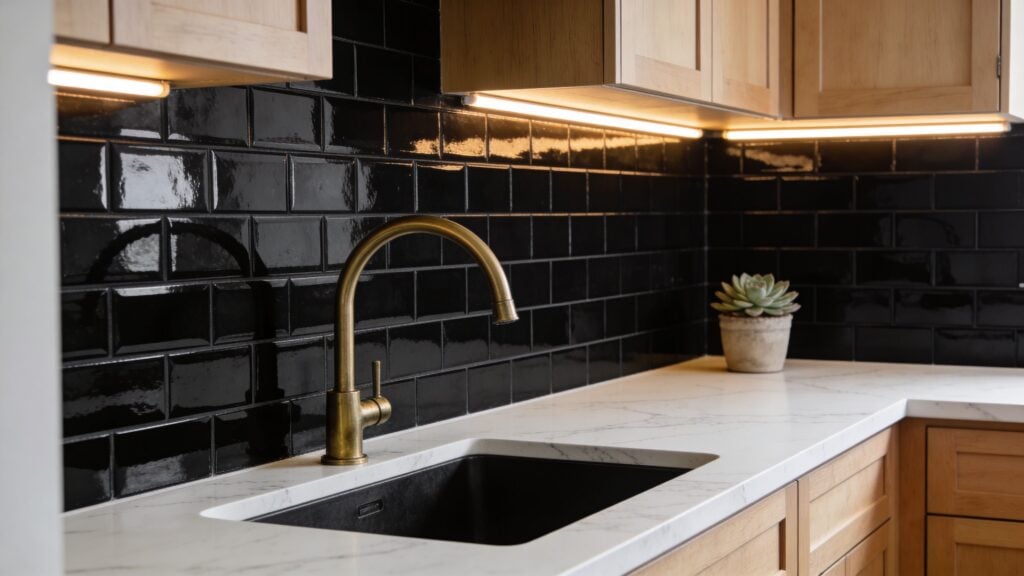
You’re probably looking at a kitchen that still functions fine, but doesn’t feel current anymore. The cabinets may be in good shape, the layout may still work, yet the wall between the counter and uppers feels like the one part holding the room back. In a lot of South Jersey homes, especially older kitchens in places like Collingswood, Haddon Heights, Cherry Hill, and Moorestown, that backsplash area is small in square footage but oversized in visual impact.
That’s why black kitchen backsplash tile keeps coming up in real remodel conversations. It can sharpen a dated kitchen, give simple cabinetry more presence, and create a polished look without requiring every finish in the room to be expensive. The key is choosing the right black tile for your house, your light, your cooking habits, and your tolerance for maintenance.
Table of Contents
- Why Black Backsplashes Are a Smart Choice in 2026
- Choosing Your Black Backsplash Material and Finish
- Perfecting the Pattern and Tile Scale
- Grout Color and Long-Term Maintenance
- Creating Harmony with Cabinets and Countertops
- Budgeting Your South Jersey Backsplash Project
- How The Cabinet Coach Simplifies Your Selection
- Frequently Asked Questions
Why Black Backsplashes Are a Smart Choice in 2026
A lot of homeowners start with hesitation. Black sounds dramatic. It sounds like a choice that could feel too trendy, too dark, or too hard to keep clean. Then they hold a black sample next to white cabinets, a warm oak door style, or a quartz slab with soft veining, and the reaction changes fast. The room suddenly feels more intentional.
That shift isn’t just anecdotal. Searches for black backsplash designs have surged by 200% since last year, and kitchens with high-contrast designs such as black tile against white cabinets can see a resale value boost of up to 12%, according to Marble Systems’ black backsplash design report. That’s a strong signal that black backsplash tile isn’t a fringe look anymore.
In South Jersey, this works especially well because the housing stock is mixed. You’ll see compact mid-century kitchens, traditional colonials, and newer open-plan homes all within a few miles of each other. Black tile has enough range to fit each one. In a smaller kitchen, it can add depth and structure. In a larger kitchen, it can keep the room from looking washed out or too builder-basic.
Black tile works best when it’s treated as a grounding finish, not a random accent.
There’s also a practical side. Homeowners who cook often usually want materials that feel finished but aren’t fussy. Black backsplash tile can deliver that balance when the tile, grout, and finish are chosen carefully. The result can look refined rather than loud.
If you’re also weighing broader remodel choices, it helps to look at how black tile fits into the bigger design picture alongside cabinetry, counters, and hardware. The design direction in these 2026 kitchen trends for South Jersey homeowners lines up with what many local homeowners are asking for right now: contrast, cleaner surfaces, and materials that hold up to real daily use.
Choosing Your Black Backsplash Material and Finish
The biggest mistake I see is choosing black tile by color alone. “Black” can mean glossy ceramic subway, matte porcelain, reflective glass, honed slate, marble-effect porcelain, or natural stone with movement. Those aren’t interchangeable in a working kitchen.
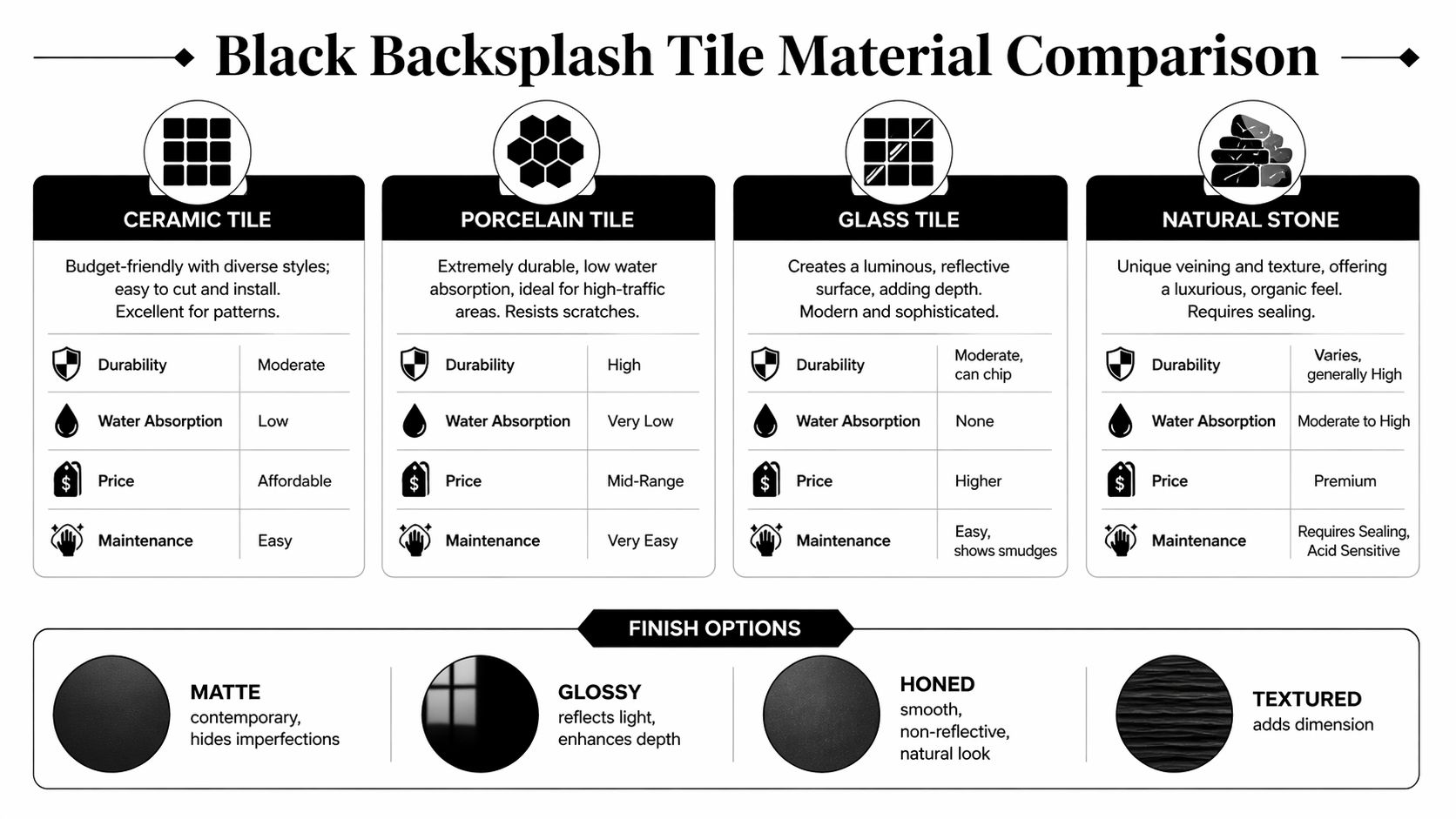
Material matters more than most homeowners expect
Here’s the quick comparison I use when narrowing the field.
| Material | Average Cost (per sq. ft.) | Durability/Maintenance | Best For |
|---|---|---|---|
| Ceramic | Varies by line and style | Easy to maintain, good for walls, less tough than porcelain | Budget-conscious remodels and decorative layouts |
| Porcelain | Varies by line and style | Strong, dense, low-maintenance, excellent for busy kitchens | Families, heavy-use kitchens, long-term durability |
| Glass | Varies by line and style | Easy to wipe, reflective, but can show smudges and edge chips | Light bounce, modern looks, smaller spaces |
| Natural stone | Varies by stone and finish | Beautiful, but needs more care and may require sealing | Character-rich kitchens and more organic designs |
Ceramic is often the easiest entry point. It’s widely available, easier to cut, and works well if you want a classic subway layout or a decorative shape. If your kitchen gets heavy use, though, porcelain is usually the safer bet because it’s denser and more forgiving over time.
Natural stone looks beautiful in the right kitchen, but it’s not the best default answer for every household. If you cook frequently and don’t want to think about acid sensitivity, sealing schedules, or careful cleaner selection, porcelain that mimics stone is often the more practical move.
For a broader tile decision framework, this guide on how to select tile backsplash is useful when you’re comparing appearance against maintenance.
Finish changes the day-to-day experience
Finish is where homeowners usually make the final decision. It should also be where they think hardest about cleaning.
According to House Digest’s discussion of black backsplash trade-offs, glossy black tiles reflect light to create an illusion of depth, while matte finishes are better at concealing fingerprints and water spots because they reduce surface sheen and contrast. That’s exactly how it plays out in real kitchens.
If the room lacks natural light, glossy black can help. It gives the wall movement and keeps the backsplash from looking flat. If you have kids, frequent cooking, or a habit of using the sink and range hard every day, matte is usually easier to live with.
A simple way to choose:
- Go glossy if your kitchen needs light bounce, you like a sharper modern look, and you’re comfortable wiping splashes sooner.
- Go matte if you want a softer finish that hides day-to-day mess better.
- Choose honed or textured surfaces if you want the richness of black without a mirror effect.
- Skip highly delicate natural finishes if you want low-stress upkeep.
Practical rule: If you want black tile to feel luxurious for years, choose the finish based on how you cook, not how the sample looks under store lighting.
Perfecting the Pattern and Tile Scale
The same black tile can look classic, architectural, or heavy depending on size and layout. Scale is what decides whether the backsplash feels crisp or busy.

Pick the scale first, then the pattern
In many South Jersey kitchens, wall space is broken up by windows, short runs of cabinetry, and corner transitions. That means tile scale matters more than homeowners expect. If you choose a tiny pattern in a busy footprint, the room can start to feel visually chopped up.
Large-format black tiles often solve that. Homestyler’s black backsplash article notes that large-format black tiles can reduce visible grout lines by up to 75% compared to standard 3×6-inch tiles, and some glossy finishes can improve light diffusion by up to 40%. In practical terms, that means a smaller kitchen can feel calmer and more expansive.
Subway tile still works. It just needs intention. A standard offset brick pattern feels familiar and easy. A vertical stack looks more current. Herringbone adds energy, but it also adds visual activity and more cuts, which isn’t always what a tight kitchen needs.
Layouts that work well in black tile
A few layouts consistently perform well:
- Stacked subway works when you want a clean, modern wall that lets cabinet lines lead.
- Classic running bond softens the boldness of black because the layout feels recognizable.
- Large-format field tile is strong in compact kitchens where fewer grout joints help the wall read as one plane.
- Mosaic or geometric tile can be striking, but only when the rest of the kitchen is restrained.
One detail matters more than often considered. If the countertop has strong movement, keep the backsplash pattern simpler. If the counters are quiet, the backsplash can take on more personality.
For homeowners mixing black tile with more textured cabinetry, this look at fluted cabinet and tile trends in Cherry Hill kitchens is a useful reference point because it shows how surface texture changes the whole composition.
If you want to see installation ideas in motion, this quick video helps visualize how pattern choices affect the final wall:
Grout Color and Long-Term Maintenance
Black tile gets most of the attention, but grout determines whether the backsplash feels refined or frustrating after the first few months.
Why grout choice changes everything
Light grout with black tile creates contrast and highlights every tile edge. That can look great in the right kitchen, especially if you want a graphic pattern. It also means the eye will notice every joint, every slight irregularity, and eventually every stain.
Dark grout usually gives a better long-term result for a working kitchen. According to Maryland Tub & Tile’s guide to dark kitchen backsplashes, a dark, charcoal-colored epoxy grout can hide oil and grease stains four times better than light-colored cementitious grout. The same source also notes that epoxy’s low porosity helps prevent microbial growth, which makes it a smart choice behind the cooktop.
That matters in real life. The area behind a range catches oil mist, sauce splatter, and steam. If you want a backsplash that still looks sharp after weeknight cooking, dark epoxy grout is hard to beat.
Choose grout based on how you clean, not just how the sample board looks.
What black tile really needs for upkeep
Black backsplash tile isn’t high maintenance, but it is honest. It will show hard-water spotting, soap haze near the sink, and dried grease if you let residue sit. The solution is simple, not complicated.
A good maintenance routine looks like this:
- Wipe dry after splashes near the sink and cooktop, especially on glossy tile.
- Use pH-neutral cleaners instead of harsh alkaline products that can dull some finishes over time.
- Keep a microfiber cloth nearby for quick dry wipes instead of waiting for buildup.
- Match the grout to the tile if you want a lower-stress look.
If you’re maintaining grout over the long term, a practical resource on grout sealer is worth reviewing because it explains where sealing still matters and where product choice changes the upkeep burden from the start.
One honest trade-off: black tile rewards consistency. If you’re the type who wants every splash hidden until the weekend, matte surfaces and darker grout will serve you better than glossy tile with bright joints.
Creating Harmony with Cabinets and Countertops
A black backsplash succeeds when the rest of the kitchen gives it the right context. On its own, it’s just a dark surface. Paired well, it becomes the feature that makes the whole room feel custom.
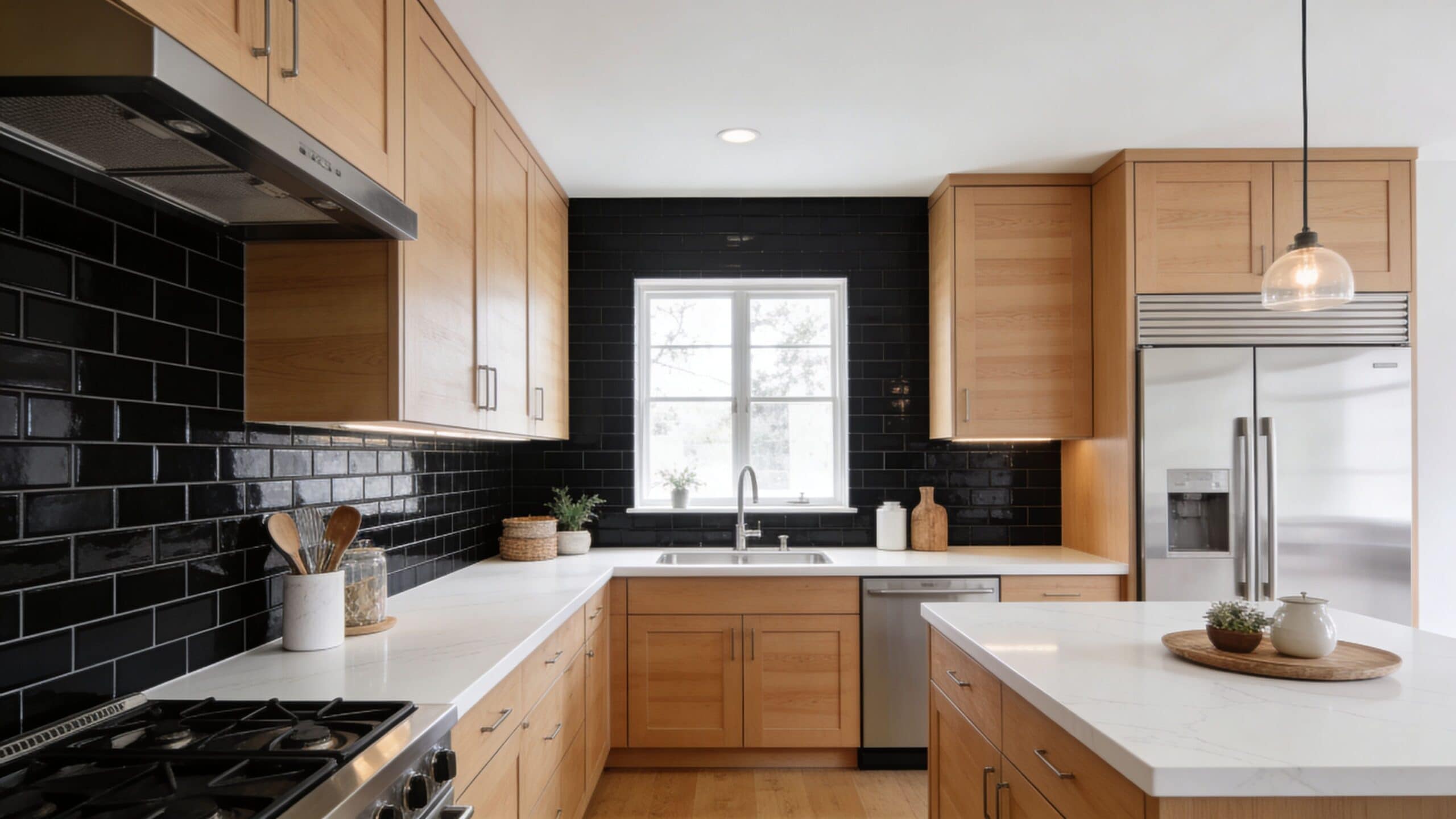
The pairings that usually work best
White cabinetry is the most obvious partner because the contrast is clean and timeless. It gives the black backsplash definition without making the room feel heavy. Wood cabinetry is another excellent match, especially medium or warm wood tones that keep the kitchen from feeling stark.
A few combinations tend to work well:
- White shaker cabinets with black tile for crisp contrast and a refined look
- Natural oak or walnut tones with black tile for warmth and depth
- Soft gray cabinets with black tile when you want contrast without as much brightness
- Quartz countertops with quiet veining when the backsplash is the focal point
Countertops matter here. If the slab has dramatic movement, the backsplash should usually stay simpler. If the slab is clean and restrained, black tile can carry more texture or sheen. For homeowners deciding between surfaces, this comparison of quartz, granite, and quartzite countertops in Cherry Hill helps sort out which counter personality best supports a bold backsplash.
Lighting and hardware complete the look
Under-cabinet lighting can make or break a black backsplash. Without it, dark tile can flatten out at night. With it, the tile gains shape, reflectivity, and texture. If you want inspiration on fixture direction and layering, these kitchen lighting ideas are helpful because they show how task lighting changes material perception, not just brightness.
Hardware should support the backsplash, not compete with it. Brushed brass warms black tile. Stainless and brushed nickel keep it cooler and more contemporary. Matte black hardware can work, but it needs separation from the backsplash through cabinet color or profile so the room doesn’t collapse into one dark band.
The best black backsplash kitchens usually balance one bold surface with several quieter ones.
Budgeting Your South Jersey Backsplash Project
Backsplashes are small compared with cabinets and countertops, but they’re detail-heavy. That’s why homeowners are often surprised by how much price can swing from one tile choice to another.
What pushes the price up
The tile itself is only one variable. Installation complexity changes the total quickly. A straightforward rectangular subway tile on a flat wall is one kind of project. A handmade-look tile with variation, lots of outlet cuts, a herringbone layout, and tricky inside corners is another.
These issues usually raise the budget:
- Complex patterns because they create more cuts and more layout time
- Wall prep when the existing surface isn’t flat, sound, or ready to tile
- Premium trims and edge treatments rather than a simple termination
- Specialty grout choices such as epoxy, which can be worth it but require more skill to install
The kitchen’s age also matters. In older South Jersey homes, it’s common to uncover uneven drywall, old adhesive residue, or out-of-square corners once demolition starts. None of that is unusual, but it does affect labor.
Where it makes sense to spend and save
If the goal is a polished result without overspending, spend on the things you’ll notice every day: tile finish, layout quality, and grout selection. Save on unnecessary complexity. A well-chosen black ceramic or porcelain tile in a clean layout often looks more expensive than an overly complicated design installed poorly.
A sensible budgeting approach is to decide early which of these matters most:
- Lowest maintenance
- Most dramatic visual impact
- Most affordable path to a finished look
- Best fit with a full kitchen remodel
That choice usually narrows the field fast. For many households, porcelain with a simple pattern and dark grout lands in the sweet spot. It gives the look people want, avoids a lot of upkeep headaches, and doesn’t depend on fragile materials to feel elevated.
How The Cabinet Coach Simplifies Your Selection
Black backsplash tile looks simple on Pinterest. In a real kitchen, it rarely is. The undertone of the cabinet paint, the way daylight hits the wall, the reflectivity of the countertop, and the finish on the faucet all affect whether the black reads rich, flat, warm, or harsh.

Why in-home selection changes the result
Homeowners benefit from seeing materials in their own space instead of under generic showroom lighting. A black tile sample can look polished in one kitchen and too cold in another. The difference is often the room itself.
That’s also why a coordinated approach matters financially. According to Backsplash.com’s category guidance on black backsplash tile, integrating a black backsplash with professional selections for cabinetry and countertops can boost resale ROI by up to 12%. When the finishes are working together, buyers notice the kitchen as a whole, not as disconnected upgrades.
What a guided process solves
A guided process helps with the decisions that usually stall a remodel:
- Which black is the right black. Some lean warm, some cool, some read charcoal rather than true black.
- Which finish fits the household. A busy family kitchen needs different performance than a light-use entertaining kitchen.
- How the backsplash ends cleanly. Edge details, transitions, and outlet placement all affect the finished look.
- Whether the tile supports the broader remodel. A backsplash should reinforce the cabinetry and counters, not fight them.
For homeowners who want to understand how that process works from first consultation through installation planning, The Cabinet Coach experience lays out the value of guided, in-home design support especially well.
A black backsplash is rarely a single-product decision. It’s a composition decision.
Frequently Asked Questions
Is black kitchen backsplash tile a passing trend
No. It’s more accurate to treat it as a recurring design move that has become more mainstream. The look changes with finish, scale, and pairing, but black itself has lasting range.
Will black tile make a small kitchen feel smaller
Not if you choose it well. Large-format tile, fewer grout lines, reflective finishes, and good under-cabinet lighting can keep the wall from feeling heavy. Poor lighting and overly busy patterns are usually the actual problem.
Is black backsplash tile hard to keep clean
It depends on the finish. Glossy black shows more spotting and fingerprints. Matte surfaces usually hide day-to-day mess better. Dark grout also reduces maintenance stress.
Does black tile only work in modern kitchens
No. It works in modern kitchens, but also in transitional and more traditional homes. The style comes from the tile shape, layout, edge detail, cabinet door style, and hardware around it.
What’s the safest choice for most households
For many homeowners, matte or low-sheen porcelain with dark grout is the safest blend of durability, style, and manageable upkeep.
If you’re planning a kitchen update in Cherry Hill or anywhere in South Jersey, The Cabinet Coach can help you compare backsplash tile, cabinetry, countertops, and hardware in a way that makes sense for your home, your lighting, and your budget. The mobile showroom approach makes it easier to choose confidently and avoid the expensive mistake of selecting a black backsplash that looked great in isolation but not in your actual kitchen.