
A lot of homeowners start the same way. They know their kitchen is dated, but the bigger problem is how it feels to use. The fridge door blocks a walkway. The sink is too far from the range. Someone grabs coffee while someone else is draining pasta, and the whole room jams up.
That frustration is usually not about style. It is about layout.
If you have been asking what is the kitchen work triangle, the short answer is this: it is a planning rule that helps place the sink, refrigerator, and stove so everyday cooking feels smooth instead of clumsy. It is old, but it still solves a very current problem in South Jersey homes, whether you are working with a Cherry Hill colonial, a Moorestown family kitchen, or a narrower Camden rowhouse where every step matters.
Table of Contents
- The Hidden Logic of Great Kitchen Design
- The Classic Kitchen Work Triangle Explained
- Benefits and Modern Limitations of the Rule
- Beyond the Triangle Modern Layouts and Work Zones
- Actionable Tips for Your Remodel
- Designing Your South Jersey Kitchen with The Cabinet Coach
The Hidden Logic of Great Kitchen Design
A kitchen can photograph beautifully and still work poorly.
You see it when meal prep turns into a string of wasted steps. You pull produce from the fridge, cross the room to rinse it, turn back for a knife, then pivot around an open dishwasher door just to get to the cooktop. In busy family kitchens, that kind of layout creates constant interruption.
Why some kitchens feel easy and others do not
Good kitchens usually share one trait. The core tasks happen in a clear pattern.
That is the logic behind the kitchen work triangle, a planning idea developed through University of Illinois research in the mid-20th century. According to KitchenAid’s overview of the work triangle, the concept was found to cut cooking workflow steps by up to 30% and is now used in over 80% of residential kitchen remodels.
That longevity matters. Design trends change. Human movement does not.
For homeowners comparing layouts, this is really a branch of broader interior design space planning. Rooms work better when movement is intentional, and the kitchen happens to be the room where poor spacing shows up fastest.
How this shows up in South Jersey homes
In South Jersey, the same rule plays out differently from house to house.
A Cherry Hill colonial may have enough width for a balanced L-shape with a centered sink. A Camden rowhouse may need tighter planning so the cooking path does not get tangled with the main hallway. In either case, the question is the same: can one person move between storage, prep, and cooking without crossing obstacles or colliding with traffic?
That is also why trend-heavy ideas need a reality check. An oversized island or statement range wall may look appealing online, but the layout still has to function on a Tuesday night. If you are weighing style ideas, this roundup of South Jersey kitchen design trends for 2026 is useful, but the best trend is still the one that makes the room easier to use.
A strong kitchen layout does not start with finishes. It starts with movement.
The Classic Kitchen Work Triangle Explained
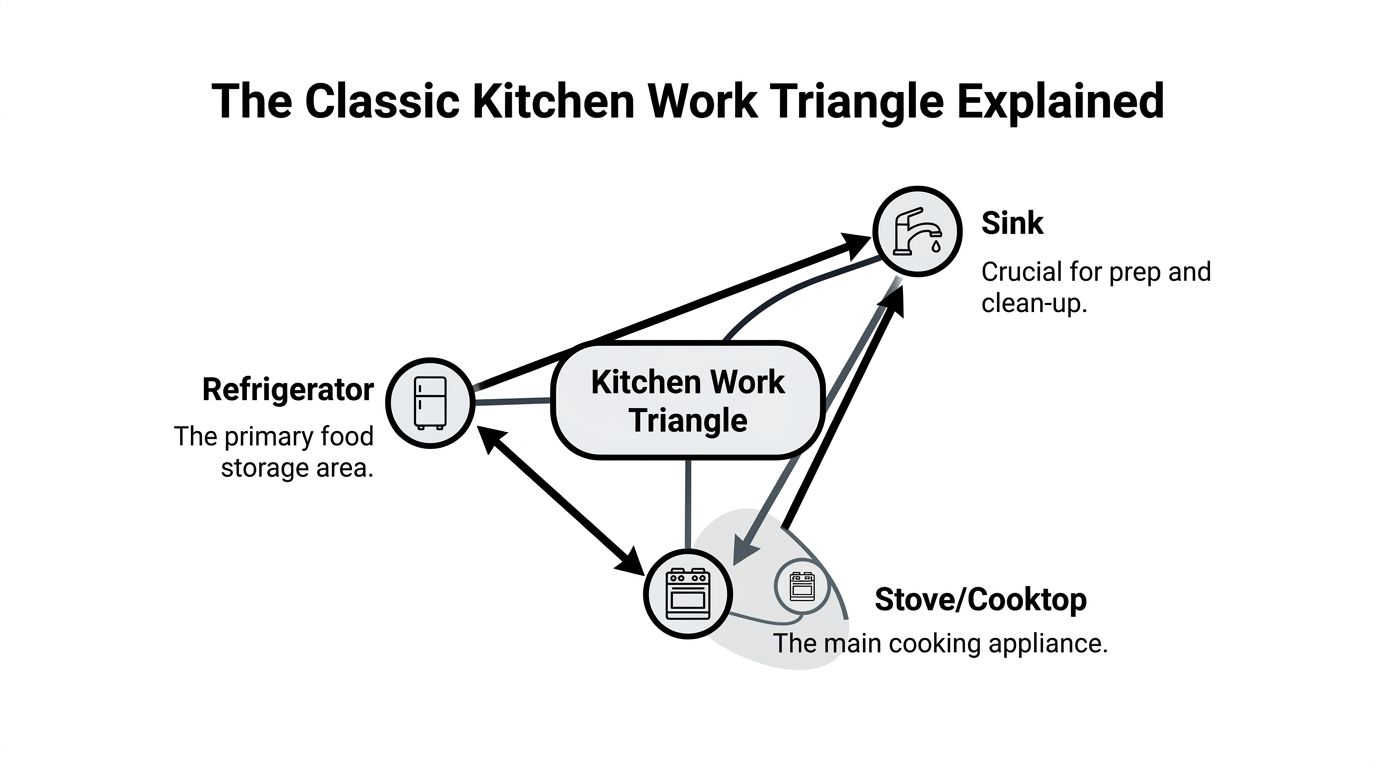
The classic triangle connects three points in the kitchen: the refrigerator, the sink, and the stove or cooktop.
Each point supports a core task. The refrigerator handles storage. The sink supports prep and cleanup. The stove handles cooking. When those three are spaced well, the room feels natural to work in.
The measurements that make it work
The triangle is not just a loose idea. It has practical dimensions.
The National Kitchen and Bath Association standardizes the triangle with legs of 4 to 9 feet, a total perimeter of 13 to 26 feet, and minimum walkways of 42 to 48 inches for ergonomic flow, as summarized in this NKBA-based guide.
Those numbers solve two different problems:
- Too tight: If the points are crowded together, you lose landing space, elbow room, and safe circulation.
- Too spread out: If the points drift too far apart, cooking starts to feel like a series of laps.
A good triangle lets you move from fridge to sink to range in a clean rhythm. Not rushed. Not cramped.
Kitchen Work Triangle At-a-Glance
| Measurement | Recommended Distance |
|---|---|
| Each leg of the triangle | 4 to 9 feet |
| Total triangle perimeter | 13 to 26 feet |
| Walkway for one cook | 42 inches minimum |
| Walkway for multiple cooks | 48 inches minimum |
How to think about it in real life
The easiest way to understand the triangle is to follow dinner prep.
You take chicken or vegetables from the refrigerator. You bring them to the sink to rinse or prep. Then you move them to the cooktop. If any one of those steps feels awkward, the layout needs work.
In an L-shaped kitchen, this often means placing the sink in a middle position so it acts as a hub. In a U-shaped kitchen, the triangle often forms naturally, but only if one leg is not stretched too long. In a galley kitchen, the layout can work extremely well when major appliances are arranged to avoid crossing paths.
When homeowners sketch ideas, I tell them to mark appliance centers first. Cabinets support the workflow. They do not define it.
If you are getting serious about layout choices, this planning guide on how to plan a kitchen remodel is worth reviewing before you lock in appliance locations.
Benefits and Modern Limitations of the Rule
The work triangle became a standard for a reason. In the right kitchen, it is still one of the clearest ways to create efficiency.
For a single cook, especially in a compact or medium-size room, it keeps the essentials close without packing them too tightly. You can prep, cook, and clean in one coherent loop. That usually means fewer interruptions and less backtracking.
Where the triangle still shines
The classic rule works best when the kitchen has one primary cook and one clear purpose.
It is especially effective in:
- L-shaped kitchens where the sink can anchor the middle of the workflow
- U-shaped kitchens with open circulation and strong counter access
- Galley kitchens where each station is easy to reach without crossing social space
The main point is efficiency. According to Naked Kitchens’ guide to the work triangle, triangles with a perimeter over 26 feet can increase cooking task time by as much as 15% because of extra walking and fatigue.
That trade-off is easy to feel in large renovated kitchens. Homeowners often assume bigger means better, but a layout that spreads the core stations too far apart can make daily use less comfortable.
Where the rule starts to break down
The triangle has limits because modern kitchens do more than they did when the rule was first developed.
Today a kitchen might include:
- a microwave drawer
- a wall oven
- a beverage fridge
- a second sink
- an island used for homework, serving, or casual dining
The triangle does not account for all of that. It was built around the idea of one cook moving between three main stations. Once two people are cooking, or the island becomes a major prep surface, the old geometry can feel restrictive.
In open-concept homes, another issue appears. Traffic cuts through the cooking area. Kids head to the fridge. Guests gather near the island. The room becomes social space and work space at the same time.
That is why technology and appliance choices matter too. A kitchen with induction, integrated refrigeration, or specialty prep features may benefit from a more customized layout than a pure triangle. If you are exploring those options, this article on smart kitchen technology in Cherry Hill shows how modern equipment changes the way people use the room.
The triangle is still a strong starting point. It just should not be treated like a law.
Beyond the Triangle Modern Layouts and Work Zones
The most practical update to the triangle is the work zone approach.
Instead of asking only how the sink, stove, and fridge relate to one another, you organize the room around activities. Prep. Cooking. Cleanup. Food storage. Sometimes coffee or baking. The kitchen becomes a set of linked stations instead of one fixed geometric rule.
How work zones solve modern problems
This matters most in homes where more than one person uses the kitchen at the same time.
For households with two or more cooks, creating multiple non-overlapping work zones can reduce interference and collisions by 40%, according to Fine Homebuilding’s guidance on kitchen planning. That is a major reason many larger remodels no longer rely on a single classic triangle.
A prep zone might center on the sink, trash pull-out, cutting space, and knife storage.
A cooking zone might group the range, utensil drawers, oils, spices, sheet pans, and pots.
A cleanup zone might place the sink, dishwasher, dish storage, and recycling together so unloading feels direct.
In practice, this is how a modern family kitchen becomes calmer. One person can wash produce while another uses the range without crossing the same path over and over.
For homeowners who want a visual way to compare layouts before choosing one, this kitchen layout guide can help you think through common floor plans.
A short walkthrough helps make the idea concrete:
What this looks like in South Jersey homes
In a Cherry Hill open-plan remodel, the island often becomes a prep or serving zone rather than a traffic obstacle. In a Burlington County family kitchen, a microwave drawer and snack storage can move to the edge of the room so kids are not crossing the cook’s path. In a Camden rowhouse, the smartest solution may be a compact linear layout with tightly grouped stations and strong storage planning.
The key is separation of purpose.
- Keep guest traffic out of the cook’s lane: Seat people at the island edge, not directly in front of the range.
- Group tools where they are used: Spices near the cooktop, colanders near the sink, food containers near the cleanup area.
- Use islands carefully: An island should support the workflow, not slice through it.
Some kitchens still benefit from a small core triangle inside a bigger zoned plan. That hybrid approach often works best. It preserves efficiency for the main cook while giving the rest of the household room to function.
If you are considering a more open arrangement, this piece on wall-cabinet-free kitchen designs is useful because it shows how layout, storage, and openness have to be balanced together.
Actionable Tips for Your Remodel
A good kitchen plan should hold up under ordinary use. Not just holidays. Not just reveal photos. Everyday use.
The easiest way to test a layout is to follow common tasks and see where the friction shows up.
Route traffic away from the working core
The first move is simple. Do not force household traffic through the main cooking path.
If the refrigerator is the most frequently visited appliance, try to place it where someone can grab milk or fruit without cutting across the sink-to-range route. In family homes, this one decision often does more for day-to-day comfort than any decorative upgrade.
If someone can get a drink without passing behind the cook, the kitchen usually feels better immediately.
Let cabinetry reinforce the layout
Cabinet planning should follow behavior.
Put a pull-out pantry close to the refrigerator if that is where dry goods are used during prep. Place utensil drawers near the range, not on the far side of the island. Keep trash and recycling near the prep sink or main prep counter so scraps can be cleared without crossing the room.
Here, custom storage earns its keep. A spice pull-out beside the cooktop, a tray divider near the oven, and a deep drawer for pots below the range all remove small daily annoyances.
Match the rule to the layout you have
Different floor plans need different priorities.
L-shaped kitchens often work best when the sink sits between the fridge and range, with uninterrupted prep space on at least one side.
U-shaped kitchens should avoid overloading one wall. If the fridge is too far from the sink and cooktop, the room starts to feel stretched.
Galley kitchens reward precision. Keep major stations aligned so doors and people do not collide, and be selective about where tall pantry units go.
One-wall kitchens rarely form a textbook triangle, so focus on sequence instead. Keep storage, prep, and cooking arranged in a logical run with clear counter space between tasks.
Small choices matter too. Dishwasher placement affects cleanup flow. Landing space beside the fridge affects grocery unloading. Even handle style can matter if a tight aisle causes drawers and doors to compete for space.
Designing Your South Jersey Kitchen with The Cabinet Coach
You see the problem the first week after a remodel. The new kitchen looks sharp, but the refrigerator door blocks the main path, the dishwasher drops open into the prep area, and two people cannot work without bumping into each other. I see some version of that across South Jersey when a layout follows a trend instead of the house.
A Cherry Hill colonial usually gives you more room to separate prep, cooking, and cleanup. A Camden rowhouse or an older Pennsauken bungalow often asks for tighter decisions, better cabinet planning, and stricter control of traffic paths. The triangle still helps, but only if it is adjusted to the room you have.
Good design adapts the rule to the house
The work triangle is a planning tool, not a scorecard. In a compact kitchen, a classic sink fridge range relationship can still make daily use easier. In a larger kitchen, the better answer may be a strong prep zone near the refrigerator, a cleanup zone that stays out of the way, and storage placed where the household naturally reaches for it.
That is usually where cabinetry either saves the layout or fights it.
In real projects, I look at the small friction points that wear people out. Where do groceries land after a Costco run. Can someone unload the dishwasher without blocking the range. Does the island help with prep, or does it force extra laps around the room. Cabinet choices matter in every one of those decisions, especially in older South Jersey homes where every inch has to work harder. This guide on how to choose the best kitchen cabinets in South Jersey is a useful next step if you are comparing options.
Why local context matters
Good kitchen design starts with the way the house is used.
A family in Mount Laurel may need clear sightlines to the backyard and seating that keeps kids close to homework and snacks. A downsizing homeowner in Haddonfield may care more about easier cleanup, wider walkways, and less bending. In a tight city footprint, sometimes the smartest move is to break the old triangle rule and prioritize one clean prep run with enough landing space and storage nearby.
That is the trade-off. Perfect geometry matters less than daily function.
If your kitchen feels awkward now, the issue is usually flow, not just age or finishes. Fix the flow, and the room starts working better every morning, every school night, and every holiday when five people suddenly end up in the kitchen at once.
If you are planning a kitchen remodel in Cherry Hill or anywhere in Camden or Burlington County, The Cabinet Coach can help you build a layout that fits your home, your habits, and your budget. The mobile showroom, guided design process, and complimentary video consultation make it easier to sort through cabinetry, finishes, and workflow without wasting time on ideas that will not hold up in real life.
Made with the Outrank app