

If you're in Cherry Hill, Haddonfield, Moorestown, or anywhere around Camden and Burlington County, you may be staring at the same kitchen cabinets every morning and thinking the same thing: the layout still works, but the room feels tired. The doors look dated. The finish has worn thin around the handles. Maybe the drawers still open, but they don't feel good doing it. And the idea of a full kitchen remodel sounds expensive, messy, and like something you'll regret starting halfway through soccer season, work travel, or the holidays.
That situation is exactly why cabinet refacing services make sense for so many South Jersey homes. A lot of houses in this area have kitchens with decent bones. The boxes are still usable, the footprint fits the room, and the homeowner doesn't want to rip out a kitchen just to stop looking at old oak doors. What they want is a cleaner, updated kitchen without turning the whole house into a jobsite.
South Jersey homeowners also tend to shop carefully. They compare options, ask practical questions, and want to know what happens once a project starts. That's one reason local service businesses increasingly focus on making the process easier to evaluate before anyone commits. If you're curious how that thinking applies more broadly in home services, Transactional LLC's guide to local SEO gives a useful look at how companies help nearby homeowners find relevant, location-based services.
For homeowners who are trying to improve style without overspending, budget kitchen upgrade ideas often start with one core truth: cabinets dominate the room. Change the cabinet look, and the whole kitchen changes with it.
Table of Contents
- Your South Jersey Kitchen Reimagined Without the Remodel
- Understanding the Cabinet Refacing Process
- A Look Inside Our 3-to-5 Day Transformation Journey
- Refacing vs Replacement vs Repainting Cost and Value
- Style Options and Inspiration for Your Home
- Is Cabinet Refacing the Right Choice for You
- South Jersey Cabinet Refacing FAQs
Your South Jersey Kitchen Reimagined Without the Remodel
A lot of kitchens in this part of New Jersey tell the same story. The home itself still has character. The neighborhood is where you want to stay. The kitchen layout isn't the problem. The problem is that the cabinets lock the whole room into another decade.
In Cherry Hill and nearby towns, that often means older raised-panel doors, yellowed finishes, scuffed drawer fronts, and hinges that remind you every day that the room hasn't kept up with the rest of the house. Homeowners call it outdated. In the trade, we usually call it a good candidate for change, if the structure underneath still makes sense.
Why this approach fits local homes
Cabinet refacing services work well in South Jersey because many homes here don't need a full cabinet tear-out to feel new again. They need a visible upgrade. Doors, drawer fronts, exterior surfaces, hardware, and finish details carry most of the visual weight in a kitchen. When those pieces change, the room often feels rebuilt even though the footprint stays put.
Practical rule: If you like where the sink, stove, and storage are now, you're already asking the right first question for refacing.
That's the part many homeowners miss when they first compare options. They assume they have only two choices: live with the kitchen or gut it. In reality, refacing sits in the middle. It gives you a substantial visual reset without all the demolition, disposal, and layout redesign that come with replacement.
What homeowners usually want
Around Camden and Burlington counties, the goals tend to sound pretty similar:
- A fresh look: White, off-white, wood tone, navy, greige, or a cleaner Shaker profile.
- Less disruption: A kitchen update that doesn't take over the house for weeks.
- Better details: New pulls, concealed hinges, smoother drawer action, and coordinated finishes.
- Smarter spending: Money goes into what you see and touch every day.
That last point matters. Cabinet refacing services aren't about cutting corners. They're about deciding where the value is. If the cabinet boxes are still doing their job, replacing every box just to get new doors usually isn't the smartest move.
A good refacing project feels like the kitchen finally matches the house you're already happy living in.
For South Jersey homeowners who want a guided process instead of a showroom marathon, a mobile selection approach can make that easier. You can review finishes, door styles, and combinations at home, in your own light, against your own flooring and wall color. That's often more useful than guessing under store lighting.
Understanding the Cabinet Refacing Process
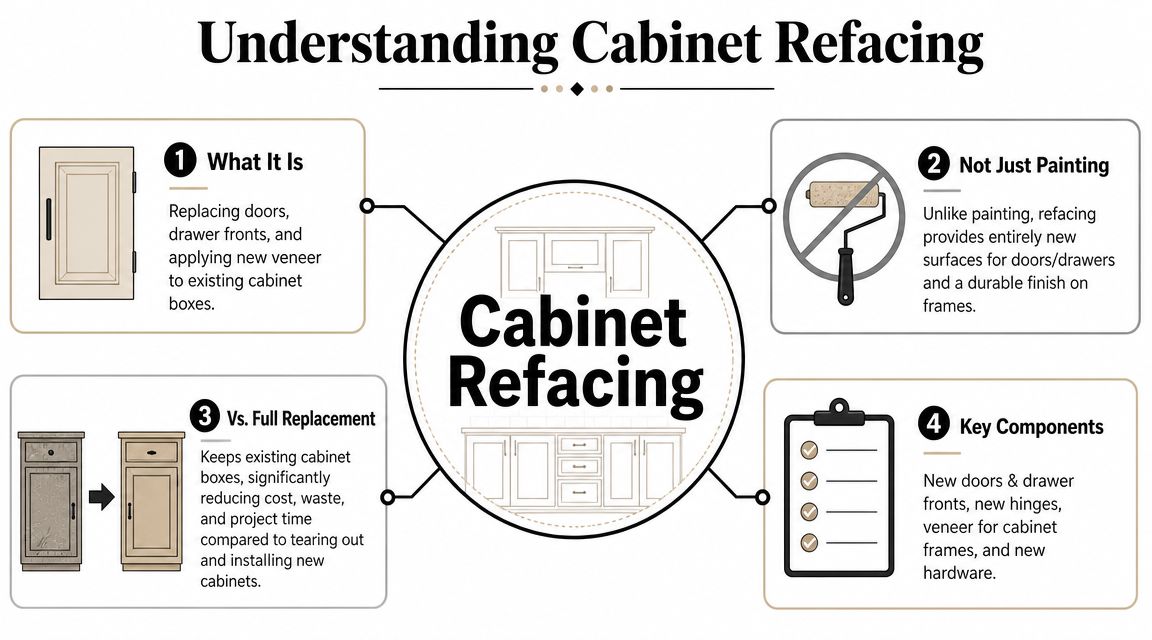
Cabinet refacing isn't a paint job with a nicer sales pitch. It's a methodical upgrade that keeps the usable cabinet structure and changes the surfaces that define how the kitchen looks and feels. The simplest analogy is this: if the cabinets have a solid frame, refacing gives them a brand-new suit.
What refacing actually changes
The cabinet boxes stay in place. The old doors and drawer fronts come off. Exposed face frames and ends are covered so the visible exterior becomes consistent with the new finish. New doors, new drawer fronts, and updated hardware complete the look.
That distinction matters because homeowners sometimes compare refacing to repainting when they're not the same service at all. Painting changes the color of existing surfaces. Refacing changes the visible cabinet package itself.
A typical refacing scope may include:
- New doors and drawer fronts: Style changes happen, whether you want Shaker, slab, or a more traditional profile.
- Exterior surface matching: Exposed cabinet faces are covered so the frames match the new fronts.
- Hardware updates: Hinges, pulls, knobs, and slides often get updated at the same time.
- Finish coordination: The end result should look intentional, not patched together.
If you're comparing surface-level changes to full finish transformations, cabinet paint and stain options help clarify where refinishing ends and refacing begins.
When refacing works and when it doesn't
Refacing only works when the existing cabinet boxes are worth keeping. Professional guidance is clear that cabinet refacing is technically viable only when the existing cabinet boxes are structurally sound, because the process preserves the carcass and upgrades only the visible components. Guidance also emphasizes checking box strength, level and square alignment, and moisture damage before proceeding in Highland Cabinetry's explanation of what cabinet refacing is.
That means a real evaluation looks beyond the door style. It asks practical questions.
- Are the boxes solid? Loose joints, failing bottoms, and sagging shelves can point to broader problems.
- Are the cabinets square and level? Door alignment depends on what's underneath.
- Has water gotten involved? Moisture around sinks, dishwashers, or poorly vented areas can ruin a refacing candidate.
- Does the current layout still work? Refacing preserves the footprint. It doesn't redesign one.
If the bones are good, refacing is efficient. If the bones are failing, refacing only dresses up the problem.
The consultation process matters here too. Home service businesses that reduce friction upfront tend to help homeowners make clearer decisions before the first truck arrives. If you're interested in how that works across service categories, Twizzlo's online booking guide offers a useful look at why structured scheduling and early qualification improve the customer experience.
A Look Inside Our 3-to-5 Day Transformation Journey
One reason homeowners hesitate on cabinet work is simple: they can't picture what the week will be like. They know what they want the kitchen to become, but not what happens between day one and final cleanup. A clear process takes a lot of that anxiety out of the project.
This visual gives a straightforward overview before getting into the details.

How the process starts in a real South Jersey driveway
The first step isn't demolition. It's clarity. For many South Jersey homeowners, the easiest starting point is a video consultation. That conversation covers the basic questions fast: what you dislike about the current kitchen, whether the layout still works, what style direction you lean toward, and whether refacing even sounds appropriate.
After that comes the part that makes this approach especially practical for busy households: the mobile showroom visit. Instead of driving from store to store, you review door styles, finishes, hardware, countertop pairings, and related selections at home. You can see samples where they'll live. That's more useful than trying to remember whether a painted sample looked warm or cool under retail lighting.
The Cabinet Coach uses that mobile showroom and video consultation process to narrow choices early, then move into site verification, material selection, and installation planning with fewer surprises.
A fuller look at that service model is available in The Cabinet Coach experience overview.
What happens once installation begins
Industry benchmarks note that a standard refacing project typically installs in about 3 to 5 days because the cabinet footprint and utilities remain in place, according to Lowe's cabinet refacing installation guide. That timeline makes sense in the field because the crew isn't tearing out the entire kitchen and rebuilding from scratch.
Here's how that usually plays out.
Measurement and confirmation
Before installation, every opening, reveal, hinge requirement, drawer front size, and exposed end is verified. Precision matters. Refacing looks clean only when sizing and overlay choices are disciplined.Removal of old fronts and hardware
Existing doors, drawer fronts, hinges, pulls, and related hardware come off first. The goal is to get back to a workable base without damaging cabinet structures that are staying.Surface prep
Frames and exposed cabinet areas are cleaned and prepared. Minor surface correction may happen here. This is one of those stages homeowners rarely see discussed, but it matters because finish quality depends on prep quality.
Before going further, it's helpful to see a short walk-through of how a reface comes together in practice.
Application of matching exterior material
Exposed cabinet faces and ends are covered so they visually match the new door and drawer package. At this stage, the kitchen starts losing its old identity.Installation of new components
New doors and drawer fronts go on. New hinges and other selected hardware are installed and adjusted. Door reveals, alignment, and drawer action all get tuned at this point.Final fit, cleanup, and walkthrough
The last stage is where the difference between rushed work and professional work shows up. Gaps get checked. Doors get adjusted. Edges get reviewed. The workspace gets cleaned.
Most homeowners don't mind a short project. They mind a disorganized one.
That's why the process should feel calm and deliberate from the first consult through the final reveal. In a good refacing job, the kitchen changes quickly, but not sloppily.
Refacing vs Replacement vs Repainting Cost and Value
Most homeowners don't need another vague answer about "it depends." They need to know where each option fits. Repainting, refacing, and full replacement solve different problems. If you compare them by cost alone, you'll miss the fundamental decision. The better comparison is cost, disruption, function, flexibility, and how far each option effectively moves the kitchen.
Where refacing sits in the middle
Cabinet refacing has earned a strong place in kitchen remodeling because it usually lands between cosmetic touch-up work and full renovation. Verified industry guidance notes that cabinet refacing typically costs 50% to 70% less than replacing cabinets entirely, with common U.S. project ranges around $7,000 to $12,000 for a standard 10×10 kitchen in Redo Cabinet Refacing's cost overview.
That middle position is why so many homeowners consider cabinet refacing services when the boxes are still good but the appearance is dragging the whole room down. You're not paying for a complete tear-out. You're also getting more than a color change.
Repainting can make sense if the existing doors are worth saving and your goals are modest. Full replacement makes sense when the structure, storage plan, or layout no longer works. Refacing makes the most sense when you want a dramatic visual shift while keeping the kitchen footprint.
Refacing is the value play when your complaint is mostly what you see, not where everything sits.
Kitchen Cabinet Upgrade Options Compared
| Factor | Cabinet Refacing | Full Replacement | Professional Repainting |
|---|---|---|---|
| Cost position | Mid-range. Commonly cited around $7,000 to $12,000 for a standard 10×10 kitchen, and often 50% to 70% less than replacement based on the source above | Highest cost option because cabinets are removed and replaced | Lowest entry cost in many cases, but scope is narrower |
| Project timeline | Shorter install window when the existing footprint stays in place | Longest timeline because demolition, disposal, and installation expand the work | Usually less invasive than replacement, though prep and cure time still matter |
| Disruption level | Moderate and controlled. Less demolition, less site upheaval | Highest disruption. More trades, more debris, more moving parts | Lower disruption if cabinets are in good condition |
| Customization potential | Strong aesthetic change, limited layout change | Highest customization because the kitchen can be reconfigured | Lowest structural or style change because you're keeping the same fronts |
| Best use case | Homeowner likes the layout and wants a new look | Homeowner wants a new footprint, more storage, or entirely new cabinetry | Homeowner wants a finish refresh and existing doors are still the right style |
That cost range is only part of the value equation. A better question is what your money buys.
- With repainting, your money mainly buys finish improvement.
- With refacing, your money buys a different visual identity.
- With replacement, your money buys design freedom.
If you want a more focused breakdown of how those costs are usually framed, this guide on the cost of kitchen cabinet refacing is a practical next read.
The mistake I see most often is homeowners choosing based on discomfort rather than diagnosis. They hate the cabinets, so they assume replacement. Or they want to save money, so they default to paint. The better path is asking what needs to change. Appearance, function, layout, or all three. Once that answer is clear, the right option usually becomes obvious.
Style Options and Inspiration for Your Home
Once homeowners realize they don't need a full tear-out to transform the room, the conversation gets more fun. Style opens up. The kitchen stops being a problem to solve and starts becoming a room you can shape intentionally.

Materials doors and hardware that change the room
The biggest visual drivers in cabinet refacing services are the door style, finish, and hardware. Change those three with discipline, and the kitchen reads as current even before countertops or backsplash are touched.
Some of the most common directions homeowners explore include:
- Painted Shaker doors: A reliable fit for colonial homes, transitional interiors, and family kitchens that need to brighten up.
- Slab or flat-panel fronts: Cleaner lines for homeowners who want less ornament and a more contemporary edge.
- Wood-look finishes: Useful when the goal is warmth, not starkness.
- Matte black, brushed nickel, or warmer metallic hardware: Small pieces, big impact.
Hardware matters more than people think. A narrow bar pull, a rounded knob, or a square pull can move the same cabinet door in very different directions stylistically.
If you're still sorting through palettes, guidance on choosing kitchen cabinet colors can help narrow what fits your flooring, wall color, and natural light.
For broader visual vocabulary, homeowners sometimes benefit from reviewing how different aesthetics are defined before they pick materials. Roomstage AI has a useful primer on diverse interior design styles for home inspiration, especially if you're trying to tell the difference between transitional, modern, farmhouse, and more specific looks.
A Mount Laurel style story
A common South Jersey scenario goes like this. A homeowner in Mount Laurel has a kitchen with solid cabinet boxes and a layout that functions well enough for daily life. The issue is visual fatigue. The old honey oak finish darkens the room, the raised-panel profile feels heavy, and the hardware looks like it belongs to a different house.
Instead of replacing the whole kitchen, the homeowner chooses a cleaner door profile, a lighter perimeter color, and a deeper accent tone on an island or a single feature run. The room shifts fast. The same footprint suddenly feels brighter, more intentional, and easier to coordinate with new counters, tile, or wall paint.
A few style combinations that usually work well in area homes:
- Soft white plus brushed nickel: Classic and easy to live with.
- Warm greige plus black pulls: Good for homes bridging traditional and modern finishes.
- Navy accent cabinetry: Strong visual contrast without overwhelming the room.
- Natural wood tone plus simple hardware: Works well when the rest of the house already leans warm and textured.
Good cabinet design doesn't start with a trending color. It starts with what the house already wants to be.
That's the advantage of reviewing materials at home. You can judge samples against your floor, wall tone, and light at breakfast, midday, and evening. That usually leads to better decisions than choosing from memory.
Is Cabinet Refacing the Right Choice for You
Cabinet refacing services are a sharp solution for the right kitchen and the wrong solution for the wrong one. A lot of frustration in remodeling comes from forcing a method onto a kitchen it wasn't meant to fix.
The first question isn't "Do I want new cabinets?" It's "What problem am I trying to solve?"
The right fit for refacing
Refacing is usually a strong fit if most of these statements sound like your kitchen:
- You like the current layout: The sink, appliance locations, and storage zones are basically working.
- The cabinet structure still feels solid: Doors may be ugly, but the boxes aren't failing.
- You want a major visual upgrade: You're after a different look, not a full room redesign.
- You want less disruption: You'd rather avoid a long teardown and rebuild if it isn't necessary.
Homeowners often feel relief. They realize they don't have to overbuy a solution. If your kitchen's main problem is visible age, refacing addresses the actual issue.
When you should skip refacing
There are also times when honesty matters more than convenience. Verified guidance notes that refacing is the wrong move when homeowners want to reconfigure the kitchen layout, add new cabinet runs, or incorporate tall pantry storage, because refacing preserves the existing footprint, as explained by Kitchen Cabinet Refacing AZ's comparison of refacing and more customized solutions.
That means refacing isn't the answer if your real goal is any of the following:
- You want a new layout: Moving appliances, opening walls, changing work zones.
- You need more cabinetry: Added pantry towers, new perimeter runs, or major storage expansion.
- The current workflow is bad: The room doesn't cook well, store well, or circulate well.
- The cabinets have deeper structural issues: Problems that go beyond finish and appearance.
If the footprint is the problem, changing the doors won't solve it.
A simple self-check helps. Stand in the kitchen and answer these three questions:
- Do I like where everything is?
- Do the cabinets feel physically dependable?
- Am I mostly unhappy with how the kitchen looks?
If the answer is yes across the board, refacing belongs on your shortlist. If one of those answers is no, you may be looking at a partial remodel or full replacement instead.
That's not bad news. It's useful news. The right decision isn't the one with the lowest initial price. It's the one that matches the actual condition of the kitchen and the kind of change you want to live with for years.
South Jersey Cabinet Refacing FAQs
Homeowners usually reach the same final set of questions once they've narrowed in on refacing. They're less concerned with the concept and more concerned with the practical edges of the decision.
Can I add modern upgrades during refacing
Usually, yes. Many homeowners pair refacing with updated hinges, drawer slides, pulls, knobs, and interior accessories. This is often the smartest time to improve the daily feel of the kitchen because the visible cabinet package is already being updated. The key is making sure those additions fit the existing cabinet configuration.
Will my kitchen be usable during the project
Refacing is generally easier on daily life than a full tear-out because the cabinet structure stays in place. That doesn't mean the kitchen operates normally every minute of the job, but it does mean less demolition and less chaos. Homeowners usually care less about perfection during the work than they do about predictability. A clear schedule matters.
What if my cabinets look fine but have hidden damage
This is one of the most important questions, and it's one many articles skip. Refacing is not a repair strategy for failing cabinetry. Verified guidance points out that refacing is not a fix for kitchens with damaged boxes, warped frames, or moisture issues, because the structure must be sound for the project to succeed, as noted by Affordable Cabinet Refacing's discussion of when refacing fails.
A cabinet can look acceptable from across the room and still fail the closer inspection. Sink bases, dishwasher-adjacent cabinets, and older particleboard components deserve a careful look.
A pretty door can't correct a swollen box or a twisted frame.
How do I start without committing to a full remodel
Start with qualification, not commitment. A short video consultation is useful because it helps sort out whether your kitchen is a refacing candidate before anyone talks about a full construction schedule. From there, reviewing materials in your own home usually answers the next questions faster than a generic showroom trip.
If you're in Camden, Burlington, or Gloucester County and want to explore cabinet refacing services with a practical, low-pressure first step, the cleanest move is to start with a design conversation, confirm whether your existing cabinets are suitable, and then narrow finishes and hardware based on your actual space.
If you're ready to see whether cabinet refacing fits your South Jersey kitchen, visit The Cabinet Coach and schedule a complimentary video consultation. It's a simple way to talk through your layout, cabinet condition, style goals, and next steps before you commit to a larger remodel.